



Apply through Clearing


Our Clearing hotline is open for support, Monday - Thursday 9.00-16.45 and Friday 9.00-15.45. You can apply online at any time.


Sign up for updates
Interested in studying at the University of Hertfordshire and want to sign up to our mailing list to learn more about our facilities, living in the UK and student life? Use the form below and our team will also keep you informed of key updates such as events near you, applications opening and more!
BSc (Hons) Psychology
Key information
-

Typical offer:
Entry requirements -

Fees: See below
Full details -

UCAS code: C800
-

Institute code: H36
-

Study abroad option
Why choose this course?
- Psychology ranked joint first nationally for research impact (2021 Research Excellence Framework)
- 8th in the UK for counselling, psychotherapy and occupational therapy (Daily Mail UG, 2027)
- 94% satisfaction for academic support (National Student Survey, 2026)*
You’ll join our strong and vibrant community. We support one another, embracing diversity and inclusion. We’ll help you to grow, and much of our research examines the positive impact that psychology can have on both people’s lives and society, including promoting physical and mental wellbeing, reducing crime and promoting equality.
You’ll be actively engaged in research, with opportunities to regularly conduct experiments. You will be taught by staff with an outstanding reputation for research, with 60% of our research publications in Psychology rated as internationally excellent or world leading (2021 Research Excellence Framework).
You can shape your own studies. Starting in your second year, you begin to focus on the areas of psychology that especially interest you. We also offer a study abroad option, and in your final year you carry out your own research project. Whether it's forensic studies, educational work or clinical psychology, the choice is yours.
You’ll increase your employability with valuable transferable skills, including the ability to think critically, analyse data and communicate effectively. Psychology graduates are highly sought after in many areas, including marketing, learning and development roles in organisations, charities, the public sector and consultancy. You can also gain further qualifications and work in a University as an academic psychologist.
Our course is accredited by The British Psychological Society, which is important if you want to work as a professional psychologist in a forensic, clinical, health or educational setting. You’ll also be in the right place to study on our postgraduate courses on business and clinical psychology.
What's the course about?
A major part of the course examines important theoretical issues within psychology.
For instance, to what extent are people the product of their genes or upbringing? Why do we sleep and dream? How does the brain store memories and thoughts? Why do people obey authority? We also focus on how psychology can help to transform lives and improve the world. What are the best ways to promote and improve health? How can psychological research be used to understand and predict offending behaviour? How do our brains recover from injury? How can teachers encourage their pupils to grow in the face of adversity?
Throughout the course you’ll gain several core skills. For example, you’ll discover how to think critically about a topic, collate and assess evidence, and present your findings. You’ll also find out how to design and conduct psychological studies. This will involve devising research questions, collecting data, using statistical tools as well as qualitative methods, and writing a laboratory report. These are all transferable skills that are highly valued by employees, and can also form a vital stepping-stone to future professional qualifications and work.
See a list of our Psychology staff
Your main campus is College Lane
This is where the creative arts, science and health-related subjects are based. This means you’ll share the campus with future nurses, scientists, artists and more. You can use the common rooms to relax with friends, work out in the 24-hour gym or have a drink in our on-campus pub or cafes. We also have restaurants for you to eat in or grab something on the go. Our Learning Resources Centres are open 24/7, which means you can study whenever suits you best. Want to pop over to the other campus? You can take the free shuttle bus or walk there in just 15 minutes.
What will I study?
In the first year, you’ll study several key topics, including developmental, cognitive and biological psychology. You will also learn about research methods and statistical analysis, and carry out several studies and experiments.
In the second year, you’ll begin to shape your course. As well as core modules, you’ll be able to choose options that help you explore areas of interest in more depth. Some examples of options include cyberpsychology, personal construct theory and nonverbal behaviour. Some of these courses are unique to the University of Hertfordshire.
You’ll also enhance your employability by undertaking 120 hours of work experience, providing an opportunity to explore how psychology is relevant to a range of work settings. If you pass all your first and second-year modules, then you’ll be eligible to take part in our study abroad option. This is a great experience, which some of our students take up to explore different learning environments and cultural contexts, and to also boost their employability.
In the final year, you’ll continue to shape your course, and we offer a wide range of options, including health psychology, cognitive neuropsychology, counselling, clinical psychology, sports psychology, forensic psychology, occupational psychology and educational psychology. You'll also work with a member of staff to design and carry out your own research project.
For more information on each of the years, please click the links in the sections below.
Student Blogs
Lauren - A day in my life studying BSc Psychology
Hi, my name is Lauren, and I am currently a second year BSc Psychology student at the University of Hertfordshire 👋
In this blog, I am going to give you an overview of a day in the life studying psychology.
I have really enjoyed the course so far and I am looking forward to being able to tailor my course even more in the third year, when we get to choose modules in areas of psychology that we are interested in: for example Clinical Psychology.
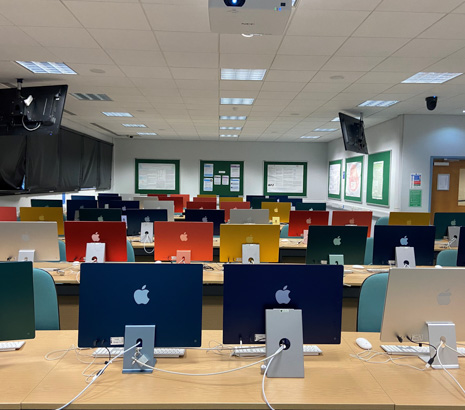
I currently live on campus, so in the morning I walk over to my lectures which take place on College Lane campus. The walk from the accommodation to the lectures takes between 5-10 minutes. The lectures tend to last two hours each with a 10-minute break in the middle. For our research methods lab, we are in the ILab (pictured) which is a room with Mac computers that has all the software we need for the course - for example SPSS. If I have lectures in the afternoon as well, my friends and I tend to have lunch at the local shopping centre in Hatfield called the Galleria.
After our lecture in the afternoon, I tend to go to the LRC on College Lane to complete any reading that I need to do, seminar questions as well as completing assignments and revising for exams.
In the evening, I like to attend an Active Students session, for example boxfit. These sessions are free for all students. I then finish off any work that I needed to complete that day ready for the next day.
I hope this gives you a better understanding into the day of a life of a student studying BSc Psychology! If you have any further questions, please feel free to contact me on Unibuddy 😀

Student Blogs
Elanor Webb - Advice as an alumni
Having graduated from Herts with an undergraduate and postgraduate degree in Psychology, I am now working in the sector as a senior research assistant psychologist. For anybody looking to study psychology, I want to offer you four key pieces of advice and tips to help get you started!
1. Don’t feel like you need to go into the course (or finish it!) with your career plans mapped out
Finding your feet after university can be daunting – I won’t sugar-coat it. Psychology, particularly the clinical field, can be a competitive area of work to get into, and it’s often not a quick, linear, or easy pathway into a career. So if you don’t have your life roadmap paved out for the next decade - or even the next year – don’t sweat it (easy said than done though, I know). Had you asked me what I wanted to do three years ago, as I came towards the end of my undergraduate degree, you would have been met with a nervous laugh and a face of complete panic.
My decision to continue into postgraduate education was largely the result of uncertainty about what direction I wanted to go in with my career. As my undergraduate degree was coming to an end, I knew clinical psychology was an area of particular interest to me, which prompted my decision to study for an MSc in Research in Clinical Psychology. Essentially, this was a course targeted at people who want to get onto the clinical doctorate training, and those who want to pursue a research career in the clinical field. Ironically, I began the degree as the former, and finished it as the latter.
Working in a secure mental health setting has also confirmed to me that clinical doctorate training isn’t the route that I want to take, and it’s research that I really love. So I’d definitely say to keep your mind open, and try to avoid that tunnel vision thinking of "this is what I want and I need to get there as soon as possible". There’s no timeline to your career and people often get caught up in thinking about the end goal without enjoying the parts in between.
2. Take advantage of opportunities during the degree… your post-grad self will thank you for it!
That’s perhaps quite hypocritical for me to say as I certainly wasn’t one for doing this. There’s a balance to be struck between focusing on your academic attainment and getting valuable experience along the way, and I definitely put my time and effort into getting good grades. A first class degree will undoubtedly open doors for you, but there’s also lots to be said for a replete ‘experience’ section on your CV.
Whilst I didn’t do a placement year, I often work with students who are on a clinical placement at St. Andrew’s, and I can definitely see the benefits of taking one. The experience they are gaining and the skills and knowledge that they are learning will undoubtedly prepare them well for both their final year studies and beyond this, in their journey into a career.
Getting involved in research can also be a really helpful thing to do. As well as updating your knowledge within an area and developing lots of useful skills, it can offer you an advantage when it comes to applying for training programmes, and is one way to stand out in a very large crowd.
3. Do your research on all the different pathways a psychology degree can take you
For many people, getting onto clinical doctorate training is the motivation underlying their decision to study for a degree in psychology. However, this is by no means the only pathway into a career within the field. As my postgraduate degree was coming to an end, and the delight of never-ending job applications began, my eyes were opened to a whole range of alternative roles and routes; at the time that I got my first research assistant job, I was also offered a training post as an education mental health practitioner – a role which I hadn’t heard about until five weeks prior. Also, there are a whole host of options available to psychology graduates which extend far beyond the area of psychology itself.
4. Celebrate your successes
Lastly, but by no means least, allow yourself to celebrate your own accomplishments and successes along the way. A degree isn’t meant to be handed to you on a plate, and it does unquestionably demand hard work, commitment, and lots of perseverance. But it also brings growth, personal and academic development, and exceeding beliefs about your own capabilities. Whilst it can be easy to get caught up in grades, studying for a degree will bring success in many other ways too. Expect the challenges that come with earning a degree, but allow yourself to revel in all the triumphs along the way – big or small!

Student Blogs
Noah - A day in the life on my psychology course
Hi! My name is Noah and I’m a third year psychology student here at the University of Hertfordshire 👋
Today I’ll be sharing what a typical day looks like for me:
5:30–7:30am: For me, I am definitely an early bird. On days when I have an early morning lecture, I’ll wake up at about half-past five, and spend around forty minutes getting ready for the day. After that, I will start block scheduling a general plan of my day on my calendar.
7:30-8:00am: Just before I arrive at University, I like to quickly stop to grab myself coffee (gingerbread latte with oat milk, if anyone is curious) – caffeine is a must!
8:00-9:30am: Once I arrive at Uni, I head straight to one of the many individual study spaces at the Learning Resource Centre (LRC) to begin some work. The LRC is open 24/7 and hosts thousands of books for every subject that the University teaches. The LRC is such a warm and wonderful environment for studying, with both group and individual study rooms, a café (The Retreat) on the lower-ground floor, as well as comfortable sofa, booths and chairs, allowing you to study in any way that suits you.
I prefer being in almost complete silence, by myself, with little to no distractions, so I absolutely love the individual study spaces.
9:30-10:30am: After my time in the LRC, I have a meeting with my project supervisor. All final year psychology students have to complete a ‘psychology project’, more often known as a ‘dissertation’, and each student chooses a supervisor for their project, often based on previous work.
During my meeting, I'm advised to make a few adjustments to my ethics and risk assessment forms, so I make a quick note to do so on my phone.
11:00-1pm: Straight after my supervision meeting, I have to attend my only lecture for the day. With psychology, there is a lot of independent research that you need to do, so I don’t really have that many lectures that I need to attend. The lecture that I was attending today was on the topic of counselling.
1-3pm: Once the lecture is finished, I make my way back home and have a little bit of a rest. During this time, I also make sure to eat some lunch!
3-5pm: After my break, I jump straight back into work. I begin with making the adjustments to my ethic and risk assessment forms, as I was told to do during my meeting earlier. Once completed, I then start studying for my Counselling module exams.
Once I have completed that, I am absolutely shattered! So I pack everything up and start to relax and unwind.
Thank you for reading my ‘Day in the Life’! This is an example of a very busy day for me, so it is vital to note that not every single day is as hectic as this 😀


Alumni Stories
Olivia Draisey
Meet Olivia Draisey who ‘fell in love with the community spirit’ at Herts while studying psychology. She’s now a psychology teacher and Head of Year 11 at Jo Richardson Community School.
Read more stories BSc (Hons) Psychology| Current job role | Psychology teacher and Head of Year 11 |
|---|---|
| Year of graduation | 2014 |
| Course of study | BSc (Hons) Psychology |

University experience
For Olivia, ‘moving to Herts was a huge step’. Before visiting us on an open day, she had been keen to stay at home in the Midlands. Instead, she ‘fell in love with the community spirit’ and while she was still a little uncertain, she decided to embrace new experiences outside of her comfort zone. Olivia enjoyed student life, feeling ‘welcome and at home’. She describes walking into our nightclub on a Wednesday night as an ‘invigorating feeling’, knowing it was a chance to chat with everyone she knew from her course and the clubs she had joined. ‘Every night there has its own memory’ she tells us. Olivia took part in activities with the dance society and wrote for the university newspaper and magazine. She tells us that this has ‘shaped who I am as an educator’.
Career progression
After graduating, Olivia studied a PGCE (Post Graduate Certificate in Education). She completed her student placements at her former college in the Midlands. Here, she co-ran the college magazine enrichment programme. She has now moved to London and continues to embody the spirit of Herts, sharing with her year group a motto she learned while studying: ‘Be nice. Work hard. Take opportunities’. Olivia’s studies have given her the qualifications she needed to teach psychology at sixth form level. Now head of year 11, she is passionate about pastoral care and supporting the wellbeing of students and staff. She hopes to progress further in this field as this would enable her to ‘unite’ her passions for education and psychology in new ways.
Alumni Stories
Adrienne Kirk
Meet Adrienne Kirk who has had a long and successful career since graduating in 1994. Adrienne currently works a Psychotherapist.
Read more stories BSc (Hons) Psychology| Current job role | Psychotherapist |
|---|---|
| Year of graduation | 2010 |
| Course of study | BSc (Hons) Psychology |
Exploring a new path
Initially Adrienne spent twenty-one years teaching Clinical Communication skills in medical schools. Her role encompassed teaching students in the essential methods of communicating as a medical professional, giving them tangible and applicable knowledge of these professions in practice.
Topics included how to take a medical history and how to deliver information and break bad news to patients. Adrienne also designed and ran the clinical practical exams. She found supporting struggling students the most rewarding element of the job which led her to making this her focus. She later retrained as a Psychotherapist.
Skills for success
Adrienne says her Psychology degree helped develop her critical and analytical skills as well as how to evaluate risk in relation to health. She says, 'I learned how to use statistics to understand data. The Social Psychology modules taught me that we are not always logical addressing social conventions and we are unaware we are applying them to our decision making.'
Adrienne was a mature student when she began her degree having worked for six years before her studies. She says, 'It was wonderful to get back into studying. I had inspiring lecturers who challenged me to think deeply and critically. There were quite a number of mature students, so I never felt that I was not part of the cohort. And I met my best friend, who I still see every week!'
Adrienne encourages new and prospective students to make the most of all the opportunities available through their programme. 'This is a time for exploration, for seriously investigating your ideas and beliefs, for meeting new people and having new experiences. I attended every lecture and there was always something interesting to think about from every one of them.'
'A psychology degree is a launchpad to so many opportunities. I went on and did a Master's in Health Psychology at UCL and from there developed an interest in doctor-patient communication. Working with medical students was so rewarding, but I decided to retrain to help others. I think it is important to have an open mind about where you might be in the future, but a psychology degree has given me an understanding of theories and a means of reading and evaluating research.'
Aspirations for the future
Adrienne is now setting up a private practice as a psychotherapist. She wants to develop a programme to help people with lifestyle changes, and to be the best version of themselves that they can be.