
Environment and sustainability
Creating a sustainable future in Hertfordshire
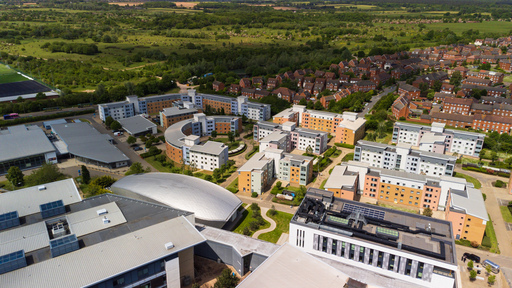
With over 3,000 staff, 35,000 students and a campus covering over 200 hectares, we are committed to not only reducing the environmental impact of our estate and the University’s activities, but also to championing a sustainable mindset across our communities, embedding the principles of sustainability as a recurring green thread across our institution - and beyond.
Our impacts, aims and objectives are aligned with the United Nations’ Sustainable Development Goals Framework. While our main focus is on environmental considerations, as a university we work collaboratively across all Schools of Study and business departments across the University to ensure a holistic and inclusive approach to sustainability.
Through investment in our estate, engagement with our communities, innovative research and the development of future generations of graduates, we are working to make a positive and lasting contribution to society.
Our commitments at Herts
To mitigate the environmental footprint of the University’s activities and operations, our Environment and Sustainability Framework is set around four key impact areas: climate change, biodiversity, waste and resource management, and sustainable communities.
We’ve made several commitments relating to these four impact areas. As set out in our Environmental Policy, we’re committed to:
- preventing pollution;
- complying with environmental legislation;
- striving for continual improvement;
- educing our impact on the climate by becoming Net Zero by 2050;
- protecting and enhancing biodiversity;
- reducing the impact of our waste and resources utilisation;
- building a sustainable community through education, student experience, research, enterprise, and global engagement.
Sustainability at Hertfordshire
As one of Hertfordshire's largest employers, educational institutions and landowners, the University has a unique opportunity to support sustainable development across the region.
Through the management of our estate, the education of future graduates, our research activities and our partnerships with businesses and communities, we seek to create positive environmental, social and economic impact.
Our sustainability programme supports the United Nations Sustainable Development Goals (SDGs) through its teaching, research, campus operations and community partnerships. This is achieved through such programs as our Centre for Climate Change Research (C3R), Net Zero by 2050, Global Health Research.
Our pathways to sustainability
We take a targeted and holistic approach to sustainability that is embedded across the University by bringing together our staff, students, local communities, businesses and partners, alongside action plans and initiatives from across the institution.
Our six pillars reflect the scope of our impact, reach and influence, and provide a framework for delivering our environment and sustainability objectives.

Measuring out progress
Transparency and accountability are essential to delivering meaningful sustainability improvements.
The University monitors a range of key performance indicators covering:
- Electricity consumption
- Gas consumption
- Water consumption
- Carbon emissions
- Waste generation
- Recycling performance
- Resource efficiency
Our Sustainability Dashboard provides an overview of environmental performance and progress against key objectives.
Performance is reviewed through annual reporting and used to identify opportunities for continual improvement.
Sustainability Dashboard 24/25
The University continues to make good progress towards its Net Zero commitments, with significant reductions in carbon emissions and continued investment in energy efficiency. Whilst performance remains positive in carbon and energy, further focus is required on waste reduction and water consumption.
Theme | Status | Headline Measure | Position |
|---|---|---|---|
Carbon | 🟢 | 11,311 tCO₂e | 33.6% reduction against 2018/19 baseline |
Energy | 🟢 | Decarbonisation programme | Supporting 85% reduction target by 2035 |
Water | 🟠 | Below 13 m³/FTE | Efficiency target achieved, but overall consumption increased |
Waste | 🔴 | <2% to landfill | Landfill target achieved, but waste volumes and recycling performance require improvement |