



Sign up for updates
Interested in studying at the University of Hertfordshire and want to sign up to our mailing list to learn more about our facilities, living in the UK and student life? Use the form below and our team will also keep you informed of key updates such as events near you, applications opening and more!
MSc Business Analytics and Consultancy
Why choose Herts?
- Teaching excellence: Learn from lead researchers in the Business Analytics and Systems department including Professor Eren Demir (Professor in Decision Sciences) who is published widely in the area of healthcare modeling and decision support systems and Professor Neil Spencer (Professor of Applied Statistics) who leads the Statistical Services and Consultancy Unit at the University of Hertfordshire (see key staff section).
- Industry connections: Benefit from our strong links with large organisations, including Ocado, Enterprise Rent-A-Car, and Tesco HQ who support our careers fairs, provide guest lectures, and networking events.
- Employment prospects: Graduates are working as business analysts, management consultants, and senior managers for organisations including Whitbread, Greenfolk Management Consultancy, and Accenture.

Alumni Stories
Opeyemi Ajewole
Meet Opeyemi. Opeyemi’s passion for business analytics and consultancy was driven by working for his family’s business. After completing his MSc in 2022, he returned to Herts as a Visiting Lecturer.
| Current job role | Visiting Lecturer at the University of Hertfordshire |
|---|---|
| Year of graduation | 2022 |
| Course of study | MSc Business Analytics and Consultancy |
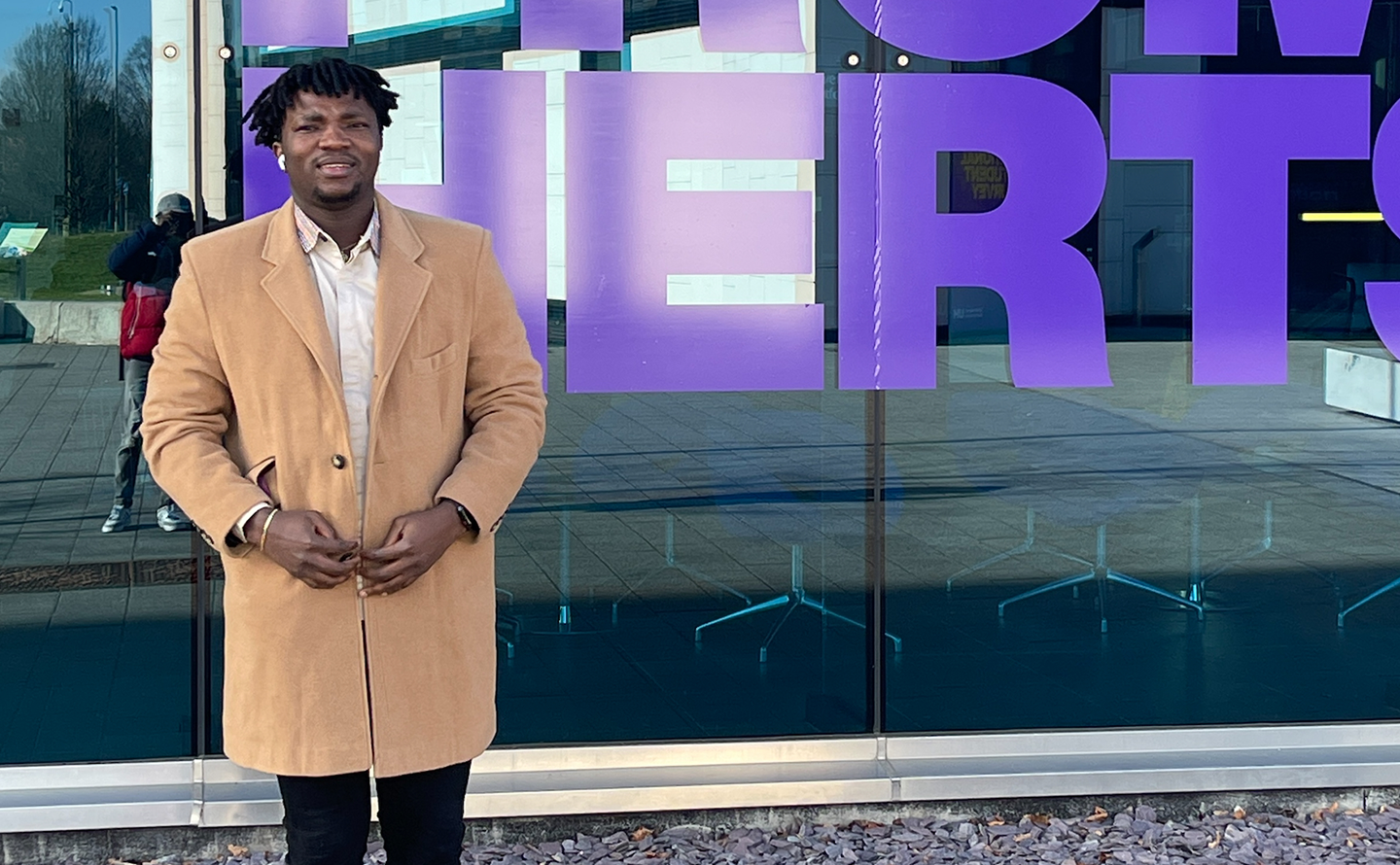
From the family business to postgraduate study
Opeyemi’s passion for business analytics and consultancy was nurtured at a young age working for his family’s business in Nigeria. As Opeyemi explains, ‘I discovered that I enjoy using data to make informed decisions and to solve business problems. I also thrive leading projects and collaborating with stakeholders to translate their goals into actionable targets.’
He wanted to build on this passion by completing a postgraduate degree and was offered a place to study by three UK universities. What attracted Opeyemi to Herts was the University’s ‘reputation for academic excellence, as well as its high-quality teaching and research’. During a visit to campus, he was blown away by the University’s ‘supportive and inclusive culture’ and its modern, well-equipped facilities.
Cherished memories
Opeyemi says that he will keep the memories he made at Herts with him forever. He says, ‘I remember spending time with coursemates in the Learning Resource Centre (LRC), where we would share stories, laugh, and support each other’s academic and professional growth. It was always a positive learning environment.
‘My most cherished memory though was graduation. I felt overwhelmed with happiness and pride when I walked across the stage to receive my degree. I remember reflecting on how I got there at the time, it was a moment that came at the culmination of all my hard work, dedication, and sacrifice. Seeing family and friends cheer me on made it even more special. I will never forget it.’
Sharing his knowledge with the next generation
After graduating, Opeyemi returned to Herts as a Visiting Lecturer where he is preparing students for future success. He says, ‘I’m eager to gain as much experience as I can at Herts. My long-term ambition is to start my own consultancy business, as I would love to choose my own clients, set my own rates, and build a team of talented and passionate consultants around me.’
Opeyemi’s advice to current and future Herts students is to remain dedicated to their studies throughout their time at university. He adds, ‘Make sure you use the resources on Hertfordshire Business School’s Centre for Academic Skills Enhancement hub and take advantage of networking opportunities with other cohorts and tutors. At Herts, you can establish valuable relationships you will rely on throughout your professional life.’
About the course
The MSc Business Analytics and Consultancy programme employs case study-based assignments to enhance students' understanding and application of business analytics across various sectors. These assignments are pivotal in achieving the programme's learning outcomes by integrating theoretical knowledge with practical, real-world applications.
Students delve into the scope of business analytics through diverse case studies that illustrate its application in different business contexts, sharpening their ability to research and critically analyse contemporary business situations. Students gain a robust understanding of the consultancy landscape by evaluating the nature of consultancy and the requisite skills for successful consultants through real-world scenarios. Furthermore, case studies allow students to critically examine and apply advanced business analytics methods and tools, fostering their ability to solve complex business problems effectively.
Case studies provide a hands-on approach to applying various analytical methods and business software to model and analyse intricate business issues, enhancing practical competence in managing real-world data. Students also explore consultancy project processes, evaluating their application in business contexts, which helps them understand project dynamics and stakeholder requirements. Additionally, various modelling techniques and research methodologies are employed across these assignments, equipping students with a versatile skill set adaptable to consultancy projects.
Intellectually, students are encouraged to evaluate core business analytics principles and design research grounded in solid business modelling principles. They critically analyse published research, assessing its validity and relevance to new business scenarios, cultivating a rigorous analytical and creative problem-solving mindset. On the transferable skills front, case studies enhance communication abilities, promote effective teamwork, foster entrepreneurial thinking, and improve time management and self-efficacy. Students also become proficient in business analytics tools, which are crucial for navigating modern business environments.
By employing case study-based assignments, the programme ensures that students acquire theoretical knowledge and develop practical skills essential for their future careers in business analytics and consultancy. This systematic approach prepares students to face and solve real-world business challenges, making them valuable assets to any organisation.
Why choose this course?
The MSc Business Analytics and Consultancy at Hertfordshire Business School stands out in the UK, ranking 6th in Business and Management in the Postgraduate Taught Experience Survey (PTES, 2024).
Distinguished for its skill development and support, MSc Business Analytics and Consultancy offers a practical, hands-on learning experience that is client-facing and counts as work experience.
Informed by the latest research and practical consultancy, MSc Business Analytics is a unique course that thoroughly prepares you for the modern business environment through real-world projects with local organisations.
Delivered by the experienced Business Analysis and Statistics (BAS) group, MSc Business Analytics leverages faculty expertise in analytical disciplines. It includes direct involvement in commercial consultancy, significantly enhancing employment prospects upon graduation.
What will I study?
You will learn how to be a successful analytical consultant through a varied programme of teaching that will include guest lectures, masterclasses, facilitated seminars, practical workshops, web-based learning, computer based tutorials, case study analysis and traditional lectures.
Assessment will be practical and coherent across the course, including a mixture of methods such as presentations (written and oral), case study work, action learning sets. The University promotes professional integrity and thus the course provides opportunities to develop the skills of communication, independent and team working, problem solving, creativity, digital literacy, numeracy and self-management.
The course will provide the opportunity to work in teams with a local organisation and an academic supervisor to scope out an area for improvement / where you can deliver a business solution, your team will then create a proposal of the research to be undertaken and this will be presented to the organisation. Individual areas of research will be identified to form the basis for your individual applied consultancy project.
Key staff
Charlotte Bryce
Professor Eren Demir
Find out more about Professor Eren Demir
Professor Neil Spencer
Find out more about Professor Neil Spencer
Dr Nnamdi Ogbuke
Seun Adegoke
Dr Sue Davis
Further course information
| Programme specifications | |
|---|---|
| MSc Business Analytics and Consultancy - Full Time, Sem A | Download |
| MSc Business Analytics and Consultancy - Full Time, Sem A | Download |
| Additional information | |
|---|---|
Sandwich placement or study abroad year |
n/a |
Applications open to international and EU students |
Yes |