BSc (Hons) Nursing (Adult)
Blend theory with hands-on adult nursing experience in our state-of-the-art Clinical Simulation Centre, hospitals and communities. Develop the skills and confidence to bring comfort, promote health and save lives. Be proud of becoming an adult nurse.

What type of applicant are you?


Sign up for Clearing VIP Access
Skip the queues on results day with an exclusive priority Clearing hotline number.
Get info and updates
Sign up for updates
Interested in studying at the University of Hertfordshire and want to sign up to our mailing list to learn more about our facilities, living in the UK and student life? Use the form below and our team will also keep you informed of key updates such as events near you, applications opening and more!
-
Typical offer: 112–120
Entry requirements -
Fees: £9,790 per year (UK)
Full details -
UCAS code: B700
-
Course length: Full time: three years
Find out more -
Location:
- University of Hertfordshire, Hatfield
-
Institute code: H36
NHS Learning Support Fund
Training grants of at least £5,000 a year are available for eligible healthcare students which you will not have to pay back. You may also be eligible for an additional £2,000 towards childcare costs to help balance your studies with family life and £3,000 for students who find themselves in unforeseen financial hardship. Find out more about the NHS Learning Support Fund
NHS Funding for UK/EU Students
Students studying on nursing, midwifery or allied health professional courses funded by Health Education England will have access to the same student loans support package and support for living costs as other students.
You could also benefit from the NHS learning support fund if you study an eligible nursing, midwifery, or allied health course. If eligible, the different kinds of support you could get include a training grant, parental support, money back for travel and temporary accommodation whilst on placement, and financial hardship (which you won’t need to pay back).
Gittins Family Bursaries
£3,000 (£1,000 in each academic year) is awarded every year to three first year students studying on this course. Students eligible are those full-time Home students with a household income below £40,000 p.a. at commencement of their first year of study. Students will be invited to fill out a short application form and winning students will be identified by a panel of academics.
PJE Foundation Scholarship
£3,600 (£1,200 in each academic year) is awarded on the conclusion of the previous scholarship to a first year, full time Health and Social Work student with a declared disability, who is returning to study after at minimum break of three years from formal education. Applications for this scholarship open in the first year of study.
The Janice Ann McNaughton Bursary
£3,000 (paid in the first year of study) is awarded every year to two first year students studying on this course. Students are eligible to apply if they are care-leavers or care-experienced students aged 18-24. If the cohort does not include two students who meet the above criteria, students under the age of 25 who are the first in their family to attend university may be considered. Applicants must fill in a short application form.

1st in the East of England for nursing and midwifery (Complete University Guide, 2026)

4th in the UK for general nursing (Guardian University Guide, 2025)

98% of Herts health and social care undergraduates are in work/study (Graduate Outcomes, 2024) 1
Course overview
From the day you start, we’ll blend your theory with practical experience. Half the course will be spent at the University. The other half of your time, you will gain hands-on skills in a variety of adult nursing clinical settings. You’ll learn about ‘normal’ adult development then recognise to manage deviations from the norm. You’ll promote health and provide real patient care in hospitals and the community.
Why choose this course?
State-of-the-art facilities: Training to become an adult nurse, you’ll build essential skills through hands-on experience in our Clinical Simulation Centre, which replicates real hospital and community settings. Practise your nursing skills in realistic environments, including simulated hospital wards and community or GP consultation rooms, so you can safely develop confidence before progressing into clinical practice.
Strong employment prospects: You can take your newly acquired theory and practical confidence to gain real experience on placement in a hospital or community setting and continue this after completing the course. 98% of Herts health and social care undergraduates are in work or study (Graduate Outcomes, 2024)1.
Have a rewarding career: Be the one to reassure that nervous patient before an operation. Be the person who aids their recovery. Be the one who helps save lives. Our nation is proud of the work our NHS does, let us be proud of you too.
Receive a support fund: You could get at least £5,000 each year that you won't even need to pay back. Find out more about the NHS Learning Support Fund.
Professional accreditations
Once you qualify, you will be entitled to apply to enter the professional register of the Nursing and Midwifery Council in the Adult Nursing field, so that you can work in the UK.
Your future career
Following successful completion of the programme, you will be entitled to apply for registration as a nurse with the Nursing and Midwifery Council in the Branch of Nursing in which you have specialised. You can now take advantage of the varied opportunities available to you, to put into practice all you have learned and make a positive contribution to the lives of individuals, and their families.
Areas in which you work in as an adult nursing graduate:
- acute services within the NHS
- a range of community settings including general or specialised community nursing
- private, Voluntary and Independent (PVI) Sectors e.g. hospices.
You will meet many interesting people and each day will be different. You will always be learning, developing new and innovative skills through experience and education that will enable you to diversify or specialise in a particular area of adult nursing, giving the opportunity for promotion and job satisfaction.
This adult nursing course entitles you to apply for registration as a nurse with the Nursing and Midwifery Council. It opens up a wide range of career options, typically within hospitals or community-based services which can take you in several different directions. For example, you may discover you have talents in leadership and management and pursue this route or you may prefer to learn more about a specialist area of practice so you can work as a specialist or consultant nurse.
See what recent graduates are up to
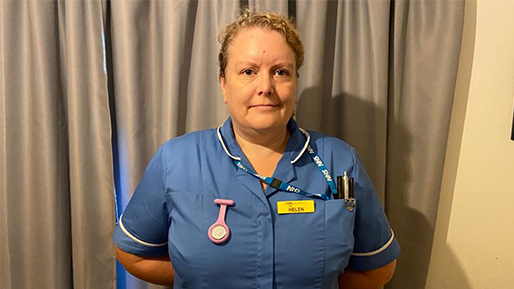
Helen Scholes
Community Nurse at Hertfordshire Community NHS Trust
Meet Helen, who decided to change career after two decades in the police. After overcoming significant challenges with help from her tutors and friends at Herts, Helen is now a Community Nurse with ambitions to become a Sister.
A career change
Helen spent over two decades in the police as a dispatcher and special constable before deciding to retrain. Helen’s experience in the police had taught her many transferable skills, including how to manage difficult and emotional situations, which made her an excellent fit for a career in healthcare.
‘I became a reablement carer, spending three years at a local company helping people get back to normal and keep their independence after a stay in hospital. I wanted to do more to help older people and those with learning difficulties though, so I began working for an out-of-hours GP service, where I was responsible for managing medication and acting as a chaperone. My colleagues were very supportive of my development, and this experience helped me realise my ultimate goal of becoming a nurse.
‘Unfortunately, I had left school without A-levels, which meant I could not apply to study nursing at university. I completed an access course at my local college but had missed the university application deadline, so decided to try my luck with Clearing. I was fortunate enough to be offered a place at Herts and accepted immediately - I had heard great things about Herts and my daughter had graduated from here in another discipline.’
Conquering unexpected challenges
Not long after Helen started her BSc Nursing (Adult) degree at Herts, she began to experience similar challenges that led to her leaving school before completing her A-levels.
‘I knew I was intelligent, but my reading speed and other things were holding me back. I was assessed by the University’s wellbeing service and found out that I had both dyslexia and dyspraxia. Despite my diagnosis, the support I received from Herts was outstanding and I could not have completed my course without the encouragement of my tutors.
‘I also owe a debt of gratitude to the friends I met on the course. Being much older than many of my cohort, I was worried I would find it difficult to meet people, but that was not the case at all. We all helped one another, whether we were struggling or needed company during a study session.’
Proudest moment and future aspirations
Helen has fond memories of Herts and says her proudest moment was giving a speech at graduation as the ‘top scoring student’.
‘I would never have imagined doing this at the start of my course. Herts has made my dreams come true.
‘I’ve just had my first appraisal in my current role and my manager has recommended I apply for a promotion. Hopefully, it won’t be long before I become a Sister. I’m also looking forward to completing my district nursing and prescribing courses at Herts in the future.’

Sarah Sesay
Nurse at St George’s University Hospital
Meet Sarah Sesay, a newly qualified nurse who has landed her dream job and plans to further her career as a specialist in infection prevention and control.
Pathway into nursing
Sarah is a newly qualified nurse working in the Acute Medical Unit (AMU) at St George’s University Hospital in London. She was the first person in her immediate family to go to university and was so proud to be awarded a first.
Sarah first completed a BTEC course at college and then progressed to do her BSc at Herts. She now has her dream job as a registered nurse in the AMU department and plans to return to further study in future to become a specialised nurse in infection prevention and control, a specialism she particularly enjoys.
Nursing at Herts
Sarah says, ‘My studies at Herts have helped shape my career path by offering me different types of support, both theoretical and in clinical practice. There were always drop-in sessions for help with writing assignments and finding resources.
‘Herts lecturers are experts in research and are always willing to provide that extra support whenever needed. Also, the simulation sessions really helped me to prepare for placement. One of the most useful clinical simulation sessions that I attended was caring for a dying patient, and I am very grateful I was able to experience it.’
‘My favourite experience at Herts was finding friends for life. We all managed to complete the course together and we are all now registered nurses in different Trusts. I can call upon our shared experiences if I need to.’
‘My advice for current and future students is to start assignments as soon as you can. The sooner you start them, the better chance you’ll have to pass and get good grades!’
What you'll study
Below you can see the modules that you will study on this adult nursing degree.
You’ll spend 50% of your time at the University. You’ll attend lectures building your knowledge on things like how you will provide a holistic assessment care plan, considering a person’s mental, emotional and physical wellbeing. You can then share your learnings in smaller groups in seminars and tutorials. You will be asked to look at case studies, individually or in a small group. Plus, you can put what you have learnt into practise, using our simulation laboratories.
You’ll spend 50% of your time in a range of placements across the three years of your study and will work alongside qualified health care practitioners.
Practice placements are organised within neighbouring NHS Trusts in Hertfordshire, and North London and in other settings including the private and voluntary sectors. There is the opportunity to learn with and from people in the community and in hospitals where nursing is experienced. The placement experiences are wide and varied, emphasising the chosen field of practice - adult nursing. During the first year, experiences may also include caring for children, service users with learning disabilities or those with mental health problems.
A student-led placement is offered at the end of the second year which gives you the opportunity to gain clinical experience in an area of practice you are interested in.
COVID-19 conditions permitting, a student-led placement is offered at the end of the second year which gives you the opportunity to gain clinical experience in an area of practice you are interested in.
In your first year, we will introduce you to the profession, right from basics. You’ll explore health and wellbeing clinically and within social, political and economic contexts. You’ll practice, challenge, question, and refine current nursing skills through simulation and practical exercises.
In your second year, you’ll further advance your knowledge. You’ll look at bioscience changes and pharmacological aspects of health and wellbeing. You’ll discuss, interpret and plan care for patients who may be experiencing different physical and psychological symptoms.
In your final year, you’ll find that you have grown to love certain topics. In this year you can delve deeper in these areas. This could be socio-political issues that impact effective nursing practises. Or this could be how spiritual, psychosocial, cultural and emotional aspects can affect how patients receive care. It’s entirely up to you.
What if I need support?
You’ll get a personal tutor to guide you through your course, all the way to graduation.
You might also want or need extra support during your time with us. Rest assured, no matter what you study, we’ve got you covered. For help with study skills, including referencing, essay writing and presentations, you’ll have access to our academic support services. You can attend workshops, one-to-one sessions and online tutorials. Both our LRCs run drop-in study skills sessions and during your placement you will be supported and assessed by appropriately prepared practitioners.
Where you'll study
Your main campus is College Lane. This is where the creative arts, science and health-related subjects are based. This means you’ll share the campus with future nurses, doctors, scientists, artists and more. You can use the common rooms to relax with friends, work out in the 24-hour gym or have a drink in our on-campus bar or cafes. We also have restaurants for you to eat in or grab something on the go. Our Learning Resources Centres are open 24/7, which means you can study whenever suits you best. Want to pop over to the other campus? You can take the free shuttle bus or walk there in just 15 minutes.
Check out our student blogs
How we support our students
At the University of Hertfordshire, we want to make sure your time studying with us is as stress-free and rewarding as possible.
We offer a range of support services, from childcare to counselling, ensuring that you make the most of your time at Herts and can focus on studying, having fun, and have the support you need.

Student Blogs
Wing Yan Graces - University support for nursing students during placement
University support for nursing students during placement
Hey there, future nurses🌟
When you're out on placement, the University has your back with plenty of support. Here’s how:
Personal Tutor👩🏻🏫
Your personal tutor is like your academic cheerleader, ready to guide you through your three years of study and help you stay on track.
Placement Team👩🏻💻
If you got any issues with your ePAD, no worries! The placement team is here to help you sort it out so you can focus on what really matters—your learning!
Module Lecturers and Academic Assessors👩🏻💼👨🏻💼
Your module lecturer and academic assessor are there to support you during your placement, making sure you have the guidance you need along the way.
Academic Support Team📔🖊️
Need help with essay writing or other academic tasks? The Academic Support Unit is filled with resources and workshops to boost your skills.
Wellbeing Team🩷
Your mental health matters! The Wellbeing Team is ready to lend a helping hand and provide support so you can keep your stress in check.
Placement Funding💰
Don't forget about the financial support available to help with transport costs during your placement!
With all these resources at your fingertips, you’ll be well-equipped to make the most out of your placement experience.

Student Blogs
Wing Yan Graces - An exciting employment opportunity for nursing students
An exciting employment opportunity for nursing students
As a fellow nursing student, I understand how vital it is to gain hands-on experience in our field while also earning money to support our daily lives and studies🥺Here’s another great opportunity for nursing students to apply for a part-time job that allows you to build practical skills in our field while also earning money to help with your daily expenses and studies.
Once you complete your first placement or finish 12 weeks of clinical experience, you can apply to the NHSP as a healthcare support worker. Simply request your last manager to sign an authorisation form. Just a reminder, please ensure you prepare all the acceptable documents for them to use. I spent a lot of time checking the requirements, so it’s important to have everything ready!
In this role, you can earn money, gain more knowledge, and connect with other nurses during your part-time work. There are 3 benefits at the same time🤩So… Why NOT?
However , please make sure to maintain a good balance between your studies and your part-time job. Your primary focus should be on your education—don’t overwork yourself and risk failing your exams🙈
Entry requirements
Clearing entry requirements
The University of Hertfordshire is committed to welcoming students with a wide range of qualifications and levels of experience. The entry requirements listed on the course pages provide a guide to the minimum level of qualifications needed to study each course. However, we have a flexible approach to admissions and each application will be considered on an individual basis. This also applies to Clearing applications, so if you don’t have the advertised grades, you can submit a Clearing application and we’ll review and consider your application on an individual basis.
Ready to apply?
Apply through Clearing now
UK and EU applicants with pre-settled/settled status in the UK
| Start date | Study type | Apply |
|---|---|---|
| September 2026 | Full time | Apply via UCAS |
| September 2027 | Full time | Apply via UCAS |
International and EU applicants without pre-settled status in the UK
Apply through Clearing


Our Clearing hotline is open for support, Monday - Thursday 9.00-16.45 and Friday 9.00-15.45. You can apply online at any time.
Fees and funding
At Herts, we’re dedicated to providing world-class teaching supported by industry-level facilities and incredible social spaces. We believe cost shouldn’t be a barrier to higher education, and we strive to keep both our standard and additional costs as low as possible.
NHS Learning Support Fund
Training grants of at least £5,000 a year are available for eligible healthcare students which you will not have to pay back. You may also be eligible for an additional £2,000 towards childcare costs to help balance your studies with family life and £3,000 for students who find themselves in unforeseen financial hardship. Find out more about the NHS Learning Support Fund
NHS Funding for UK/EU Students
Students studying on nursing, midwifery or allied health professional courses funded by Health Education England will have access to the same student loans support package and support for living costs as other students.
You could also benefit from the NHS learning support fund if you study an eligible nursing, midwifery, or allied health course. If eligible, the different kinds of support you could get include a training grant, parental support, money back for travel and temporary accommodation whilst on placement, and financial hardship (which you won’t need to pay back).
Gittins Family Bursaries
£3,000 (£1,000 in each academic year) is awarded every year to three first year students studying on this course. Students eligible are those full-time Home students with a household income below £40,000 p.a. at commencement of their first year of study. Students will be invited to fill out a short application form and winning students will be identified by a panel of academics.
PJE Foundation Scholarship
£3,600 (£1,200 in each academic year) is awarded on the conclusion of the previous scholarship to a first year, full time Health and Social Work student with a declared disability, who is returning to study after at minimum break of three years from formal education. Applications for this scholarship open in the first year of study.
| Study type | Fees | |
|---|---|---|
| UK students | Full time | £9,790 for the 2026/2027 academic year |
| EU students | Full time | £19,450 for the 2026/2027 academic year |
| International students | Full time | £19,450 for the 2026/2027 academic year |
Tuition fees are charged annually. The fees quoted above are for the specified year(s) only. Fees may be higher in future years, for both new and continuing students. Please see the University’s Fees and Finance Policy (and in particular the section headed “When tuition fees change”), for further information about when and by how much the University may increase its fees for future years.
| Scholarships, grants and bursaries | Depending on your circumstances, you may be eligible for a non-repayable scholarship, grant or bursary to support your studies. |
|---|---|
| Disabled Students' Allowance | The Disabled Students’ Allowance can cover any study-related costs you have because of a mental health problem, long term illness or any other disability. |
| Student loans | Find out about securing a student loan, from how much you could be eligible for to when you need to start making repayments. |
| Accommodation costs | We offer a great choice of student accommodation, on campus or nearby in the local area, to suit every student budget. Due to the nature of your programme, your studies are likely to continue over the summer period, requiring an extended period of accommodation on campus. There are 2 accommodation options available to you:
|
| Additional course fees | Read more about additional fees in the course fact sheet. |
More about the course
| Programme specifications | |
|---|---|
| BSc (Hons) Nursing (Adult) - Full Time, Sem A | Download PDF |
| BSc (Hons) Nursing (Adult) - Full Time, Sem A | Download PDF |
| Additional information | |
|---|---|
|
Applications open to international and EU students |
Yes |
Course length |
Full Time, 3 Years |