MEng (Hons) Motorsport Engineering
Fuel your drive for advanced engineering with our master’s in motorsport engineering. Master vehicle design and cutting-edge innovations while gaining practical skills to excel in the fast-paced, competitive world of international motorsport.

What type of applicant are you?


Sign up for Clearing VIP Access
Skip the queues on results day with an exclusive priority Clearing hotline number.
Get info and updates
Sign up for updates
Interested in studying at the University of Hertfordshire and want to sign up to our mailing list to learn more about our facilities, living in the UK and student life? Use the form below and our team will also keep you informed of key updates such as events near you, applications opening and more!
-
Typical offer: 128
Entry requirements -
Fees: £10,050 per year (UK)
Full details -
UCAS code: H336
-
Course length: Full time: four years
Find out more -
Location:
- University of Hertfordshire, Hatfield
-
Institute code: H36
-
Work placement option
Find out more -
Study abroad option
Find out more

Integrated Masters degree meeting the academic requirement to be IMechE accredited

Brand new School of Physics, Engineering and Computer Science building

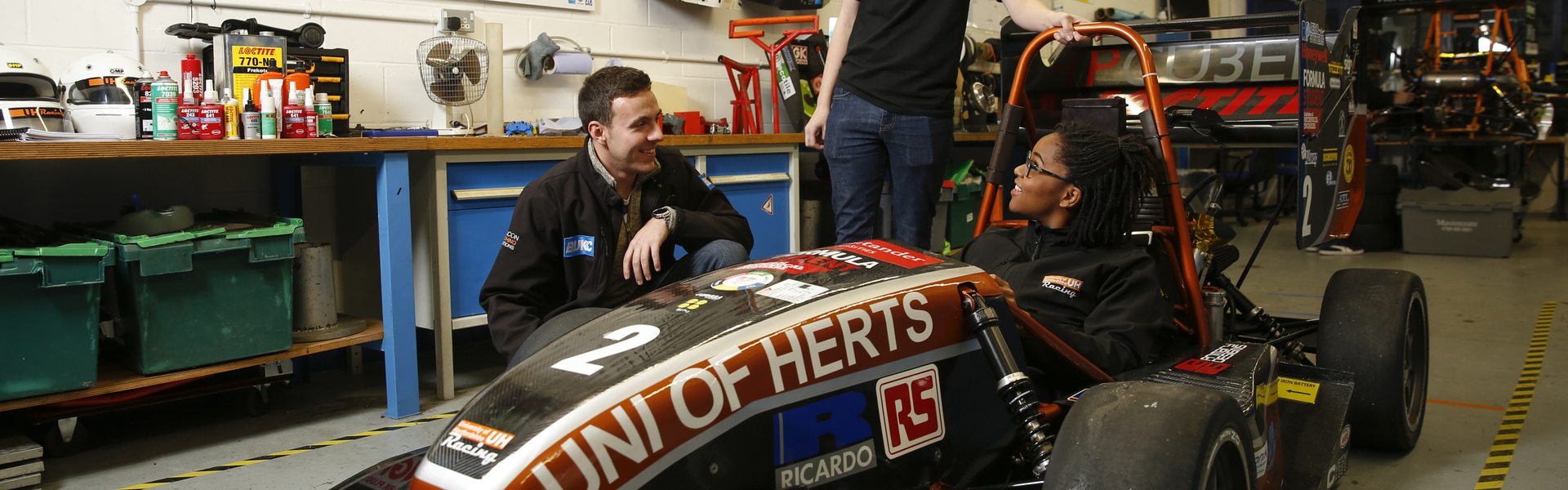
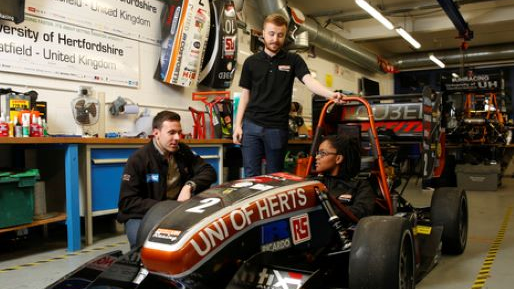
Opportunity to join the Formula Student and Formula Student AI Team
Course overview
The MEng Motorsport Engineering builds on a strong foundation in engineering, giving you the technical expertise and practical experience to design, develop and optimise high-performance vehicles at the forefront of global motorsport. You’ll extend your knowledge to master's level, studying advanced topics such as vehicle dynamics, aerodynamics and powertrain engineering, while developing leadership, innovation and problem-solving skills. Taught by experienced academics and industry professionals, and using industry-standard facilities and workshops, the course prepares you for senior roles within motorsport and high-performance engineering.
Alongside your studies, you have the opportunity to gain invaluable hands-on experience by working with other students to design, build, and compete with a Formula Student car, developing the teamwork, innovation, and problem-solving skills essential for success in this fast-paced international industry.
This course gives you the opportunity to take a placement year or study abroad for a semester or a full year. In your second year, you can explore options for a placement year or a study abroad experience, both of which take place between your second and third year of study.
Why choose this course?
This motorsport engineering degree is the perfect foundation for your future: You'll graduate with a clear route to a professional career, equipped with the knowledge and skills you need to succeed in many different engineering fields.
Industry-standard facilities: You will learn and be inspired in our brand-new Spectra building, housing the School of Physics, Engineering and Computer Science which includes experiential learning zones and state-of-the-art equipment which will enhance your learning experience. You’ll have access to an automotive lab which houses vehicles used for build labs as well as setup and vehicle dynamics labs, and also the formula student team. You’ll also have access to engine test cells, an electric motor test bench, and a large closed return wind tunnel.
Our industry connections will provide you with additional expertise and career-defining opportunities: Students and graduates have secured placement and employment opportunities at top companies such as Rolls-Royce, Multimatic, Mercedes HPP, Toyota, Safety Devices, Cummins and Williams Racing.
You will study at one of the largest engineering schools in the UK: Ranked 10th in the UK for production and manufacturing engineering (Daily Mail University Guide, 2025), the University of Hertfordshire has a strong and proven reputation in the field of engineering.
Conceive Design Implement Operate (CDIO) Framework: Herts students benefit from our membership in the CDIO initiative, an innovative educational framework supporting the next generation of engineers to ensure they are better equipped to enter and succeed in industry
Strong employment prospects: 96% of postgraduates in work/further study (Graduate Outcomes, 2026)1.
Professional accreditations
The Institution of Mechanical Engineers (IMechE)
Our MEng (Hons) Motorsport Engineering course meets the academic requirement to be IMechE accredited, an independent professional association representing the engineering profession.
Chartered Engineers (CEng)
Opportunities to register to CEng, an industry recognised title in the UK with many engineers and technicians achieving professional registration.
Your future career
MEng (Hons) Motorsport Engineering graduates are well-prepared for fulfilling careers in STEM, with skills highly valued in the industry and 96% of postgraduates in work/further study (Graduate Outcomes, 2026)1. As one of the top UK motorsport schools, we have strong industry links, providing good placement and employment prospects. Almost every Formula 1 racing team has a University of Hertfordshire graduate in its design team.
Typical areas of work for motorsport graduates include:
- manufacturing engineer
- race engineering
- motorsport planning and integration
- quality/maintenance engineer
- research analyst
- compliance engineer
After completing the automotive engineering degree, you’ll hold a versatile skill set that leads to career opportunities spanning various sectors. You will also benefit from CV enhancing opportunities such as employer competitions, insight days, digital programmes, volunteering, student leadership roles, and achievement awards.
See what recent graduates are up to

Kim Everitt
SENDplan Business owner and Test and Development Engineer at Ballard Motive Solutions
The inspiration behind SENDplan
Kim's winning business, SENDplan, is a special education needs and disability support service, that helps parents with their children’s development outside of school by finding answers to their questions and offering structured support with information and resources.
The University’s Flare awards give budding students and alumni entrepreneurial support and training to bring their business ideas to life. Kim won the 2021 Flare award for social impact, which is designed to support a business that is ethical and socially impactful, with the aim of improving the world we live in.
Kim’s business inspiration grew from volunteering. She says, ‘Over the years I have worked with my mother whose long-term career has covered a variety of SEND educational opportunities and I got involved as a volunteer with playschemes and other activities. I felt inspired by the families I worked with and wanted to find a way that I could help. The pandemic taught me to make the most of every moment, and as the restrictions started to ease, I decided to go for the opportunity in setting up the idea for my business.’
Upskilling with Flare
Kim really enjoyed taking part in the Flare competition and said, ‘Completing my business model allowed me to really push myself and see the validity of my idea and how it could all come to fruition. The business advisors on hand were excellent and encouraging. The support sessions provided information that enabled me to upskill my business knowledge and offered insight into each competition stage. The opportunity to practice my pitch in advance really helped with my confidence in going into the pitching stage of the competition too.’
The day job - a sustainable engineer
Kim’s day job is an engineer with Ballard Motive Solutions. ‘I am a Test and Development Engineer, where my key duties so far have been to create test procedures and plan vehicle level testing. I am building on my knowledge of Hydrogen Fuel Cell technology as well as learning more about high voltage systems and new areas. Already I have supported testing a Hydrogen Fuel Cell RCV on track at HORIBA-MIRA, UK which was a fantastic way to get familiar with Hydrogen vehicles at the start of my career at Ballard Motive Solutions.
‘I have always been fascinated by the evolution of technology and the potential of alternative fuels. My first interaction with sustainable technology was when I attended the Formula E testing event for fans in August, 2016 at Donington Park Circuit. This was inspiring, and encouraged me to learn about vehicle networks, software and controls systems. Throughout my career I have enjoyed testing a variety of vehicle platforms, and when I saw the opportunity to utilize my existing knowledge and develop it for sustainable applications - I had to apply. Working at Ballard Motive Solutions there are opportunities to work with the latest technology, contribute to the greater community and focus on professional development’
Supported to succeed
Kim had a great student experience at Herts, she says, ‘What I learnt as a student has provided the foundations for my career and I will always be grateful for the University’s support throughout my studies. It’s because of this support that I felt confident and comfortable enough to enter the Flare competition as a graduate and challenge myself to make SENDplan a reality.’
‘My favourite memory from my time at Herts is from my final year of study during the Shell Eco-marathon projects where I was able to push myself as an engineer. This is where I started to believe in my ability and see results from my work, and my friends taught me to embrace the notion that anyone can achieve anything they want to if they work hard and believe.’
‘I enjoyed many aspects of my studies, I developed skills in mechanical engineering all throughout and have fond memories of studying engineering mathematics with Kuldeep Singh as my Lecturer. Studying Automotive Engineering at Herts provided me with the freedom to research into areas that I was interested in, whilst also developing the skill set to adapt to a variety of upcoming and existing technologies. Since I have graduated I have continued this approach by acting on ideas and seeking out opportunities to learn.’
Extended route into higher education
Kim entered Herts through an extended engineering degree with a foundation year. She says, ‘The foundation year provided me with the fundamentals and in-depth engineering knowledge, as well as new friendship groups. It was during that year that I met one of the best mechanics/physics teachers in my entire life and found inspiration through his teaching. The class collectively upskilled quickly in a short space of time where we became close friends and were competitive with our results aiming for 100%. The course overall has led me to exactly where I dreamed of being and I would highly recommend the extended route. This programme is an ideal alternative route to higher education as it prepares you for progression to an engineering-related honours degree’.
Future aspirations
Kim’s aspiration for the future is to not only set up her business SENDplan as a fully functional support service to families, but to continue to apply herself as an engineer and pursue her career in the automotive industry.
Advice for other students and graduates
Kim’s advice for other women wanting to pursue a career in engineering, ‘I would highly recommend joining the Women's Engineering Society (WES). WES is a fantastic charity that supports women engineers throughout their career and provides the opportunity to form friendships and contacts, through their events and networking. I would recommend applying for all the opportunities that you see that spark your interest, and to gain as much experience as possible during your studies.’
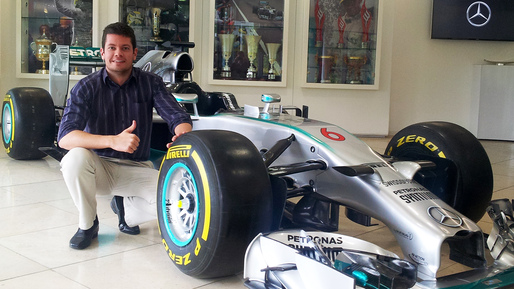
Lee Stretch
Vehicles Dynamic Engineer at Ferrari
Meet Lee Stretch who has achieved great success in motorsport engineering since graduating in 2011. He currently works as a Vehicles Dynamic Engineer for Ferrari's Formula One team.
Facilities and experience
Lee made his decision to study at the University of Hertfordshire when he attended an open day, which included a visit to the Formula Student automotive workshop. 'The students had designed and built a single seat racing car which they raced against other universities. It blew me away!' His love of Formula Student became the catalyst for where he is today.
Lee felt the course itself was well rounded, covering all aspects of engineering, with a focus on design, which he enjoyed. Crucial moments of Lee's studies, from submitting his final year project, to designing a racing car in parallel with his full-time sandwich year job, taught him what is possible with determination, and a deadline.
This culminated in second place at Formula Student Germany - the best result ever for a UK team. 'Without these experiences, perhaps I wouldn't have had the guts to move to Italy.' He says, 'I've applied so many of the topics I studied at Herts to my career at Formula One. I regularly find myself reaching for my student notes from five years ago!'
Exciting career
After graduating, Lee worked with Mercedes GP as a Performance Simulation Engineer where he worked with some of the most sophisticated lap simulation tools in the industry. 'It was a very hard three years at Mercedes but equally rewarding, with the 2014 World Championship being the icing on the cake.'
Lee's passion and commitment was recognised by the only other team that he would have considered moving to - Ferrari. Lee moved to Italy and spent time learning Italian. After only six months in the role, he had contributed to the next year's cooling system, and developed the team's lap simulation tools.
Despite working in a relatively specialised group of vehicle performance, Lee's role demanded sound mechanical understanding, thermodynamics, practical design considerations and even pure mathematics in simulation. 'Communication is paramount, so all the report writing, presentation and team working skills necessary in the final two years of my degree have proved hugely beneficial.'
Since then, Lee has decided he wants to explore something new. He says, ‘Haas F1 offered me an opportunity to lead an Advanced Simulation team, harnessing my experience to expand the capabilities of their Vehicle Science Group. I'm now creating specialised tools for studying car performance and being fully prepared for the new 2026 regulations.’
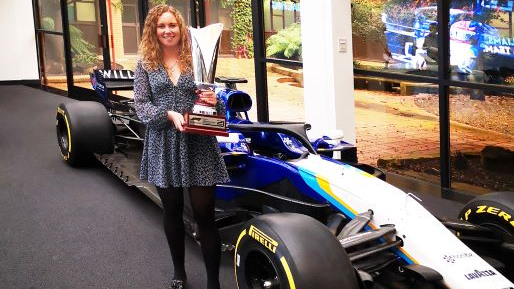
Katie Dobson
Aerodynamic Design Engineer at Williams Formula 1 team
Katie knew that she wanted to pursue a career in Motor Sport and saw the course at Herts as the perfect pathway to follow her dream.
She is currently an Aerodynamic Design Engineer with the Williams Formula 1 team and explains a bit more about her role and what it entails, ‘I was lucky enough to join Williams F1 as a Junior Aerodynamic Design engineer after completing my MEng in Automotive Engineering with Motorsport at Herts.
My role involves designing mechanical and aerodynamic components for the wind tunnel. I lead the research and development for the wind tunnel front wing design and work closely with the aerodynamicists to improve design concepts and make wind tunnel tests as streamlined as possible.’
Working in Formula 1
Katie really enjoys the challenge of the role and the industry which is fast-paced on all fronts.
‘Working in Formula 1 is very enjoyable and very rewarding when you see results on the track. Seeing Williams back on the podium and scoring points again in 2021 were particular highlights.
I also enjoy the fast-paced environment and continual research and development required to keep up with technology and rules changes.’.
Why Herts
Katie chose to study at Herts because she was impressed with the large range of studies provided by the Engineering department and the range of facilities which provided crucial hands-on experience to work in industry. She adds, ‘I was particularly impressed with the extra-curricular groups and studies provided by Herts such as the Formula Student team.’
When she talks about the best part of her course she says, ‘It was being able to apply what I had learnt during my A-Levels to further my knowledge of engineering and the knowledge and enthusiasm my lecturers had to further my studies.'
Formula Student
Knowing that hands on practical experience is so important in the industry Katie became a member of the successful Formula Student team at Herts. She is certain that it helped when it came to her career and says, 'Participating in Formula Student particularly aided my ability to gain my current role in industry.
It was able to provide me with this expertise and allow me to broaden my field of study outside of the classroom or lecture hall.’
Favourite memories
Unsurprisingly Katie’s best memories revolve around her experience with the Formula Student Team and the success on and off the track.
‘My favourite memories at Herts were the times spent designing and manufacturing UH19 and UH20 with great friends. My favourite of them being completing at FSUK, FS Czech and FS Germany with the most successful UH FS car of all time as well as winning design at both the UK and Czech competitions.’
The future
Katie has set her sights high when it comes to the future and what it could bring. ‘My future plans are to advance my career further in motorsport, and to hopefully win a Drivers and Constructors Championship in F1.’
Find out more about the Formula Student Team
If you have a great story like Katie's, please contact us!
What you'll study
Motorsport is not just exciting, it provides a proving ground for young engineers to innovate at the highest level. The competitiveness of the sport drives engineers to conceive creative ideas and take advantage of recent developments in technology. The motorsport engineering degree will give you the combination of skills necessary to strive in this fast-paced, highly competitive industry.
In your first year, you will gain a strong foundation in the fundamental principles of engineering and motorsport. You will study core modules in mathematics and modelling, statics, thermofluids, and engineering fundamentals, while being introduced to computer-aided design (CAD) and dynamics and systems modelling. You will also explore the fundamentals of automotive and motorsport engineering, learning how vehicles are designed, built, and tested. Through Applied Design (CDIO) and Electrical and Electronics (CDIO) projects, you will begin developing practical design, teamwork, and problem-solving skills essential for modern motorsport engineers.
In your second year, you will build on your technical foundation and begin applying engineering science to real-world motorsport challenges. You will develop your understanding of materials, aerodynamics, thermodynamics, and computer-aided engineering, while learning programming and control systems relevant to vehicle performance and automation. Through group and individual projects—including Motorsport Design (CDIO) and Electronics and Control Systems (CDIO)—you will gain valuable experience in the design, testing, and optimisation of vehicle systems.
In your third year, you will focus on advanced and specialised aspects of motorsport engineering, including race car vehicle dynamics, motorsport powertrain, and motorsport engineering. You will apply your accumulated knowledge and skills to an individual project, which may involve experimental testing, simulation, or design of a motorsport system.
You can also tailor your studies through optional modules that allow you to deepen your expertise in areas such as advanced motorsport design, business of motorsport, motorsport structures, or advanced materials and manufacturing. Throughout this year, emphasis is placed on professional practice, teamwork, and communication, preparing you for careers in motorsport, automotive design, performance engineering, or related fields
In your final year of study (4th or 5th year), you’ll explore advanced and industry-focused topics that reflect the latest developments in motorsport engineering. You’ll build your expertise in system design and optimisation, using professional simulation and analysis tools to model, test and refine complex vehicle systems. This year also focuses on innovation, sustainability and leadership—preparing you to take on senior technical or management roles within the motorsport and high-performance engineering sectors.
What if I need support?
You’ll have a personal tutor to guide you throughout your course, all the way to graduation. If you need additional support during your time with us, rest assured that we’ve got you covered. For help with study skills, including referencing, essay writing and presentations, you’ll have access to our academic support services. You can attend workshops, 1-to-1 sessions and online tutorials. Both our LRCs run drop-in study skills sessions. And the best thing is, it’s all free.
Optional placement year
You’ll have the opportunity to develop key professional and teamwork skills through CDIO modules, helping you build the confidence, communication, and problem-solving abilities valued by employers and essential for successful work placements.
Graduate with invaluable work experience alongside your degree and stand out from the crowd. This course offers you the opportunity to enhance your study and CV with a year in industry, typically between your second and third years of study. It’s a chance to explore career possibilities, make valuable contacts and gain sought after professional skills.
Research shows that over 70% of employers prefer students with work experience, which is why we believe work placements are career gold. Our Careers and Employment Team is here to support you as you explore your options and make valuable contacts for your future career. Students have previously undertaken placements in organisations such as:
- Multimatic
- Rolls-Royce
- Mercedes High Performance Powertrains
- Toyota
- Safety Devices
- Cummins
- Williams Racing
You’ll pay no tuition fee for this year and won’t need to worry about the details of your placement until your second year of study.
An opportunity for an amazing experience, which will help make you stand out from the crowd. With more and more companies working internationally, experience of living in another country can make a great impression on future employers.
This automotive engineering with motorsport degree offers you the opportunity to enhance your study and CV with a sandwich year abroad. The University has partnerships with over 150 universities around the world, including the USA, Canada, Asia, Africa, Australia, South America and closer to home in Europe.
If you study abroad between your second and third year of study, you’ll pay no tuition fee to the partner university and no tuition fee to us either. We’ll ask you to make your decision in your second year, so there is plenty of time to think about it.
You’ll have the opportunity to develop key professional and teamwork skills through CDIO modules, helping you build the confidence, communication, and problem-solving abilities valued by employers and essential for successful work placements.
Graduate with invaluable work experience alongside your degree and stand out from the crowd. This course offers you the opportunity to enhance your study and CV with a year in industry, typically between your second and third years of study. It’s a chance to explore career possibilities, make valuable contacts and gain sought after professional skills.
Research shows that over 70% of employers prefer students with work experience, which is why we believe work placements are career gold. Our Careers and Employment Team is here to support you as you explore your options and make valuable contacts for your future career. Students have previously undertaken placements in organisations such as:
- Multimatic
- Rolls-Royce
- Mercedes High Performance Powertrains
- Toyota
- Safety Devices
- Cummins
- Williams Racing
You’ll pay no tuition fee for this year and won’t need to worry about the details of your placement until your second year of study.
An opportunity for an amazing experience, which will help make you stand out from the crowd. With more and more companies working internationally, experience of living in another country can make a great impression on future employers.
This automotive engineering with motorsport degree offers you the opportunity to enhance your study and CV with a sandwich year abroad. The University has partnerships with over 150 universities around the world, including the USA, Canada, Asia, Africa, Australia, South America and closer to home in Europe.
If you study abroad between your second and third year of study, you’ll pay no tuition fee to the partner university and no tuition fee to us either. We’ll ask you to make your decision in your second year, so there is plenty of time to think about it.
Where you'll study
Your main campus is College Lane, this is where the creative arts, science and health-related subjects are based. This means you’ll share the campus with future nurses, doctors, scientists, artists and more. You can use the common rooms to relax with friends, work out in the 24-hour gym or have a drink in our on-campus cafes. We also have restaurants for you to eat in or grab something on the go. Our Learning Resources Centres are open 24/7, which means you can study whenever suits you best. Want to pop over to the other campus? You can take the free shuttle bus or walk there in just 15 minutes.
Learn in our new state-of-the-art building called Spectra, where you’ll experience a range of experiential learning zones. You will have access to modelling, simulation and research labs, our Racing Simulator and automotive workshop (complete with electric vehicle facility), wind tunnels, welding bay and controls testing suite. Specialist facilities include Q-Cars (QCar – Quanser systems), as well as engine test cells, and an electric motor test bench for hands-on experimentation and performance analysis.
Spectra also provides space to collaborate, with plenty of workshops, social and meeting spaces available. Even better, the building has been designed with the University’s net zero carbon target in mind, and forms part of our plan to replace or upgrade older sites that are energy inefficient.
Who you'll learn from
The School has a reputation for innovation in teaching and learning with most modules delivered through a combination of traditional face to face teaching and distance learning through the university's StudyNet web based facility. StudyNet allows students to access electronic learning resources, electronic discussion with staff and other students, and, for some modules, submit coursework 24/7 from anywhere in the world! With a heavy emphasis on Computer Aided Engineering, the school has a policy of using industrial standard software wherever possible. The school also operate an open access laboratory policy of when possible students doing experiments in their own time.
You will be taught by our team of highly qualified academics, experienced in the field of automotive engineering. Additionally, you will have access to an academic support team, a well-being team, and a personal tutor who will help you navigate university learning and living. Working together, your teaching and support team is committed to assisting you in realising and achieving your full potential.
Check out our student blogs
How we support our students
At the University of Hertfordshire, we want to make sure your time studying with us is as stress-free and rewarding as possible.
We offer a range of support services, from childcare to counselling, ensuring that you make the most of your time at Herts and can focus on studying, having fun, and have the support you need.
Student Blogs
Dobromir - Week at a glance
My week at a glance
Hello! This is what a typical week looks like for me as a student at the University of Hertfordshire!
At first, as a newly arrived second-year student, my week schedule was chaotic but trust me, once three or four weeks of the semester have passed you will have already got used to the pace and will have developed at least a basic schedule for your week, as I did. For me, it is all about the balance between university, part-time work, and social life.
Monday
On Mondays, as I have a part-time job, I usually go to work in the morning until lunch and then head back to university for two hours of face-to-face teaching in the early afternoon. After I finish lectures, I dedicate my late afternoon to revisiting lecture notes and working on assignments, sometimes ahead of their time, to avoid falling behind. My evening is usually spent in the gym and then resting.
Tuesday
Tuesdays are quite hectic for me, as I am out from 09:00 to 20:00. I spend the first half of my day at lectures and, after a short break in the afternoon, I head to work and stay there until 20:00. As you can expect, after such a long and exhausting day, all I can do when I’m back home is just to relax and get some good sleep.
Wednesday
My Wednesdays are flipped Mondays, since I go to lectures in the morning, refresh and then head to work, where I spend my afternoon. At evening time, I go through and catch up on lecture and tutorial notes, if I have missed something, and work on assignments. In Engineering, most projects require you to work in a group with other fellow students. The Learning Resource Centre (LRC) is where you will work on group projects as it is most convenient for gathering people. The environment is very relaxing and much of the time is spent chatting and having fun, so be ready to spend a substantial part of your time in the LRC!
Thursday
My whole Thursdays are spent at university as I have lectures from 09:00 to 18:00 and I am keen on attending all of them. Don’t get intimidated, there are regular breaks between lectures that give students more than enough time to refresh! As you can imagine, after my last lecture, I would rather do some exercise, so I will go to the gym and let go of excessive energy.
Friday
On Fridays, as my schedule is quite free, I take my time in the morning to meet up with fellow students and work on assignments. Getting through afternoon lectures is easy and feels like it happens instantaneously as everyone is excited about the end of the work week and wants to go out. And, as you can expect, that is exactly what happens on a Friday afternoon. I go out for a walk with friends, if the weather is nice, and in the evening, we go to a pub and celebrate the end of the work week.
Saturday
I value my free time and for that exact reason, I spend the first half of my Saturday studying and working on assignments. I avoid distractions, as the sooner, I finish, the sooner I will be able to go out and have fun. Afternoon time is usually spent shopping, going to a café with friends or at the gym
Sunday
My Sundays are almost identical to my Saturdays with the only difference that at evening I take 30 minutes, sometimes even less, to check my progress with my assignments, make sure I don’t miss any deadlines and plan out a schedule for the upcoming week. Then it is time for a good recharge before the week starts.
At first, all the things you must do as a student sound like a lot to handle, but, trust me, it will all come naturally, and you will eventually learn to handle your tasks with ease!
Things you need to know before studying Engineering at Herts
Preparation
When you arrive at university, you will be overwhelmed with many emotions: some students get excited about all the new people they are about to meet, others feel intimidated by the new environment. Regardless of how you feel, try not to compare university to anything you have experienced before. I have already gone through this stage and I can tell you that university life is differs a lot from anything I have experienced so far. If you feel nervous, know that you are not alone. You are on the same boat with more than 1500 other newly arrived students, so just open yourself up for this new opportunity and go out and speak to people. You won’t believe how easy it is to make friends, especially during Fresher’s Week and at The Forum.
Qualifications
Many people believe that you can only be a good Engineering student if you have taken A-Levels in Mathematics, but you will be pleased to hear that this is not true. I graduated from high school with a diploma in foreign languages and my knowledge in mathematics has always been average. Nevertheless, my performance in all mathematics and mathematics related modules in university has been excellent so far. The teaching staff is so good and there is so much support at uni, that you can rest assured you will receive the best help you can get if you struggle with studies.
Reading
As a student in engineering, you will not be required to read too many articles or books. Do not get me wrong, there will be a lot of work and you will really have to put effort into studying if you want to have good grades. For most of the time, you will be working on various software programs, you will spend a good portion of your time in laboratories and at the Learning Resource Centre (LRC) and you will also, depending on how good you are at maths, have to invest some or a lot of your time into solving exercises. Group projects are also an essential part of your experience at university.
Assignments
The nature of a job as an engineer in almost any company requires you to work well in a team. University is really good at preparing you for that and therefore most of your assignments will require you to work well in a team. Some people are naturally good at that, others, like me, are not that good at it, but you will learn fairly quickly. Be prepared to spend the majority of your time working on assignments with fellow students. The environment is really relaxing and, often times, working together is so fun that you don’t notice how time flies.
Assessments
In engineering, you will be assessed mostly through group or individual assignments, practical lab works and exams. The ways of assessing you are very similar to how your performance at a company will be assessed: some of them test your ability to work in a group and others test your performance under pressure. Either way, every type of assessment has benefits that will prepare you for a career as an engineer.
Time Management
Managing your time wisely is crucial for succeeding at university and later on in life. So, a piece of advice I could give to you would be to learn to regularly check your schedule and plan out your activities at least a week in advance. It’s very helpful that you can download the lecture timetable on your mobile device and easily keep track of your engagements and work other activities around them.
Student Blogs
Dobromir - Things you should know
Things you need to know before studying Engineering at Herts
Hello! I am a second-year student in Automotive Engineering with Motorsport and in this guide, I will give you the basics you need to know about before you start studying at university!
Preparation
When you arrive at university, you will be overwhelmed with many emotions: some students get excited about all the new people they are about to meet, others feel intimidated by the new environment. Regardless of how you feel, try not to compare university to anything you have experienced before. I have already gone through this stage and I can tell you that university life differs a lot from anything I have experienced so far. If you feel nervous, know that you are not alone. You are on the same boat with more than 1500 other newly arrived students, so just open yourself up for this new opportunity and go out and speak to people. You won’t believe how easy it is to make friends, especially during Fresher’s Week and at The Forum.
Qualifications
Many people believe that you can only be a good Engineering student if you have taken A-Levels in Mathematics, but you will be pleased to hear that this is not true. I graduated from high school with a diploma in foreign languages and my knowledge in mathematics has always been average. Nevertheless, my performance in all mathematics and mathematics-related modules in university has been excellent so far. The teaching staff is so good and there is so much support at university, that you can rest assured you will receive the best help you can get if you struggle with studies.
Reading
As a student in engineering, you will not be required to read too many articles or books. Do not get me wrong, there will be a lot of work and you will really have to put effort into studying if you want to have good grades. For most of the time, you will be working on various software programs, you will spend a good portion of your time in laboratories and at the Learning Resource Centre (LRC) and you will also, depending on how good you are at maths, have to invest some or a lot of your time into solving exercises. Group projects are also an essential part of your experience at university.
Assignments
The nature of a job as an engineer in almost any company requires you to work well in a team. University is really good at preparing you for that and therefore most of your assignments will require you to work well in a team. Some people are naturally good at that, others, like me, are not that good at it, but you will learn fairly quickly. Be prepared to spend the majority of your time working on assignments with fellow students. The environment is really relaxing and, often, working together is so fun that you don’t notice how time flies.
Assessments
In engineering, you will be assessed mostly through group or individual assignments, practical lab works and exams. The ways of assessing you are very similar to how your performance at a company will be assessed: some of them test your ability to work in a group and others test your performance under pressure. Either way, every type of assessment has benefits that will prepare you for a career as an engineer.
Time Management
Managing your time wisely is crucial for succeeding at university and later on in life. So, a piece of advice I could give to you would be to learn to regularly check your schedule and plan out your activities at least a week in advance. It’s very helpful that you can download the lecture timetable on your mobile device and easily keep track of your engagements and work other activities around them.
Student Blogs
Dobromir - Guide to the facilities
Guide to the Engineering facilities
Hello! This is my guide to all engineering facilities, how I use them and how you can benefit from them.
As an engineering student, you will spend most of your time on College Lane Campus, like lectures, tutorials, practical lab works, and assessments are all held at the School of Engineering and Technology. There are plenty of facilities available to you, however, speaking from personal experience, I can tell you that the one you will use the most will be the Learning Resource Centre (LRC).
Learning Resource Centres (LRCs)
Most of the modules will not require you to read too many articles or books other than the ones you already use in class. However, you will have a lot of assignments that consist of working on a project in a group with other fellow students. There is one LRC on College Lane Campus and another one on de Havilland Campus. Both LRCs have study rooms with projectors and desks, which make them very convenient for group gatherings. Both LRCs are identical, and you will use the one that is closer to your accommodation, regardless if it is on-campus or off-campus. If you, for any reason, wish to go to the LRC located further away from you, there is a shuttle bus that can take you from one campus to the other in less than five minutes. If the weather is nice and you wish to walk instead of taking the bus, it’ll take you less than 15 minutes to get from one campus to the other.
The LRCs have many computers, equipped with all software you use in class, and there are laptops for loan. There are study rooms you can book, especially useful for group gatherings, there are desks you can study at, or if you prefer silence, the last floor of each LRC is for silence study. If you study better at complete isolation, there are silent rooms, designed for just a single person (they are perfect if you don’t want to get distracted by anything). If you want to take a break, each library has a café, which offers a range of snacks, as well as coffee.
Online Library
If you prefer to stay home, instead of going to the LRC, the online library is a perfect option for you. You can access the University’s online library, where you can find any book that you can otherwise find at the LRC. Most books related to engineering have online copies available, so if you feel more comfortable studying at the comfort of your home, rest assured you can do so.
Support
During your studies at university, you can be sure that there will always be dedicated support at your disposal. As an engineering student, you will have several modules in mathematics and if that is something you struggle with, you can always use the Math’s support service, which is found at College Lane LRC. In addition to that, you can always speak to your lecturers in class or after class, or you can email or go to a drop-in session, if necessary. Same goes for all other modules as well, no lecturer will ever send you back. In fact, they may invite you to attend their drop-in session, where they will have a better opportunity to help you.
In terms of preparing yourself for starting and developing a successful career as an engineer, or if you want to get a part-time job, you will need to write a perfect CV (Curriculum Vitae) that will make you stand out from the others. For this purpose, you can use the Careers and employability service, where you will get advice and help from professionals in the branch. You can book a session, during which you will be able to discuss you CV and Cover Letter, if you wish to apply for a placement or a graduate scheme, and get advice on how to improve them.
Entry requirements
The University of Hertfordshire is committed to welcoming students with a wide range of qualifications and levels of experience. The entry requirements listed on the course pages provide a guide to the minimum level of qualifications needed to study each course. However, we have a flexible approach to admissions and each application will be considered on an individual basis.
| Typical offer (UCAS points) | 128 |
|---|---|
| Typical A Level offer | ABB Mandatory subjects: Excluded subjects: General Studies, Critical Thinking |
| Typical IB offer | 128 UCAS points from a minimum of three HL subjects at grade 5 or above to include HL Mathematics |
| Typical BTEC offer | DDM Mandatory subjects: Extended Diploma in Engineering to include merit in a Mathematics unit and Principles at Level 3 |
| Typical T Level offer | None |
| GCSE | Grade 4/C in English Language and 4/C in Mathematics. |
| Access courses | Not accepted |
| Additional information | Find out more about our standard and contextual Undergraduate Entry Requirements. |
| English language | All students from non-majority English speaking countries require proof of English language proficiency, equivalent to an overall IELTS of 6.0 with no less than 5.5 in any band or equivalent. If you do not have the required IELTS or equivalent for direct entry on to your degree programme, our Pre-sessional English and International Foundation courses can help you to achieve this level. |
|---|---|
| Additional information | Find out more about International Entry Requirements. |
Ready to apply?
UK and EU applicants with pre-settled/settled status in the UK
| Start date | Study type | Apply |
|---|---|---|
| September 2027 | Full time | Apply via UCAS |
| Full time with placement year | Apply via UCAS | |
| Full time with study abroad year | Apply via UCAS |
International and EU applicants without pre-settled status in the UK
Apply through Clearing


Our Clearing hotline is open for support, Monday - Thursday 9.00-16.45 and Friday 9.00-15.45. You can apply online at any time.
Fees and funding
At Herts, we’re dedicated to providing world-class teaching supported by industry-level facilities and incredible social spaces. We believe cost shouldn’t be a barrier to higher education, and we strive to keep both our standard and additional costs as low as possible.
| Study type | Fees | |
|---|---|---|
| UK students | Full time | £10,050 for the 2027/2028 academic year |
| EU students | Full time | £17,970 for the 2027/2028 academic year |
| International students | Full time | £17,970 for the 2027/2028 academic year |
Tuition fees are charged annually. The fees quoted above are for the specified year(s) only. Fees may be higher in future years, for both new and continuing students. Please see the University’s Fees and Finance Policy (and in particular the section headed “When tuition fees change”), for further information about when and by how much the University may increase its fees for future years.
| Scholarships, grants and bursaries | Depending on your circumstances, you may be eligible for a non-repayable scholarship, grant or bursary to support your studies. |
|---|---|
| Disabled Students' Allowance | The Disabled Students’ Allowance can cover any study-related costs you have because of a mental health problem, long term illness or any other disability. |
| Student loans | Find out about securing a student loan, from how much you could be eligible for to when you need to start making repayments. |
| Accommodation costs | We offer a great choice of student accommodation, on campus or nearby in the local area, to suit every student budget. |
| Additional course fees | Read more about additional fees in the Programme Specification. |
More about the course
| Programme specifications | |
|---|---|
| MEng (Hons) Motorsport Engineering with Placement Year - Full Time, Sem A | Download PDF |
| PEAU - MEng (Hons) Motorsport Engineering with Study Abroad - Full Time, Sem A | Download PDF |
| PEAU - MEng (Hons) Motorsport Engineering with a Year Abroad - Full Time, Sem A | Download PDF |
| PEAU - MEng (Hons) Motorsport Engineering - Full Time, Sem A | Download PDF |
| PEAU - MEng (Hons) Motorsport Engineering with a Year Abroad (Full Time, Semester A Intake) 2026-27 | Download PDF |
| Additional information | |
|---|---|
|
Applications open to international and EU students |
Yes |
Course length |
Full Time, 4 YearsSandwich, 5 Years |