


Sign up for updates
Interested in studying at the University of Hertfordshire and want to sign up to our mailing list to learn more about our facilities, living in the UK and student life? Use the form below and our team will also keep you informed of key updates such as events near you, applications opening and more!
MA Interior Architecture and Design
Why choose Herts?
- Employment Prospects: Graduates work as interior and spatial designers, as well as design specialists for organisations including The National Gallery and Aston Martin.
- Industry-Related Learning: Graduates have previously gained experience working within firms such as Yoo, Aston Martin and The National Gallery.
- Strong Industry Connections: You will have excellent networking opportunities with organisations including Zaha Hadid and Foster and Partners.

Alumni Stories
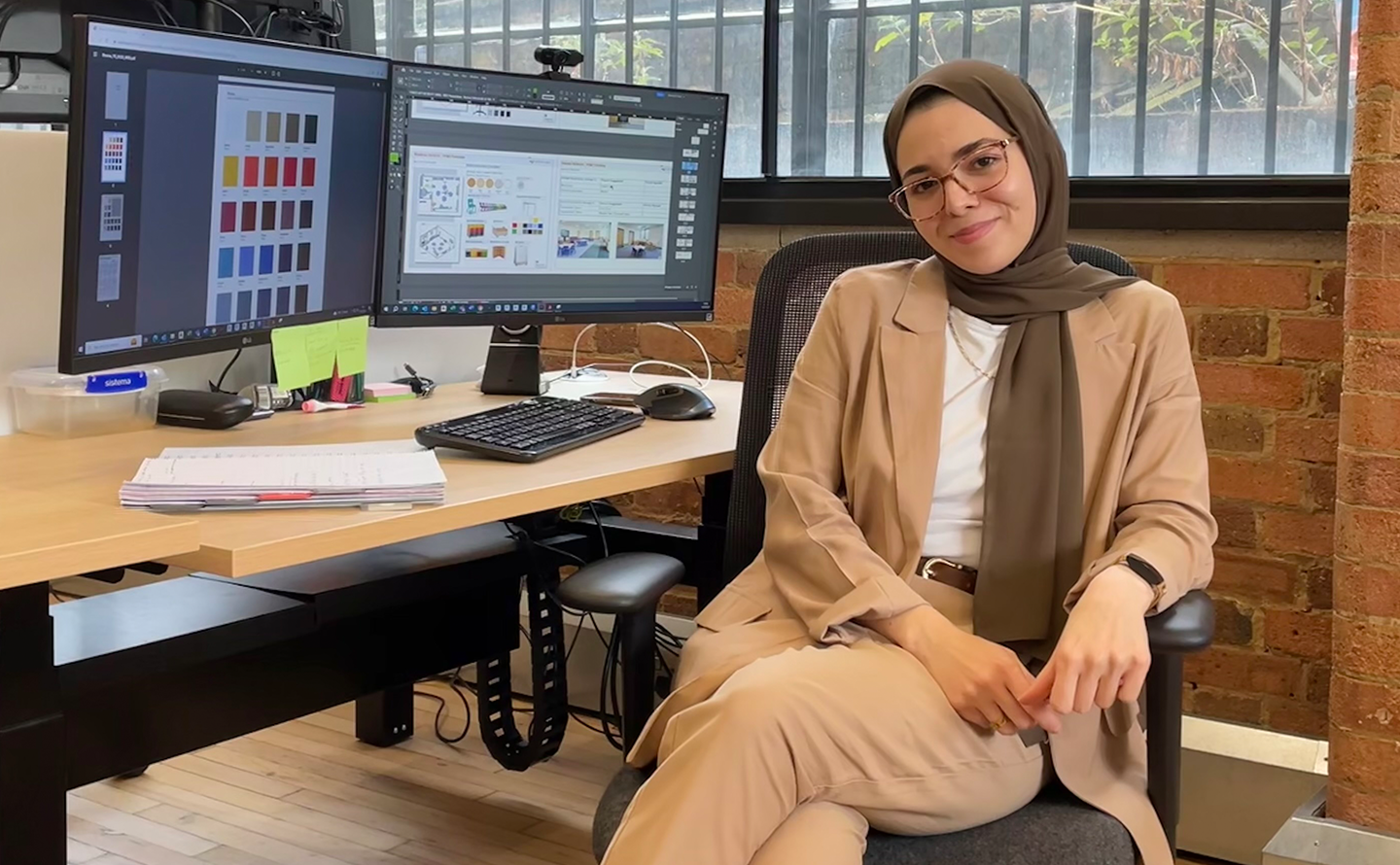
Kiymet Shevket
Meet Kiymet. The onset of the COVID-19 pandemic encouraged Kiymet to refocus her career plans and she decided to study a postgraduate degree at Herts. She is now working for a world-renowned architecture studio in London.
| Current job role | Workplace Consultant for a world-renowned architecture studio |
|---|---|
| Year of graduation | 2022 |
| Course of study | MA Interior Architecture and Design |

Making an impact
Kiymet had previously thought of becoming an interior designer, but the COVID-19 pandemic encouraged her to reassess her interests and skillset. ‘I was always more interested in research and the digital tools that could be used to understand a user’s needs better before implementing them into a design proposal.' So, Kiymet decided to refocus her career plans and chose to study a postgraduate degree at Herts.
Kiymet adds, ‘I wanted to learn more about entrepreneurship, and apply findings of neuroarchitecture and environmental psychology to various projects in an innovative way. The course covered these aspects, and the University’s values also aligned with my own. I knew Herts would help me make an impact on the industry.’
Developing leadership skills
Kiymet also wanted to develop her leadership skills and Herts offered her plenty of opportunities to do so. She became a Student Representative for her course and took several classes on our Student Leaders Development Programme. Kiymet adds, ‘Herts allowed me to pursue my goals, and the support I received from my tutors and peers was one of the best parts of my experience there. The campus is a beautiful place to study too!’
Her advice
Kiymet is now a Workplace Consultant at a world-renowned architecture practice in London.
Her advice for those looking to follow in her footsteps is, ‘Find your niche whilst you are a student and then tailor your portfolio to highlight it. You can make the most out of the opportunities you receive at Herts by tailoring your design proposals, essay questions, and Go Herts Award submission to align with what you want to do. Being able to show this to an employer is much more powerful than just talking about it.’
Alumni Stories
Beyza Kayali
Meet Beyza. After completing an undergraduate degree at Herts, Beyza found her first role through the University’s online careers platform. To power her development, she has chosen to complete her postgraduate degree at Herts too.
| Current job role | Furniture, Fixtures, and Equipment (FF&E) Interior Designer at a central London design company |
|---|---|
| Year of graduation | 2021 |
| Course of study | BA (Hons) Interior Architecture and Design |
Choosing Herts
Beyza’s brother inspired her to study at Herts. He had already chosen a course here, and the School of Creative Arts’ strong international reputation persuaded her to apply to Herts too. Beyza adds, ‘The University is very diverse, and this was an important factor for me choosing to study here.’
Earning a Go Herts Award
Beyza found her course challenging, but interesting to study. She also built strong relationships with her tutors.
Some of her favourite memories from Herts were spending every day during her final assignments in the University’s Learning Resources Centres with friends, and the deep conversations they used to have when they had group assignments together.
She also became a Student Representative for her course in her second year and then went on to become a School Community Organiser for the School of Creative Arts in her final year. Beyza also contributed to the School of Creative Arts’ Student Society. She says, ‘All my voluntary roles and extra-curricular activities counted towards my Gold Go Herts Award, and they were something I enjoyed doing too. The award was just a nice bonus!’
Becoming an interior designer
Beyza is now an FF&E Interior Designer for a London-based design company. She says, ‘My course prepared me well for this role, from learning certain types of software, to how to create design schedules.’
Beyza found her first job after Herts through Handshake, the University’s online careers platform. She adds, ‘My first job after graduating was at a construction company in Hatfield, not far from the University’s campus. I made great connections there and learnt a lot.’
Her ambition is to become an experienced Senior Designer, who can make her mark on the industry through her sustainable creations. To achieve her goals, she has started studying MA Interior Architecture and Design part-time at Herts, where she is able to explore the topic of sustainability in design and construction further.
Her advice to current and future Herts students is to, ‘Take it easy and enjoy your time at Herts. Stay in touch with your tutors too, as they may have great connections for your future work!’
About the course
On the MA Interior Architecture and Design degree you'll:
- develop your professional skills
- work with design professionals of international standing and in industrial contexts
- develop research skills
- exhibit your work and work as a tutor and mentor with our undergraduates
Why choose this course?
MA Interior Architecture and Design lies within the postgraduate design programme at the School of Creative Arts. Within the programme there is strong emphasis on professional practice and the real-world applications of art and design. You'll develop key research skills and gain a good understanding of the work of other practitioners in your field.
The aim of this postgraduate degree is to equip you with the skills, knowledge, and understanding required to practice at an advanced level, to foster your creativity and enhance your employment opportunities. You will work alongside artists and designers who are involved with a wide variety of media and forms and will benefit from visiting interior designers, architects, and design professionals. Induction, seminars, and social events for students and staff mean that you will be part of a friendly and supportive postgraduate community, which also includes film makers, musicians, and professionals working in new media. Senior research staff and internationally renowned artists work with postgraduate students, helping you to develop original and challenging work.
The MA Interior Architecture and Design degree will be of interest to interior and spatial designers, architects, and design professionals in related disciplines. It gives you a forum to explore a wide range of issues, including creative practice and the psychology of space as well as the use of materials, scale and form in the creation of private, commercial and public spaces.
Through working with a strong experimental ethos and developing solid technical skills, you will examine the connection between architecture and interior design and the creation of both real and virtual spaces.
Interior architecture and design have a dramatic impact on our understanding of the spaces in which we live and work. This course is dedicated to helping you advance your practice against the expanding profile of this subject area.
What will I study?
The MA Interior Architecture and Design will develop your professional skills. It is designed to help you develop your practice and give you the skills recovery to further your career in industry both in the UK and abroad. The course includes practice based modules where you will explore and develop your work as a interior designer. It also contains course or research skills, entrepreneurialism and professional practice. The final part of the course enables you to complete a major project.
Key staff
Giuseppina Giuffrida
Programme Leader PG Design
Find out more about Giuseppina Giuffrida
Further course information
| Programme specifications | |
|---|---|
| MA Interior Architecture and Design - Part Time, Sem A | Download |
| MA Interior Architecture and Design - Full Time, Sem A | Download |
| Additional information | |
|---|---|
Sandwich placement or study abroad year |
n/a |
Applications open to international and EU students |
Yes |
Student experience
At the University of Hertfordshire, we want to make sure your time studying with us is as stress-free and rewarding as possible. We offer a range of support services including; student wellbeing, academic support, accommodation and childcare to ensure that you make the most of your time at Herts and can focus on studying and having fun.

Student Blogs
Tyffane - MA Design Student Letter
Welcome to the MA Design Programme at University of Hertfordshire
Hi, new student!
Congratulations on being accepted into this programme! My name is Tyffane, I am a MA Graphic Design and Branding student, and I will be sharing my experience on the course so far. When I started this course, I was unsure of my career path within the creative industries, but I planned on working towards becoming a creative director. Now, midway through the year, I have encountered so many new areas of interest, from emotional design to branding to neuroarchitecture. That’s what is great about this course, that you might not know what you want to do, but no matter what, you start to find your place soon enough.
So, what is it like to be a postgraduate design student?
First of all, your classes. Most of your classes will occur in the same room. Students from all three courses, MA Interior Architecture and Design, MA Graphic Design and Branding, and Ma Illustration, will be working together for most of the first and second semesters. I found this very inspiring because everyone comes from different backgrounds and experiences to navigate this journey together. You will see each other grow and become the determined creatives you aspire to be.
The classroom offers you the opportunity to be very experimentative. Being practical and curious will help you achieve the most out of your course. You can learn new skills and develop a better picture of which skills to apply to your future aspirations, from storytelling and brand analysis to rendering and site analysis techniques. Not only will you be more practical, but you will also be more critical, meticulous, and receptive to the industry skills, methodologies, and current trends to apply to your career.
Design is about storytelling, visual communication, problem-solving, and knowing what your audience wants. An interdisciplinary collaboration with interior architects, graphic designers, illustrators, and possibly, non-creatives can provide a more open-minded approach to your studies. And, did you know, you could achieve all of this in our multi-award-winning course? From the internationally renowned Design and Art Direction Awards, also known as the D&AD Awards to the National Lighting Student Designer of the Year, this programme provides a rich environment to inspire students. We students at the School of Design and Creative Arts are so proud to uphold a strong reputation that recognises student success and dedication, and we hope to celebrate your achievements someday!
With that said, I’d like to give you a few tips on how to successfully learn more on this programme:
1. Analyse your briefs thoroughly
Ensuring you understand your assignment briefs and deliverables can help you get ahead. This means annotating the documents, sketching rough ideas, and brainstorming your next steps.
2. Ask questions
Design is very subjective. Sometimes, you might need another perspective to ensure you’re on the right track - and that’s okay. Make sure you engage with your tutors; try to write down several questions at the end of each lecture or tutorial so you can grasp your tasks and next steps. Get your advice, support, and guidance from your tutors, peers, and non-creatives, e.g. target audiences. It is also helpful to know who to ask for what. For example, knowing when to ask tutors about something you didn’t understand during the lecture or when to chat with peers for a second opinion. Asking the right questions will help to bring the right people to you.
3. Apply your studies to real life
Immersing your studies in your interests and daily life is an insightful way to stay on top of your work and achieve a better understanding of your tasks. You can use online tools, visit the Learning Resources Centre (the LRC) for physical resources, and book a workshop session for hands-on experimentation to bring your ideas and concepts to life. One good tip is to take weekly summaries and see how your ideas start to connect and iterate into fruition. Don’t be afraid to learn more. Your work will provide you with extensive practical, teamwork, and analytical skills to hone and apply to your career beyond university.
4. Time management
Start as soon as possible. Sometimes, things will not go as planned, and you will need to find a way to work around inconveniences accordingly. It is best to work bit by bit and learn what times of the day you are most productive, gradually building up your work schedule. Get the rough and early sketches out sooner so it is easier to filter out and execute your better and more thought-out ideas properly. You do not want to rush your iteration development process. Another helpful tip is to hold yourself accountable by regularly working with someone to brainstorm your ideas and next steps.
5. Socialise
Take time for yourself. Enjoy what the campus has to provide: from the weekly bakery stall treats to the vast variety of sports and societies to join! You’re not just here to study; the university offers you a lifestyle to prioritise your health and wellbeing when needed. With such a stimulating course, it is crucial to understand how to rest effectively. Sometimes, stepping away from the work can give you a new perspective! Why not take a stroll across the beautiful campus or indulge in the free Active student sessions provided by the sports village that offer various activities from beginner to advanced levels?
I encourage you to reach out whenever you need. The great thing about the University of Hertfordshire is that you are part of a community, where you don’t have to go through anything alone. Communicate with your tutors, your teammates and your peers; they will be willing to help! Within your cohort will be student representatives, who work with the Student Union to pass on course feedback to enhance your academic experiences and your personal tutors, who assist you with your personal and professional development. You can also access further support from a multitude of departments, whether you would like to focus on time management, academic skills, wellbeing, or disability support.
But most of all, enjoy your time here. I’m so excited for your journey! The work and effort will be worth it. I hope this helps you for a great year ahead!
Tyffane Aladeoni-Jimoh