BSc (Hons) Physiotherapy
A dynamic approach to learning and hands-on placement opportunities will equip you with the skills to become an accomplished physiotherapist. A solid knowledge base will see you thrive in a contemporary physiotherapy practice.

What type of applicant are you?


Sign up for Clearing VIP Access
Skip the queues on results day with an exclusive priority Clearing hotline number.
Get info and updates
Sign up for updates
Interested in studying at the University of Hertfordshire and want to sign up to our mailing list to learn more about our facilities, living in the UK and student life? Use the form below and our team will also keep you informed of key updates such as events near you, applications opening and more!
-
Typical offer: 128-136
Entry requirements -
Fees: £9,790 per year (UK)
Full details -
UCAS code: B160
-
Course length: Full time: three years
Find out more -
Location:
- University of Hertfordshire, Hatfield
-
Institute code: H36
NHS Learning Support Fund
- Training grants of at least £5,000 a year are available for eligible healthcare students which you will not have to pay back.
- You may also be eligible for an additional £2,000 towards childcare costs to help balance your studies with family life and £3,000 for students who find themselves in unforeseen financial hardship.

4th in the UK for physiotherapy (Guardian University Guide, 2026)

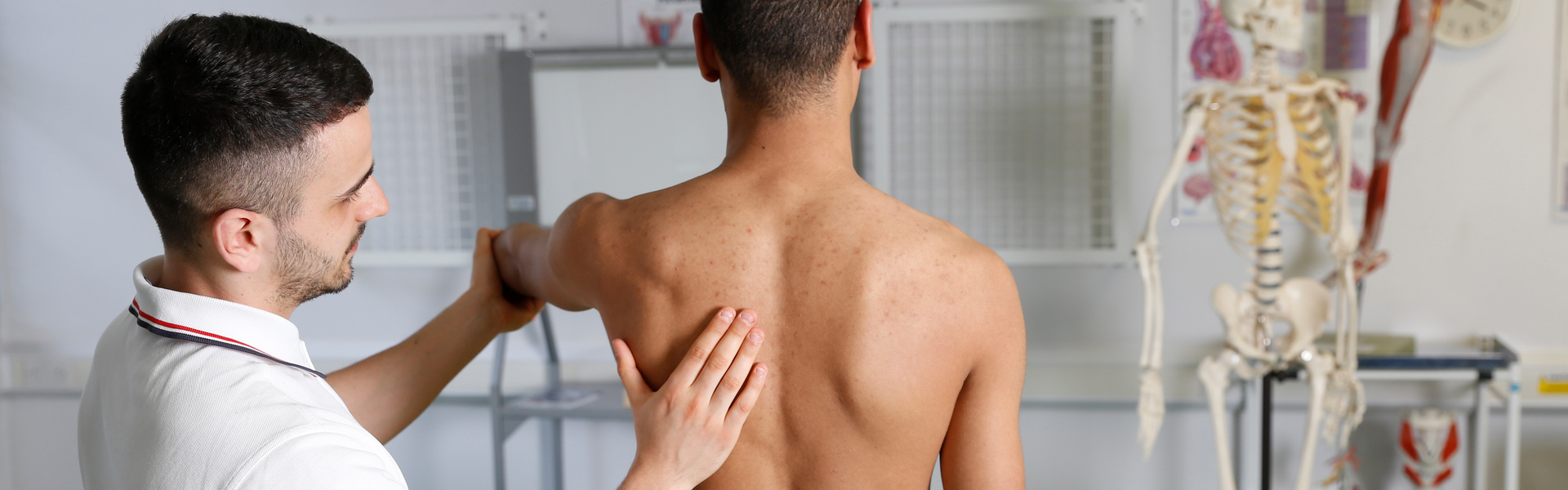
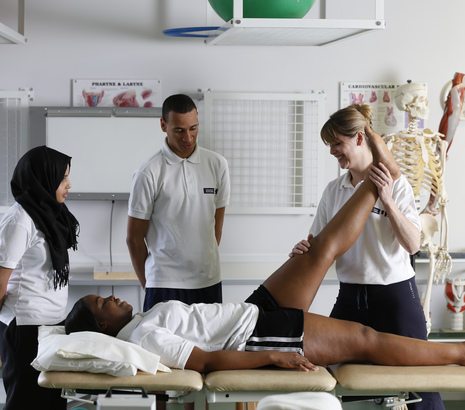
Learn clinical skills in specialist physiotherapy labs and simulation unit

Health and Care Professions Council (HCPC) and Chartered Society of Physiotherapy (CSP) approved
Course overview
A physiotherapy degree at Herts will equip you with essential knowledge and hands-on experience to become a proficient and contemporary physiotherapist. Designed for aspiring healthcare professionals, it covers critical topics such as anatomy, physiology, kinesiology, biomechanics, physiotherapy practice, and electrotherapy.
As a student on our physiotherapy course, you will engage in several practical placements. These opportunities will enable you to collaborate with other healthcare professionals, enhancing your interdisciplinary skills.
Why choose this course?
This BSc Physiotherapy degree will give you the knowledge and practical experience needed to succeed in a career within the healthcare profession.
Valuable work placements offer hands-on industry experience: You will typically complete a two-week practice placement in Semester A, followed by a four-week placement at the end of the first year in Semester C, both of which provide essential experience in real-world settings. In your second year, you can expect to undertake two six-week practice placements, and in your final year, you will complete two additional six-week placements, further enhancing your practical skills and professional network. These placements will allow you to connect the theoretical knowledge and practical skills learned in the university setting to real-life practice situations. During your placements, you will receive support, supervision, and education from highly qualified clinicians while maintaining links to tutors back at the university. Typically, you will be visited at least once during every placement to offer additional support and guidance as needed.
Strong employment prospects: Physiotherapy degree graduates are highly sought after, with 98% of Herts health and social care undergraduates in work or further study (Graduate Outcomes, 2024).¹
Access to excellent facilities: Your clinical practical skills will be refined in our specialised physiotherapy labs and custom simulation unit.
Professional accreditations
As a Herts graduate in physiotherapy, you will be eligible to apply for membership of the Chartered Society of Physiotherapy (CSP) and registration as a Physiotherapist with the Health and Care Professions Council (HCPC).
Your future career
As a graduate of the BSc (Hons) Physiotherapy course, you will have the opportunity to pursue a variety of professional career options within the NHS, as well as in the private, sports, fitness, independent, and charity sectors, both in the UK and overseas.
For more information you can visit the Chartered Society of Physiotherapy (CSP) website and the NHS Careers.
A physiotherapy graduate can specialise in roles such as:
- neurological physiotherapy
- respiratory physiotherapy
- cardiovascular physiotherapy
- musculoskeletal physiotherapy
- elderly care / frailty physiotherapy
- orthopaedic physiotherapy
- mental health physiotherapy
- sports physiotherapy
- paediatric physiotherapy
- academia / education
- research
A physiotherapy degree from Herts will equip you with the skills necessary to thrive in your future career. The combination of classroom learning and practical placements will provide you with a comprehensive foundation to excel in the field.
What you'll study
The three-year, full-time BSc Physiotherapy course offers a range of learning experiences through lectures, seminars, tutorials, and work placements.
In your first year, you will focus on the foundations for physiotherapy practice, covering anatomy, physiology, kinesiology, biomechanics, therapeutic practice, and electrotherapy.
You will continue to develop your practical skills throughout the course, with a scenario-based approach to learning and teaching. In year 2 you will build on what you have learnt during the previous year, as well as being introduced to complex patient care and research methods.
In your final year, research and inter-professional collaboration are essential. Practical skills are developed continuously throughout the course through a scenario-based approach to learning and teaching. This is supported by practical laboratory sessions, simulation exercises in the bespoke physiotherapy simulation unit, and small group discussions and tutorials.
What if I need support?
You will be assigned a personal tutor to guide you through your course all the way to graduation. If you need extra support during your time with us, rest assured that we’ve got you covered. Regardless of your field of study, you’ll have access to our academic support services for assistance with study skills, including referencing, essay writing, and presentations. You can participate in workshops, 1-1 sessions, and online tutorials. Both of our Learning Resource Centres (LRCs) offer drop-in study skills sessions, and the best part is that all of this support is free.
Where you'll study
Your main campus is College Lane. This is where the creative arts, science and health-related subjects are based. This means you’ll share the campus with future nurses, scientists, artists and more. You can use the common rooms to relax with friends, work out in the 24-hour gym or have a drink in our on-campus bar or cafes. We also have restaurants for you to eat in or grab something on the go. Our Learning Resources Centres are open 24/7, which means you can study whenever suits you best. Want to pop over to the other campus? You can take the free shuttle bus or walk there in just 15 minutes.
Check out our student blogs
How we support our students
At the University of Hertfordshire, we want to make sure your time studying with us is as stress-free and rewarding as possible.
We offer a range of support services, from childcare to counselling, ensuring that you make the most of your time at Herts and can focus on studying, having fun, and have the support you need.
Student Blogs
Jasmine - Week at a glance
My week at a glance
Hi and welcome to ‘My week at a glance’ studying Physiotherapy at the University of Hertfordshire!
So my ‘week at a glance’ has changed throughout all three years of Physiotherapy and also changes throughout the semester as when you are on placement your week is very different to when in lectures.
At the beginning of each week, I find it best to plan and organise my week to ensure I manage to get all of my work done but also have a work/life balance. Before practicals or lectures, there is usually prep work to be done which may be reading certain journal articles/ pages in books or watching videos. I try to do Monday's prep work on a Sunday evening, Tuesdays on a Monday evening and so on which means I can stay a day ahead throughout the week. This is also important for me as I really like my weekends to be free so I can relax, visit my family back home or see friends. I find printing off the lecture slides and reading them prior to the session can be helpful so you are aware of what content will be covered and can ask any questions you may have. They also become a particularly good revision resource.
Once completing the prep work, I then attend all my lectures, practicals and tutorials that I may have for my different modules. Lectures are completed with all Physiotherapy students within your year group while practical and tutorials are broken down into much smaller groups, usually about 10-15 people. A typical day may vary from 09:00-15:00 or may be 09:00-19:00, however on a Wednesday, lessons never run past 13:00 as it is sports afternoon. If you are into your sport this is great as you will most probably have matches/games but if you are not into sport this is a great afternoon to either catch up on any work or socialise with friends! The long days mean that time management is crucial!
Prior to assessments, I usually increase the amount of time that I spend completing University work and revising and I do start to complete University work and revision over the weekends. I like to make revision cards a few weeks before the assessments so that the week prior I can simply look over them and revise.
As I mentioned before, my week at a glance when out on placement is vastly different. The weekend before starting placement I will complete all the necessary paperwork and any pre-reading and work that the placement requires. If I have to stay away from Uni/ home for the placement as it is far away then I will pack everything up on Saturday and move into my new accommodation on Sunday to ensure I am ready to start on Monday. I find that placements can be tiring therefore during weekdays by the time I have completed placement, got home, completed any work required for the following day and had dinner…. I am so tired and need to go to bed. This means that any extra work I have such as extra reading, researching or University assignments usually get done on a weekend, however, I try to get these done as early as possible which then means I can focus on my placement only.
My time is also spent taking part in extra-curricular activities building up my CPD (Continued Professional Development) portfolio and CV (Curriculum Vitae). Activities to get involved in include: teaching anatomy sessions for younger years, the Superhero series, visiting the anatomy lab and listening to guest speakers, just to name a few.
Most evenings my time is split and spent both completing Uni work and playing a sport which, I find it a great stress relief and is also great for socialising. Aside from University work, I also have a few part-time jobs which allow me to earn some money but also build up some experience and skills. I usually work on Wednesday afternoons as a student ambassador for the University, two evenings a week umpiring netball matches and then one weekend a month as a sports massage therapist. This may seem a lot, but they are jobs I LOVE therefore it doesn’t feel like work for me!
Thank you for taking the time to read this blog and I wish you the best of luck!
Student Blogs
Jasmine - Things you should know
Things you need to know before studying Physiotherapy at Herts
Hello! My name is Jasmine and here’s my guide to what I think you should know before studying Physiotherapy at Herts!
Do your research and gain work experience
Many people have the belief that Physiotherapy is all about sports or massaging which is not the case. It is important that before applying for Physiotherapy you have researched what is included within the course, have some knowledge around the main components (Cardiorespiratory, Neuromusculoskeletal and Neuroscience) and know what you are getting yourself into! Gaining work experience is not only a requirement before applying for Physiotherapy but this will also give you an insight into what you may be doing once completing your degree and whether it is for you or not. (TOP TIP: Ensure you have had some work experience within the NHS, whether it be working as a rehabilitation assistant or as a work experience student).
Hard work and perseverance
As many of you may have already been told, physiotherapy is HARD WORK!! It is NOT a course for those who do not want to put in the work as it can be very stressful, time-consuming and at times can be emotionally draining BUT it is extremely rewarding when you see patients progress, achieve goals or get better which makes it all worthwhile. There is also LOTS of support along the way and always someone to speak to. At Herts, the Physiotherapy team have an ‘open door’ policy which means that if a lecturer’s door is open you can always knock and ask questions or ask for help which is great!
Assessments
When studying Physiotherapy, you need both the knowledge but also the hands-on skills therefore there are so many ways in which you are assessed over the three years. Different assessments include assignments, practice placements, OSCEs (Objective Structured Clinical Examinations), written exams and presentations. This is great if there is a specific assessment type that you do not enjoy as you will be assessed on a variety however I would say if you do not like speaking in front of people then get some practice in before starting Physiotherapy as this is a skill you will definitely require throughout both your degree and career!
Work/Life balance
A work/ life balance is SO important. It is so easy to get carried away with work as there is so much content to learn throughout all three years therefore time management is crucial. Make sure you are available for friends, family, and hobbies. As mentioned before, Physiotherapy CAN be incredibly stressful therefore find something that you can use to de-stress and completely take your mind off things. For me this was sport; I made sure a few nights a week I took part in sporting activities with friends! (TOP TIP: Start learning and reading around different topics or anatomy the summer before starting university to give yourself a head start… you will be very grateful for it!!)
Thank you for taking the time to read this blog and I wish you the best of luck!
Student Blogs
Jasmine - Why I chose Herts
Why I chose Herts
Hello! My name is Jasmine and I have just finished my third and final year at the University of Hertfordshire studying Physiotherapy. I want to give you an insight into the reasons I decided to study at Herts.
When moving away from home, it was important for me to get the right balance between being far enough away from home that I still managed to get the ‘uni experience’ yet not too far from home to allow me to pop home for a weekend. Being from Essex, Herts is about an hour from me therefore this was the perfect distance to achieve this.
Being a campus University, there is everything you need including a bank, bar, club, doctor's surgery, pharmacy, shops, restaurants just to name a few. This really appealed to me as I didn’t know the area prior to starting university but I knew I would have all necessities on campus.
The accommodation was another factor that really influenced me to choose Herts. Compared to other accommodation I visited from different Universities the accommodation was so clean, spacious, and big which I loved. There were so many different options to choose from which was great so I decided to choose a townhouse with 12 people in my first year which then allowed me to meet 11 people immediately as I did not know anyone before starting.
Physiotherapy at Herts won me over massively in comparison to other universities for many reasons. Herts offer two placements within the first year of studying and as a person who learns when ‘doing,’ this was a massive bonus for me. Not only do you get exposure to patients, different health care professionals and different physiotherapy settings but the first year has to be a pass to proceed and does not count towards your final grade, therefore, this gives you an opportunity to find your feet and treat a variety of conditions before being marked.
Another massive attraction to Herts for me was the Physiotherapy facilities that were available. The SIM centre is used throughout all three years of the course and allows exposure to real-life scenarios but without the pressure due to dummies being used. The labs are fully kitted out with machines and equipment and they are always available to practice on when lectures and practicals are not being undertaken which was a big positive for me.
Throughout my schooling life, I have always taken every opportunity to undertake extra qualifications or extracurricular activities to build on my skills therefore this was something I wanted to continue throughout University. At Herts there is the opportunity to undertake many other activities such as a sports massage course, REPS gym instructor course, visiting the anatomy lab and massaging at the London Marathon, just to name a few.
I hope this has given you an insight into why I chose Herts to study at! Thank you for taking the time to read this blog and I wish you the best of luck!
Entry requirements
The University of Hertfordshire is committed to welcoming students with a wide range of qualifications and levels of experience. The entry requirements listed on the course pages provide a guide to the minimum level of qualifications needed to study each course. However, we have a flexible approach to admissions and each application will be considered on an individual basis.
Ready to apply?
UK and EU applicants with pre-settled/settled status in the UK
| Start date | Study type | Apply |
|---|---|---|
| September 2026 | Full time | Apply via UCAS |
| September 2027 | Full time | Apply via UCAS |
International and EU applicants without pre-settled status in the UK
Apply through Clearing


Our Clearing hotline is open for support, Monday - Thursday 9.00-16.45 and Friday 9.00-15.45. You can apply online at any time.
Fees and funding
At Herts, we’re dedicated to providing world-class teaching supported by industry-level facilities and incredible social spaces. We believe cost shouldn’t be a barrier to higher education, and we strive to keep both our standard and additional costs as low as possible.
NHS Funding for UK Students
Students studying on nursing, midwifery or allied health professional courses funded by Health Education England will have access to the same student loans support package and support for living costs as other students.
You could also benefit from the NHS learning support fund if you study an eligible nursing, midwifery, or allied health course. If eligible, the different kinds of support you could get include an NHS Learning Support Fund’s (LSF) training grant, parental support, money back for travel and temporary accommodation whilst on placement, and financial hardship (which you won’t need to pay back).
For more detailed information on the scholarships and/or bursaries available, please visit our fees and funding page and the NHS learning support fund website.
Compulsory
Student membership of Chartered Society of Physiotherapy £40.33.
Accommodation costs for clinical placements for students who are not eligible for an NHS Bursary, includes international and Irish students (figures quoted depends upon placement venue and distance travelled). Eligible students can claim back all, or part of their costs, dependant on circumstances. Approximately £1,800.
Transport to clinical placements (students can claim if eligible for NHS Bursary and travel costs). Approximately £600
*Tuition fees are charged annually. The fees quoted are for the specified year(s) only. Fees may be higher in future years, for both new and continuing students. Please see the University’s Fees and Finance Policy (and in particular the section headed “When tuition fees change”), for further information about when and by how much the University may increase its fees for future years.
| Study type | Fees | |
|---|---|---|
| UK students | Full time | £9,790 for the 2026/2027 academic year |
| EU students | Full time | £19,450 for the 2026/2027 academic year |
| International students | Full time | £19,450 for the 2026/2027 academic year |
Tuition fees are charged annually. The fees quoted above are for the specified year(s) only. Fees may be higher in future years, for both new and continuing students. Please see the University’s Fees and Finance Policy (and in particular the section headed “When tuition fees change”), for further information about when and by how much the University may increase its fees for future years.
| Scholarships, grants and bursaries | Depending on your circumstances, you may be eligible for a non-repayable scholarship, grant or bursary to support your studies. |
|---|---|
| Disabled Students' Allowance | The Disabled Students’ Allowance can cover any study-related costs you have because of a mental health problem, long term illness or any other disability. |
| Student loans | Find out about securing a student loan, from how much you could be eligible for to when you need to start making repayments. |
| Accommodation costs | We offer a great choice of student accommodation, on campus or nearby in the local area, to suit every student budget. |
| Additional course fees | Read more about additional fees in the Programme Specification. |
More about the course
| Programme specifications | |
|---|---|
| BSc (Hons) Physiotherapy (Revised 2025) - Full Time, Sem A | Download PDF |
| BSc (Hons) Physiotherapy - Full Time, Sem A | Download PDF |
| Additional information | |
|---|---|
|
Applications open to international and EU students |
Yes |
Course length |
Full Time, 3 Years |