BSc (Hons) Dietetics
Fuse your passion for people and food on this dietetics degree to become the only health professional qualified to diagnose and treat diet and nutrition related issues at an individual and wider public health level.

What type of applicant are you?


Sign up for Clearing VIP Access
Skip the queues on results day with an exclusive priority Clearing hotline number.
Get info and updates
Sign up for updates
Interested in studying at the University of Hertfordshire and want to sign up to our mailing list to learn more about our facilities, living in the UK and student life? Use the form below and our team will also keep you informed of key updates such as events near you, applications opening and more!
-
Typical offer: 128
Entry requirements -
Fees: £10,050 per year (UK)
Full details -
UCAS code: B410
-
Course length: Full time: three years
Find out more -
Location:
- University of Hertfordshire, Hatfield
-
Institute code: H36
-
Study abroad option
Find out more
NHS Learning Support Fund
- Training grants of at least £5,000 a year are available for eligible healthcare students which you will not have to pay back.
- You may also be eligible for an additional £2,000 towards childcare costs to help balance your studies with family life and £3,000 for students who find themselves in unforeseen financial hardship.

1st in the UK for graduate prospects in food science (Complete University Guide, 2027)

2nd in the UK for nutrition and dietetics (Daily Mail University Guide, 2025)

10th in the UK for food science (The Times University Guide, 2027)
Course overview
Dietetics is the interpretation and communication of the science of nutrition, to enable people to make informed and practical choices about food and lifestyle in both health and disease.
Dietitians work with individuals with special dietary needs, inform the general public about nutrition, evaluate and improve treatments, and educate patients, doctors, nurses and other health professionals.
This dietetics course covers the broad range of sciences that inform dietetics and is the first of its kind in the UK to award academic credit for practice placements. Placements are offered in the NHS, as well as in non-NHS settings. Dietitians are employed in the NHS in both hospital and community settings, and also work in other areas such as sports nutrition, the food industry, charities, education and research.
Why choose this course?
This full-time 3-year dietetics degree offers you an undergraduate route to qualify as a dietitian in three years, rather than the usual four.
You will benefit from our strong industry connections and placement opportunities: Placements are offered in both the NHS (acute and community) and other settings to ensure you gain the practical experience and skills needed to succeed in your chosen career, and are awarded academic credit.
Strong employment prospects: Dietetics graduates are in high demand. An impressive 91% of our undergraduates are in work/study (Graduate Outcomes, 2026)1.
This course offers professional accreditation: You will graduate from the BSc Dietetics with registered dietitian status. This is unique in the East of England.
Take advantage to study abroad: Herts is the only higher education institution to offer a study abroad year for dietetics students.
Benefit from a wide range of cocurricular opportunities to boost your CV: Take part in volunteering to enhance your skills and employability.
Professional accreditations
This BSc (Hons) Dietetics degree is approved by the Health and Care Professions Council (HCPC) and accredited by the British Dietetic Association (BDA). Graduates are eligible to apply for registration, meaning you are fully qualified to practise as a dietitian.
Your future career
Dietitians are employed in the NHS in both hospital and community settings. In addition, dietitians work in sports nutrition, food industry, charities, education and research or on a freelance basis. This dietetics degree gives you the theoretical knowledge and practical experience to meet those expectations.
Dietitians work in a range of specialist areas including:
- oncology
- renal disease
- public health
- paediatrics
- mental health
- critical care
- research.
We will get you ready to stand out in the graduate job market. This dietetics course is specifically designed to ensure you leave with the skills and knowledge to succeed in your career. You will benefit from CV-boosting opportunities and optional modules that further enhance your employability.
What you'll study
The BSc Dietetics degree is delivered over three to five days, with 12-25 contact hours per week. In addition, up to 20 additional hours a week of self-directed study is required.
A variety of teaching approaches are used, from seminars, tutorials and workshops to practical laboratory sessions.
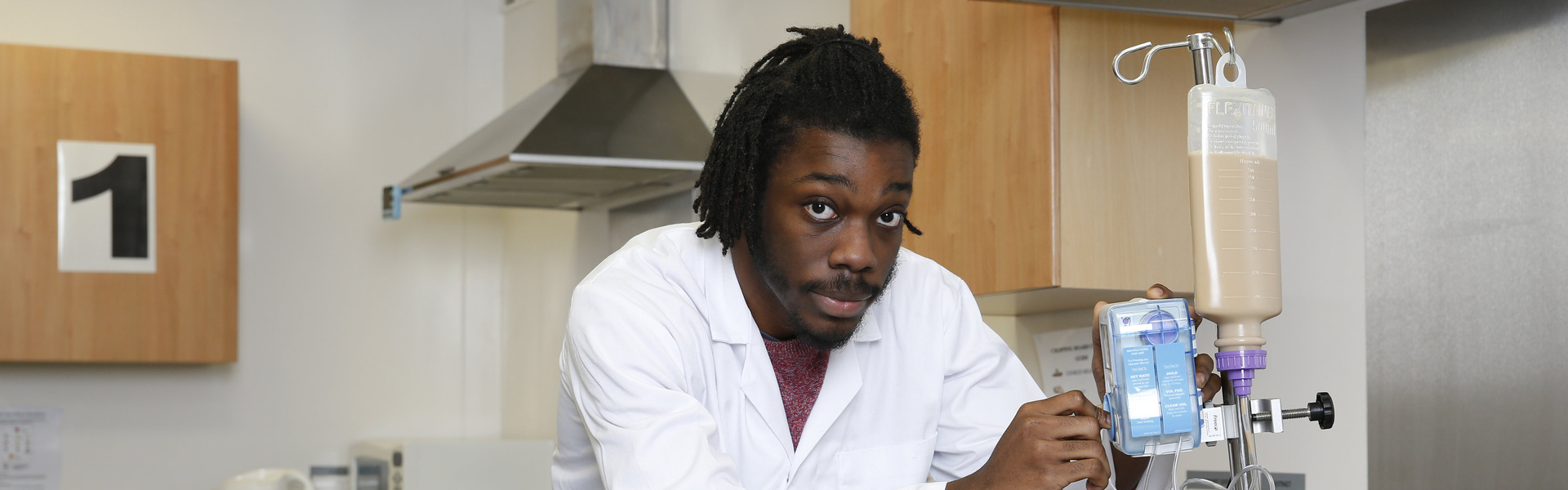
In your first year, you will learn the basics of society and how food is embedded in our daily lives. You will learn the fundamentals of recognising nutritional requirements and how deficiencies can occur and explore these practically in simulated environments. You will be out on placement from your first year of study, developing your communication skills and professionalism.
In the second year, you will explore nutrition in health and disease. By now, you will already know how a normal healthy body functions. In this year, you will learn what can go wrong, how to recognise and diagnose nutritional illness and create treatment plans. You’ll start to develop your research expertise, and how to apply this to evidence-based practice. This learning culminates in a clinical placement, supervised by Registered Dietitians as part of a dietetic team.
In the final year, you delve deeper into complex clinical conditions, learning from experienced practitioners from specialist areas of dietetics, public health and contemporary nutrition. You’ll also be introduced to the work of leadership and management roles. You’ll learn to reflect on the effects of your choices on the patients and their loved ones. At the end of your final clinical placement, you will confidently provide quality nutritional care for children and adults emerging as autonomous practitioners, ready to take on your first graduate role!
You will undertake three practice placements, consisting of a total of 28 weeks over your three years of study. This will give you the opportunity to develop the appropriate knowledge, skills and attitudes to be ready to qualify as a registered dietitian. Placements are in a variety of stimulating NHS settings such as Acute, Mental Health and Primary Care Trusts, where trained practice educators will support and help you to develop your learning, providing experiences ranging from acute clinical practice in hospitals to GP clinics, visiting clients in their own homes and health promotion activities. Placements will be across the eastern counties of Bedfordshire, Cambridge, Essex, Hertfordshire, Norfolk and Suffolk.
Assessment methods include: written course work, group work, exams, lab reports, poster presentations, case studies, vivas (verbal examinations) and practice placements.
What if I need support?
You’ll have a personal tutor to guide you through your course, all the way to graduation.
If you need additional support during your time with us, rest assured that we’ve got you covered. For help with study skills, including referencing, essay writing and presentations, you’ll have access to our academic support services. You can attend workshops, 1-to-1 sessions and online tutorials. Both of our Learning Resource Centres run drop-in study skills sessions.
Optional placement year
Study Abroad offers the opportunity for an amazing experience that will help make you stand out from the crowd. The University of Hertfordshire is the only higher education institution to offer this opportunity to dietetics students. With more and more companies working internationally, experience of living in another country can make a great impression on future employers.
This course offers you the opportunity to enhance your study and CV with a sandwich year abroad. The University has partnerships with over 150 universities around the world, including the USA, Canada, Asia, Africa, Australia, South America and closer to home in Europe.
If you study abroad between your second and third year of study, you’ll pay no tuition fee to the partner university and no tuition fee to us either. We’ll ask you to make your decision in your second year, so there is plenty of time to think about it.
Study Abroad offers the opportunity for an amazing experience that will help make you stand out from the crowd. The University of Hertfordshire is the only higher education institution to offer this opportunity to dietetics students. With more and more companies working internationally, experience of living in another country can make a great impression on future employers.
This course offers you the opportunity to enhance your study and CV with a sandwich year abroad. The University has partnerships with over 150 universities around the world, including the USA, Canada, Asia, Africa, Australia, South America and closer to home in Europe.
If you study abroad between your second and third year of study, you’ll pay no tuition fee to the partner university and no tuition fee to us either. We’ll ask you to make your decision in your second year, so there is plenty of time to think about it.
Find out more about study abroad optionsWhere you'll study
Your main campus is College Lane. This is where the creative arts, science and health-related subjects are based. This means you’ll share the campus with future nurses, doctors, scientists, artists and more. You can use the common rooms to relax with friends, work out in the 24-hour gym or have a drink in our on-campus bar or cafes. We also have restaurants for you to eat in or grab something on the go. Our Learning Resources Centres are open 24/7, which means you can study whenever suits you best. Want to pop over to the other campus? You can take the free shuttle bus or walk there in just 15 minutes.
Who you'll learn from
You will be taught by our team of highly qualified academics, who are all registered practitioners with postgraduate and teaching qualifications.
Check out our student blogs
How we support our students
At the University of Hertfordshire, we want to make sure your time studying with us is as stress-free and rewarding as possible.
We offer a range of support services, from childcare to counselling, ensuring that you make the most of your time at Herts and can focus on studying, having fun, and have the support you need.
Student Blogs
Maia - My typical day
A typical day in the life at Herts
Hello! I’m Maia and I’m just about to go into my second year of studying Dietetics! (Most people go blank when I say Dietetics so think of it as the science behind food and nutrition!)
As a Dietetics student, my day always starts with a killer breakfast! My go-to is chocolate orange oats but I sometimes have pancakes – depends on how much time I have! I live in Barnet; a few towns away from Hatfield and therefore I commute. My commute is one of my favourite parts of my day, as I drive, and the roads around the university are rural and beautiful – particularly on those frosty winter mornings!
When I arrive at uni, I grab a coffee from either the Starbucks or Costa we have on campus. Then I’ll head for a morning of lectures and workshops. I love that every day is different and walking between lectures there is always something going on at the university – whether it’s a vintage sale at the Forum or a mini lunchtime concert.
For lunch, I sometimes go and choose something from the Forum restaurant, or I’ll bring my own! I often want to do a little reading before an afternoon lecture, so I’ll take a packed lunch to the library and find a cosy little nook to spend an hour or so! There are so many great little comfortable spaces to chill or study in across both campuses, and I and my course mates often find one for lunchtime!
After lunch, it’s usually time for some more timetabled work. The Dietetics course at Herts is really varied, so I’ll often have a day with lectures, seminars, workshops and lab practicals, both in the science building and in the dedicated diet lab for Dietetics and Nutrition students!
At the end of the day, I walk to the bus stop to get the park and ride the bus back to my car. This service is great by the way! Saves me having to walk to the car park when I’m tired or it’s getting dark. I plug my music in and drive home!
Once home I like to catch up with my family over dinner and then after dinner is usually when I will start some reading or revision depending on the day. I keep a big folder on my desk where I can add any notes from the day, and I try and keep it organised! Then, sometimes I’ll head to the gym and other times I’ll see some friends, it really depends – but it’s important to me to keep a good work/social life balance and my schedule really allows me to fit all of this in!
Student Blogs
Maia - Things you should know
What you need to know before studying Dietetics at Herts
Hello! I’m Maia and I am about to start my second year at the University of Hertfordshire studying Dietetics.
So, you’ve just firmed Herts – congratulations! It’s about to get extremely exciting!
- If you have any anxiety right now about the upcoming adventure ahead of you, just know that you are going to be extremely well looked after! I had a very thorough induction week, with dedicated sessions on getting around the university with tours, how to use the library and information on all of the resources available there, sessions where I got to know all of my lecturers and chances to meet and speak with second and third years about their experiences! One stand-out session was a massive ‘classroom picnic,’ where we all made or brought in dishes to share and try and it was just such a nice afternoon with everyone – even our lecturers dropped in for a bit!
- What you put in is what you get out! I know you’ve heard this countless times before, but it really is true! There are so many extra-curricular activities to get involved in and opportunities to make your CV look knock-out! My lecturers are always advertising events and online seminars and we are taught the importance of CPD (Continued Professional Development) from day one! This leads me to my next point…
- Within the field of Dietetics, knowledge is power, and nutrition knowledge and research are always changing and evolving, and it is up to us! As future nutrition healthcare professionals to make sure we are always up to date. This feeds into our lectures too – often someone will have a read of something in the media and we all end up having a massive discussion! This makes for an inspirational and stimulating environment and we often then go away and do our own research to learn more.
- You’ve chosen a degree with a million and one future career paths! Take your time whilst at uni to enjoy the process of discovering them all! What I didn’t realise when I first started was that Dietitians can work in sports, the media, the community, in schools and in public health – they don’t just work in the NHS! Use your summers to go on as many work experience placements and internships that you can get your hands on and just lap it all up!
- NADS. NADS is the Nutrition and Dietetics society at Herts. Once you start at the university, you can join the society and then be sent emails about events they are putting on. They organise lots of socials throughout the year, and it’s an enjoyable way of getting to know students outside of your year group, so you can compare experiences and get advice about what might be coming up for you!
- You’ll have a small group size compared with many other degree courses. This is helpful, particularly at first when you are trying to remember everyone’s names and make friends! It also helps to create a friendly relaxed environment and all the lecturers know you by name and face! Also, you are about to be surrounded by 25+ foodies! Get ready to stare at your course mates’ lunches and swap recipes and talk weird food trends for the next three years!
Student Blogs
Karen - Why I chose Herts
Why I chose Herts
Hello! I’m Karen, I am a mature student currently in my second year of Dietetics at the University of Hertfordshire.
I fell in love with Herts when I went to their open day. The student ambassadors and dietetic team were so friendly and approachable that I knew from that day that my heart was set on the University of Hertfordshire.
Our dietetics program has a small cohort of roughly 30 people, so you get to know everyone in your class, it’s great that we have a diverse range of students from the UK and international to school leavers, mature students, parents, and so on. Honestly, this course has a diverse range of students from all walks of life; it is a great representation of students that I am proud to be a part of.
What stood out to me about the University of Hertfordshire was that I didn’t have to worry about sorting out my placements, some of the other universities I looked at told me I was responsible for finding my placements, which I found daunting but here they are all allocated for you giving me more time to focus on my studies. Each year, I get to go on placement, and by the time I graduate, I will have worked in both an NHS hospital and a community-based setting, which is rare to find at other universities.
All of the lecturers are registered dietitians and nutritionists and we have guest/visiting lecturers to come and speak about their specialist fields. I like the variety of teaching methods used at Hertfordshire; we don’t just have lectures but workshops and practicals in our diet lab, it is great that they incorporate different learning styles to help us with our academics.
The University has loads of societies and activities catered to students; I liked that there is also a focus on students having a life outside of their studies. Throughout the year, there are various events around campus that students can participate in, most of which are free or at a reduced price. I recommend participating and being open to what Herts has to offer you.
Entry requirements
The University of Hertfordshire is committed to welcoming students with a wide range of qualifications and levels of experience. The entry requirements listed on the course pages provide a guide to the minimum level of qualifications needed to study each course. However, we have a flexible approach to admissions and each application will be considered on an individual basis.
| Typical offer (UCAS points) | 128 |
|---|---|
| Typical A Level offer | ABB Mandatory subjects: Biology or chemistry at grade B or above and one other applied science. |
| Typical IB offer | 128 |
| Typical BTEC offer | DDM Mandatory subjects: BTEC Extended Diploma in Applied Science. Required subjects: Distinctions in biological and physiological units and/or units related to chemistry. |
| Accepted T Levels | Healthcare Science; Health; Science |
| Access courses | 45 Level 3 credits to include 30 level 3 credits at distinction and 15 level 3 credits at merit. This must include 15 level 3 credits in biology or chemistry and 15 level 3 credits in a second science or mathematics. |
| Additional information | Find out more about our standard and contextual Undergraduate Entry Requirements. Occupational heath and DBS check. |
| English language | All students from non-majority English speaking countries require proof of English language proficiency, equivalent to an overall IELTS score of 7.0 with a minimum of 6.5 in each band. If you do not have the required IELTS or equivalent for direct entry on to your degree programme, our Pre-sessional English and International Foundation courses can help you to achieve this level. |
|---|---|
| Additional information | Find out more about International Entry Requirements. |
Ready to apply?
UK and EU applicants with pre-settled/settled status in the UK
| Start date | Study type | Apply |
|---|---|---|
| September 2027 | Full time | Apply via UCAS |
International and EU applicants without pre-settled status in the UK
Apply through Clearing


Our Clearing hotline is open for support, Monday - Thursday 9.00-16.45 and Friday 9.00-15.45. You can apply online at any time.
Fees and funding
At Herts, we’re dedicated to providing world-class teaching supported by industry-level facilities and incredible social spaces. We believe cost shouldn’t be a barrier to higher education, and we strive to keep both our standard and additional costs as low as possible.
| Study type | Fees | |
|---|---|---|
| UK students | Full time | £10,050 for the 2027/2028 academic year |
| EU students | Full time | £25,180 for the 2027/2028 academic year |
| International students | Full time | £25,180 for the 2027/2028 academic year |
Tuition fees are charged annually. The fees quoted above are for the specified year(s) only. Fees may be higher in future years, for both new and continuing students. Please see the University’s Fees and Finance Policy (and in particular the section headed “When tuition fees change”), for further information about when and by how much the University may increase its fees for future years.
| Scholarships, grants and bursaries | Depending on your circumstances, you may be eligible for a non-repayable scholarship, grant or bursary to support your studies. |
|---|---|
| Disabled Students' Allowance | The Disabled Students’ Allowance can cover any study-related costs you have because of a mental health problem, long term illness or any other disability. |
| Student loans | Find out about securing a student loan, from how much you could be eligible for to when you need to start making repayments. |
| Accommodation costs | We offer a great choice of student accommodation, on campus or nearby in the local area, to suit every student budget. |
| Additional course fees | Read more about additional fees in the course fact sheet. |
More about the course
| Programme specifications | |
|---|---|
| BSc (Hons) Dietetics with a Year Abroad - Full time, Sem A | Download PDF |
| BSc (Hons) Dietetics - Full time, Sem A | Download PDF |
| Additional information | |
|---|---|
|
Applications open to international and EU students |
Yes |
Course length |
Sandwich, 4 Years |