BSc (Hons) Nursing (Child)
Transform lives as a children's nurse. Gain practical experience and develop a diverse range of skills in clinical settings with a unique blend of theory and hands-on training. Help children and families lead healthy lives with expert patient care.


Sign up for Clearing VIP Access
Skip the queues on results day with an exclusive priority Clearing hotline number.
Get info and updates
Sign up for updates
Interested in studying at the University of Hertfordshire and want to sign up to our mailing list to learn more about our facilities, living in the UK and student life? Use the form below and our team will also keep you informed of key updates such as events near you, applications opening and more!
-
Typical offer: 112–120
Entry requirements -
Fees: £9,790 per year (UK)
Full details -
UCAS code: B702
-
Course length: Full time: three years
Find out more -
Location:
- University of Hertfordshire, Hatfield
-
Institute code: H36
NHS Learning Support Fund
Training grants of at least £5,000 a year are available for eligible healthcare students which you will not have to pay back. You may also be eligible for an additional £2,000 towards childcare costs to help balance your studies with family life and £3,000 for students who find themselves in unforeseen financial hardship. Find out more about the NHS Learning Support Fund
NHS Funding for UK/EU Students
Students studying on nursing, midwifery or allied health professional courses funded by Health Education England will have access to the same student loans support package and support for living costs as other students.
You could also benefit from the NHS learning support fund if you study an eligible nursing, midwifery, or allied health course. If eligible, the different kinds of support you could get include a training grant, parental support, money back for travel and temporary accommodation whilst on placement, and financial hardship (which you won’t need to pay back).
PJE Foundation Scholarship
£3,600 (£1,200 in each academic year) is awarded on the conclusion of the previous scholarship to a first year, full time Health and Social Work student with a declared disability, who is returning to study after at minimum break of three years from formal education. Applications for this scholarship open in your first year of study.
The Janice Ann McNaughton Bursary
£3,000 (paid in the first year of study) is awarded every year to two first year students studying on this course. Students are eligible to apply if they are care-leavers or care-experienced students aged 18-24. If the cohort does not include two students who meet the above criteria, students under the age of 25 who are the first in their family to attend university may be considered. Applicants must fill in a short application form.

1st in the East of England for nursing and midwifery (Complete University Guide, 2026)

10th in the UK for children's nursing (Guardian University Guide, 2026)

95% and above student satisfaction in five categories (National Student Survey, 2026)1
Course overview
Children’s Nursing is a professional career caring for children and young people. You’ve probably arrived at this page because you have a passion for helping children and young people. Right from the start, you’ll receive a blend of theory and practical experience. Half the children's nursing degree will be spent at the University. The other half of your time, you’ll gain real work skills in a variety of child nursing clinical settings. You’ll learn about ‘normal’ child development, and how to recognise when a child’s development is not normal. You’ll learn how to intervene and manage atypical development on our paediatric nursing degree. You’ll promote a healthy lifestyle in children, young people and their families and provide real patient care in hospital and community placements.
Why choose this course?
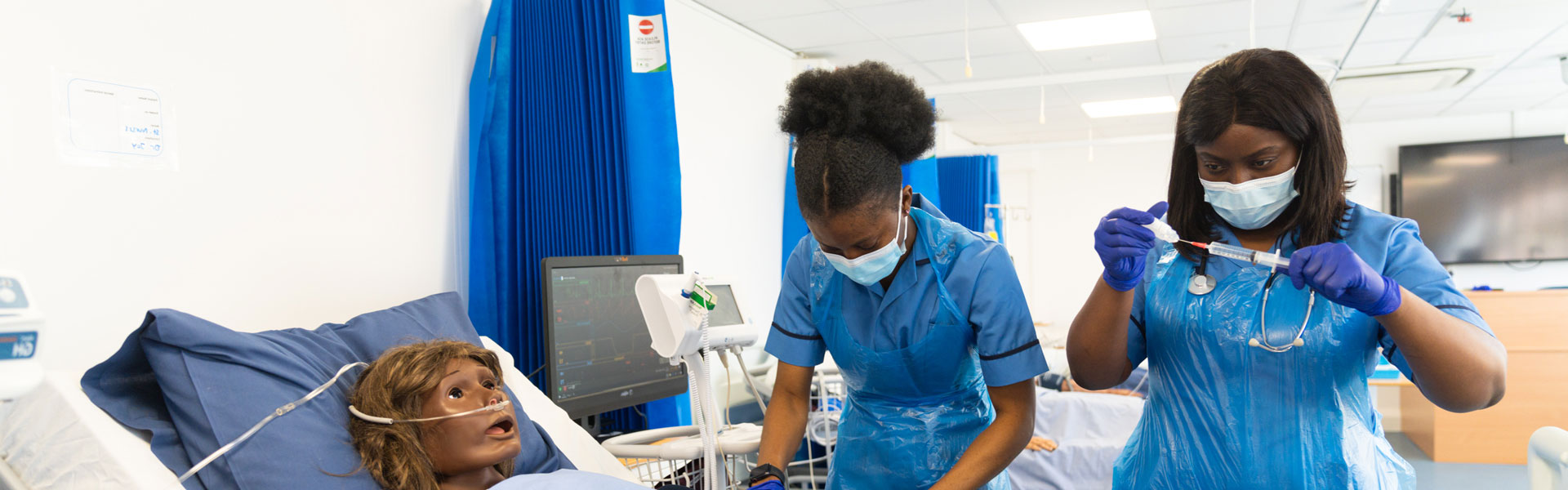
On-campus nursing facilities: We will ease you into the nursing world using our Children’s Nursing lab and our Simulation Centre. This way you can safely practice your nursing skills before you go out into the real world.
Tailor your learning: During the course you can choose to study one of a few specialist modules. Whether you wish to care for children and young people with acute medical conditions or supporting neonates and their families in hospital or the community, you will have the opportunity to study the module of your interest.
Strong employment prospects: 98% of Herts health and social care undergraduates are in work or study (Graduate Outcomes, 2024)1.
Professional accreditations
Entitlement to apply to enter the professional register of the Nursing and Midwifery Council as a Registered Nurse (Child).
Your future career
This course entitles you to apply for registration as a children’s nurse with the Nursing and Midwifery Council. It opens up a wide range of career options, typically within hospitals or community-based services which can take you in many different directions. For example, you may choose to work in a specialist area such as a neonatal unit or children’s accident and emergency department, or you may prefer to consider community-based settings such as hospice care or community children’s nursing.
See what recent graduates are up to
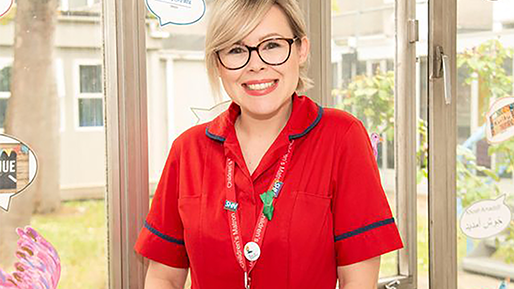
Lizzie Franklin-Jones MBE
Matron for Children's Emergency Service at Lister Hospital, Stevenage
Meet Lizzie Franklin-Jones MBE, an NHS nurse who has been recognised for her services to nursing and mental health.
A passion for nursing
Lizzie loved nursing from the first day of her studies. ‘I remember the first cannula I took out of a patient and even the way my first placement smelt. I remember the amazing teachers and placement mentors who taught me.’
‘Who would have thought I would now be an advanced paediatric life support instructor! I have my dream job and I am currently leading an exciting transformational project in expanding our emergency service.’
‘As soon as I graduated, I was offered a band five position within the emergency department where I did my last 12-week placement. This was a fantastic transition, however I remember being such a confident final year student but a very wobbly newly qualified nurse. It took me a little time to find my feet. I was able to take a career break and spent two years in Australia, working as an emergency nurse and travelling the world. I had the time of my life! As a band six I then worked across the UK at different hospitals through an agency, this gave me experiences of other clinical areas and teams. None of them quite met my expectation and I found I have blossomed at the East and North Hertfordshire NHS Trust, where I have grown and developed my skills, knowledge, and leadership.’
‘The Florence Nightingale Foundation also changed my life. I was the first national scholar to be awarded the Michael Clift Leadership Scholarship, a scholarship to improve the care of vulnerable children and young people with mental health needs presenting to the emergency department in emotional distress and/or experiencing a mental health crisis.
From lived experience growing up, this was close to my heart, and this scholarship gave me with many scary but wonderful opportunities. I presented at the House of Lords to the most senior NHS leaders, including the Health Secretary and NHS Chief Executive. I spoke of the work we do at the East and North Hertfordshire NHS Trust children’s services in partnership with young people, which was impacting change across our integrated care systems. This work has improved resources and facilities, the training and skills set for the teams, and built a network where health was an important partner in the care planning of children with multi-agency input.’
‘As a junior band seven nurse, I was incredibly lucky to shadow Dame Ruth May, Chief Nursing Officer for England. My time with Ruth inspired me to branch into community nursing as a children’s matron. I realised my skills are transferable and I loved the variety and challenge community nursing brought to my personal and professional portfolio.’
‘I now work closely with the University of Hertfordshire, and love teaching future nurses the importance of parity between physical and mental health for all children and young people. I believe that anyone can be a leader, regardless of statue or position. Leadership comes from within, and I look forward to coaching and nurturing future nurse and midwifery leaders.’
An awarding winning career
In 2021 Lizzie was awarded an MBE for her services to nursing and mental health.
‘I have had the most incredible role models and national leaders who have supported my nursing career personal development and leadership. My MBE is attributed to the amazing team I work alongside, the doctors, nurses, healthcare support workers, hospital administrators, liaison services and of course my family.
My MBE is and will always be one of the proudest moments of my life. It’s recognition and a symbol for my passion and service to the NHS – my passion for leadership, learning and caring for people.’
Life as a Herts student nurse
Lizzie’s favourite memory from Herts is the people she met. ‘I remember my first night at the University. I was in halls on the de Havilland campus, and I called my mum and she told me I had to go out and meet people. I cried the first night wanted to go home. I had accidently dropped my phone down the toilet and felt completely isolated from my normal life. I subsequently went on to meet some of my best friends in the first week!
I also loved writing my dissertation about children’s resuscitation training, spending many nights in the LRC (Learning Resources Centre) with all my friends.’
Advice for other student nurses and new graduates
‘Take every opportunity and be authentic - in other words be you. Opportunity has taken me down career paths that have taught me the dos and don'ts, unleashed new passions, re-fired a fire in my belly in moments of doubt and has connected me to new people, expertise, and talent.
Be open minded and be present in the moment. Remember there is always opportunity for learning, that our role as nurses is ever changing and ever developing. A career in nursing is so vast, from education, research, digital, governance, prisons, schools, to safeguarding and politics. There is a dream job for you all, you just need to have the courage and curiosity to take the opportunity with both hands.’
What you'll study
Degree programmes are structured into levels, 4, 5 and 6. These correspond to your first, second and third/final year of study. Below you can see what modules you’ll be studying in each.
During your child nursing degree, You'll spend 50% of your time at the University. You’ll attend lectures, building your knowledge on things like providing a holistic assessment care plan and considering a child's or young person’s mental, emotional and physical wellbeing. You can then share your knowledge in smaller groups during the seminars and workshops. You will be asked to look at case studies, either individually or in a small group. Plus, you can put what you have learnt into practise by using your skills in our clinical simulation centres.
You’ll spend 50% of your time in a hospital or community setting. You could be working with NHS Trusts in Hertfordshire or in London. You'll partner with qualified, experienced nurses who will act as your supervisor.
Practice placements are organised primarily within neighbouring NHS Trusts in Hertfordshire and North London, but also in Bedfordshire and Essex and in other settings including the private and voluntary sectors. There is the opportunity to learn with and from people in the community and in hospitals where nursing is experienced. The placements are wide and varied, emphasising the chosen field of practice - Children's Nursing. This may include caring for neonates through to adolescents: children and young people with learning disabilities or mental health problems and occasionally adults.
A number of NHS Trusts support student nurses in their practice by providing placements in local health service trusts, social services, local educational institutions, private health care facilities, and the voluntary sector. North London, Hertfordshire and Bedfordshire provide this support in a varying capacity dependent on the programme undertaken and the chosen field of Nursing.
A student-led experience is offered at the end of the second year which gives you the opportunity to gain clinical experience elsewhere in the UK, e.g. closer to home or in specialised regional or national centre of excellence, your choice.
In your first year, we'll introduce you to the profession, giving you a solid foundation to build on. You'll look at how a child and young person grows and develops and the impact of illness. Remember you will be working with children, young people and their families. You will learn how to build trust and how to communicate with them.
In your second year, you'll build on what you learnt in first year. You'll explore an ill child’s journey from showing clinical signs through to diagnosis; you’ll look at ways of providing care and management until recovery or end of life care. You'll also choose to study one of our specialised modules.
In your third year, you’ll explore strategies to enhance service outcomes for children and young people. You’ll also be introduced to the work of leadership and management roles. You are now fully equipped to provide quality care to children and young people.
What if I need support?
You’ll get a personal tutor to guide you through your course, all the way to graduation. You might also want or need extra support during your time with us. Rest assured, no matter what you study, we’ve got you covered. For help with study skills, including referencing, essay writing and presentations, you’ll have access to our academic support services. You can attend workshops, one-to-one sessions and online tutorials. Both our Learning Resources Centres run drop-in study skills sessions. And the best thing is, it’s all free.
Where you'll study
Your main campus is College Lane. This is where the creative arts, science and health-related subjects are based. This means you’ll share the campus with future nurses, scientists, artists and more. You can use the common rooms to relax with friends, work out in the 24-hour gym or have a drink in our on-campus pub or cafes. We also have restaurants for you to eat in or grab something on the go. Our Learning Resources Centres are open 24/7, which means you can study whenever suits you best. Want to pop over to the other campus? You can take the free shuttle bus or walk there in just 15 minutes.
Check out our student blogs
How we support our students
At the University of Hertfordshire, we want to make sure your time studying with us is as stress-free and rewarding as possible.
We offer a range of support services, from childcare to counselling, ensuring that you make the most of your time at Herts and can focus on studying, having fun, and have the support you need.
Student Blogs
Lobsong - Week at a glance
My week at a glance
My name is Lobsong Dolma. I am a student nurse. I have just completed my second year and will be starting my third year from this September. I have had both good and stressful times during my life at university.
In a week, I have four days of lecture and three days to rest and catch up with my assignments. Our lectures are mostly in the morning so after the lecture, I go to the library to find some reading resources and start planning for my assignments. Sometimes, I go for lunch with my friends and spend some time with them in Galleria (A shopping mall near the university). This helps me to give myself a break and socialise with my friends.
I prefer studying in the library as the library has a quiet zone in which I can study peacefully or do group studies in the non-quiet zone whenever I want. Our university also offers a lot of extracurricular activities. During the mid-week, I attend the half an hour meditation session or join the meet and greet session where I can meet other student nurses from various branches and share our experiences about placements and studies. Sometimes I book a tutorial session with my lecturer or the other tutors in the library who help with referencing and essays.
In my off day, I do my essay or look at the lesson slides and prepare for the next lecture. Then I cook or clean the house sometimes and visit my relatives. We also have a lot of events such as cheeky Wednesday's, karaoke nights or Summer Ball at College Lane.
When I am on placement, I have three or four 12-hour shifts in a week. We have no teaching during our placement time, so I spend some time revising and writing my essay. Most of the time, we don't have assignments during placement but in the second year, we had two assignments due during the 10-week placement. It was quite challenging but with good time management, I was able to get it done in time.
This is how I spend my week doing studies, attending lectures, catching up with my friends and attending events. Planning, good time management and support from my tutors have helped me to overcome the challenges and enhance my overall experience at university.

Student Blogs
Lobsong - Things you should know
Things you need to know before studying Nursing at Herts
My name is Lobsong Dolma and I am a children's student nurse. I am going to be doing my final year from this September. Looking back at the time, I was extremely nervous and scared when I was applying for the nursing course. I did not know much about this field and only had a little experience in health care. English is not my first language so I thought I would not be able to do well in my essays as well. However, I have now realized and learned from my experience that you only need to know three things before studying Nursing at the University of Hertfordshire.
It's going to be tough!
Therefore, they look for skills such as resilience, hardworking and determination. Being a nursing student does not only mean that you will be reading biology books all the time. You will also be doing a variety of placements. One placement, you could be working in an intensive surgical unit and the other, you could be visiting other people's homes as a student health visitor.
Not only this, but you will also have assignments and exams to finish along with lectures and practical sessions. Juggling placement, deadlines and family life altogether is not something everyone can do. Therefore, you must understand from now that hard work, resilience and determination is necessary to do well in this course.
There is support, YOU ARE NOT ALONE!
You must have been terrified after reading the paragraph above. Calm down, it is not that bad when support is only a click away. The staff at the University of Hertfordshire are truly kind and compassionate. I have never been refused of help whenever I am faced with trouble. From essays to placements and financial hardship to emotional wellbeing, they have all the support you will ever need. For instance, you can go to the academic skills advice team if you are struggling with your essay or referencing. They even supply free sessions where you can go and learn new academic skills that will help you to improve your grades. Then there is wellbeing centre at college lane that will focus and help with many aspects of your personal life such as financial hardships, mental wellbeing and coping with life at university. For concerns about placements, you will have your designated placement link lecturers who will visit you when you are out in placement to ensure you are doing well.
Are you interested in caring for other people?
Caring for a patient in a hospital is different from providing care for a member of your family. You will be required to provide equal care to all patients from different ethnic backgrounds, beliefs, disabilities and age. One moment you could be singing lullabies to a seven-year-old while removing their cannula and the next moment you could be cleaning a necrotic wound of a 19-year-old. If you believe that you can provide compassionate care to a patient regardless of their age, gender, ethnic background, belief and disabilities, then this could be the right profession for you!
Most importantly, one must know before joining the course that hard work is necessary to be able to do well in nursing.

Student Blogs
Lobsong - Why I chose Herts
Why I chose Herts
Hi, I am Lobsong. I joined the University of Hertfordshire in 2018 for a nursing course. When I was applying for universities through UCAS (Universities and Colleges Admissions Service), I was quite confused when it came to choosing one out of five universities. I went to open events, watched YouTube blogs about many universities and read articles about them. After going for interviews, exams, and open events, I made up my mind to choose this university. There are many reasons why I chose Herts, but the three main reasons are:
Opportunities
I was glad to learn from day one that the University of Hertfordshire offers a wide range of opportunities for students. The university website supplies details about various scholarship schemes that are available to students from various courses.
It also offers many part-time job opportunities such as student ambassadors programme or working in the student union's shops. Furthermore, there are a lot of extracurricular activities such as sports session, doing art, mindfulness sessions, weekly walk with a group of people, movie nights and book reading sessions. Then there are social events such as cheeky Wednesdays and concerts held in our on-campus night club at Forum (College Lane).
Facilities
The university is equipped with many facilities that enhance the lives of students. For instance, we have university buses known as Uno bus running across the city. I live about 11 miles away from the university and it only takes me about 12 minutes to get there with Uno Bus. Without Uno, I would have to take two buses and a train which would take me at least an hour to get there. There is also shuttle bus service that is free for the students to travel from Park and Ride near College Lane to de Havilland.
In addition, there are two big libraries each including a quiet zone so that students can study according to their preferences. During the practical sessions, there are many types of equipment such as mannequins, hospital beds, a practical room that looks just like a hospital ward equipped with all the necessary resources that help us to understand and learn skills thoroughly.
The environment
The surrounding of Herts impressed me when I first came to an open event with my friends. The university was filled with trees, gardens and beautiful flowers that blended well with various buildings that were spread across the university. There are also many shops and restaurants where you can socialize, study or just enjoy a warm cup of coffee during lesson breaks. If you get stressed, you can go for a walk and visit the little forest within the university compound. Many squirrels and beautiful birds will greet you there. If you are lucky enough, you will also meet a sweet cat waiting for a cuddle. Being away from the busy city reduces noise pollution, ensures peace and enables you to enjoy the splendid view of the countryside from your desk in the library.
In short, I love my life at the University of Hertfordshire, I am so glad I chose Herts!
Entry requirements
Clearing entry requirements
The University of Hertfordshire is committed to welcoming students with a wide range of qualifications and levels of experience. The entry requirements listed on the course pages provide a guide to the minimum level of qualifications needed to study each course. However, we have a flexible approach to admissions and each application will be considered on an individual basis. This also applies to Clearing applications, so if you don’t have the advertised grades, you can submit a Clearing application and we’ll review and consider your application on an individual basis.
Ready to apply?
Apply through Clearing now
UK and EU applicants with pre-settled/settled status in the UK
| Start date | Study type | Apply |
|---|---|---|
| September 2026 | Full time | Apply via UCAS |
| September 2027 | Full time | Apply via UCAS |
International and EU applicants without pre-settled status in the UK
Apply through Clearing


Our Clearing hotline is open for support, Monday - Thursday 9.00-16.45 and Friday 9.00-15.45. You can apply online at any time.
Fees and funding
At Herts, we’re dedicated to providing world-class teaching supported by industry-level facilities and incredible social spaces. We believe cost shouldn’t be a barrier to higher education, and we strive to keep both our standard and additional costs as low as possible.
NHS Learning Support Fund
Training grants of at least £5,000 a year are available for eligible healthcare students which you will not have to pay back. You may also be eligible for an additional £2,000 towards childcare costs to help balance your studies with family life and £3,000 for students who find themselves in unforeseen financial hardship. Find out more about the NHS Learning Support Fund
NHS Funding for UK/EU Students
Students studying on nursing, midwifery or allied health professional courses funded by Health Education England will have access to the same student loans support package and support for living costs as other students.
You could also benefit from the NHS learning support fund if you study an eligible nursing, midwifery, or allied health course. If eligible, the different kinds of support you could get include a training grant, parental support, money back for travel and temporary accommodation whilst on placement, and financial hardship (which you won’t need to pay back).
PJE Foundation Scholarship
£3,600 (£1,200 in each academic year) is awarded on the conclusion of the previous scholarship to a first year, full time Health and Social Work student with a declared disability, who is returning to study after at minimum break of three years from formal education. Applications for this scholarship open in your first year of study.
| Study type | Fees | |
|---|---|---|
| UK students | Full time | £9,790 for the 2026/2027 academic year |
| EU students | Full time | £19,450 for the 2026/2027 academic year |
| International students | Full time | £19,450 for the 2026/2027 academic year |
Tuition fees are charged annually. The fees quoted above are for the specified year(s) only. Fees may be higher in future years, for both new and continuing students. Please see the University’s Fees and Finance Policy (and in particular the section headed “When tuition fees change”), for further information about when and by how much the University may increase its fees for future years.
| Scholarships, grants and bursaries | Depending on your circumstances, you may be eligible for a non-repayable scholarship, grant or bursary to support your studies. |
|---|---|
| Disabled Students' Allowance | The Disabled Students’ Allowance can cover any study-related costs you have because of a mental health problem, long term illness or any other disability. |
| Student loans | Find out about securing a student loan, from how much you could be eligible for to when you need to start making repayments. |
| Accommodation costs | We offer a great choice of student accommodation, on campus or nearby in the local area, to suit every student budget. Due to the nature of your programme, your studies are likely to continue over the summer period, requiring an extended period of accommodation on campus. There are 2 accommodation options available to you:
|
| Additional course fees | Read more about additional fees in the course fact sheet. |
More about the course
| Programme specifications | |
|---|---|
| BSc (Hons) Nursing (Child) - Full Time, Sem A | Download PDF |
| BSc (Hons) Nursing (Child) - Full Time, Sem A | Download PDF |
| Additional information | |
|---|---|
|
Applications open to international and EU students |
Yes |
Course length |
Full Time, 3 Years |