BEng (Hons) Aerospace Engineering
Launch your career in aerospace engineering, immerse yourself in our legacy and join the CDIO Initiative network of engineering leaders. Benefit from our strong industry connections and opportunities for work placements at leading companies.

What type of applicant are you?


Sign up for Clearing VIP Access
Skip the queues on results day with an exclusive priority Clearing hotline number.
Get info and updates
Sign up for updates
Interested in studying at the University of Hertfordshire and want to sign up to our mailing list to learn more about our facilities, living in the UK and student life? Use the form below and our team will also keep you informed of key updates such as events near you, applications opening and more!
-
Typical offer: 120
Entry requirements -
Fees: £10,050 per year (UK)
Full details -
UCAS code: H410
-
Course length: Various
Find out more -
Location:
- University of Hertfordshire, Hatfield
-
Institute code: H36
-
Work placement option
Find out more -
Study abroad option
Find out more
Falko Aerospace Scholarship
The scholarship is valued at £2,000 and is awarded to a BEng Aerospace Engineering student progressing into their second year. To apply, you will be invited to submit an application during your first year of study. The shortlist of applicants will be interviewed by a judging panel and a winner identified.
Sir Gerard Newman Scholarship
The Sir Gerard Newman scholarship is valued £2,000 (£500 paid in the first and second year, £1,000 in the final year) and is awarded every year to a UK or EU student studying on any aerospace, automotive, civil or mechanical engineering degree. To apply you will be invited to submit an application in your first year at University.

1st in the East of England for Aeronautical & Aerospace Engineering (Complete University Guide, 2024)

Study at one of the largest engineering departments in the UK

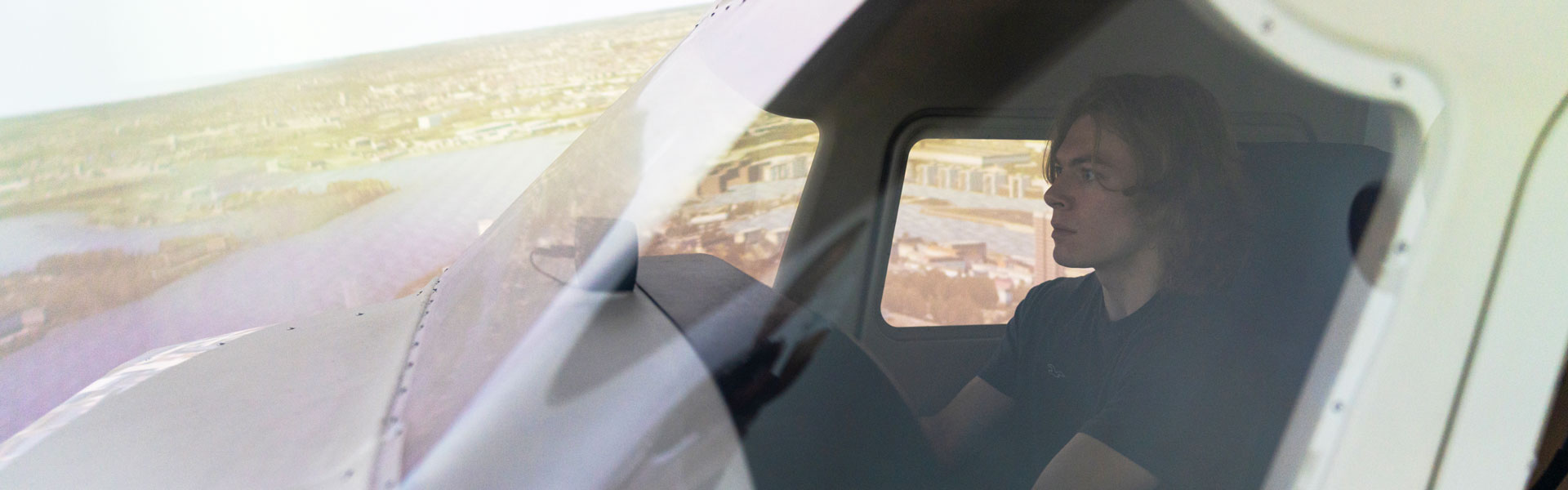
Access fantastic facilities, from flight simulators to wind tunnels
Course overview
Do you want to design an aircraft? This course will teach you everything you need, from aircraft structures and materials to aerodynamics. With a strong reputation in the aerospace industry, built through decades of collaboration with leading companies like de Havilland Aircraft Corporation and BAE Systems, this degree prepares you for a successful career in aerospace engineering.
Why choose this course?
Apply your knowledge through design and build projects: We're members of the CDIO Initiative (Conceive Design Implement Operate), a worldwide network of academic professionals, industry representatives and engineering leaders who have a passion for engineering education and engineering leadership. The CDIO framework has been embedded into our aerospace engineering degree programme, ensuring you’ll put into practice what you learn through “design and build” projects during your studies.
Access to support and facilities: You’ll be taught by experienced aerospace staff, who’ll share their industry knowledge with you. There's plenty of support on offer to help you gain the skills you need to succeed. You'll get a personal tutor for the duration of your course, who can guide you all the way to graduation. You can also access our specialised Centre for Academic Skills. Our Learning Resources Centre is open 24/7, so you can study whenever suits you best, plus you’ll have access to online resources and online discussions with staff and students.
Benefit from our strong links to industry: Our students have had work placements at companies such as Airbus, Virgin Atlantic Engineering and BAE Systems. Recent aerospace engineering graduates have gone on to work at organisations including The Royal Air Force, Jaguar Land Rover and BAE Systems.
Professional accreditations
The BEng (Hons) Aerospace Engineering course is accredited by RAeS as detailed in the programme specification and satisfies, in part, the academic requirements for Chartered Engineer (CEng) registration and in full, the academic requirements for Incorporated Engineer (IEng) registration for intake years 2022 to 2026.
Your future career
Graduate employment opportunities are excellent whether you’re interested in the civilian or defence sides of the aerospace industry, with 91% of undergraduates in work/study (Graduate Outcomes Survey, 2026)1. Some students even return from industrial placements with sponsorships and job offers. Past graduates have been employed on major projects such as the Airbus A380 or the Typhoon, or in the development of missile systems, satellites and space vehicles.
The first ever passenger jet aircraft, the Comet, was designed and tested in Hatfield. Since then, the aerospace industry has seen unimagined technical progress. Today, the University of Hertfordshire has projects in both Unmanned Aerial Vehicles (UAVs) and rocketry, with student projects, research and other activities across a wide range of areas.
Design of a modern aerospace system requires a team of engineers, each with their own specialisation. Development of the systems often transcends national boundaries to international flight, worldwide satellite communications and deep space exploration and is a truly international industry.
See what recent graduates are up to

Temitayo Adedipe
Helicopters division at Leonardo
Temitayo graduated in 2020 and was able to secure a graduate role soon afterwards. She takes up the story,
‘I am a Mechanical Engineering Graduate at Leonardo in the helicopters division. My passion for the aviation sector has existed for as long as I can remember. My role is particularly exciting as I have the opportunity to explore many aspects of the business through a variety of placements which means I am able to encounter different challenges. It always leaves me thinking, what's next, and with the sector being so vast, there is always more to learn.’
Meeting challenges
It wasn’t a straightforward path for Temitayo as she felt that gaps in her learning would mean she would find it hard to realise her dreams of working in the aviation industry. However with the support of her lecturers she flourished academically.
‘When I received my A-Level results, I didn't think that any university would accept me. I naturally excelled in humanities subjects including English and Sociology but in Maths and Physics, both of which were crucial for my the path I had chosen, my performance was lacking.
Herts accepted me however and after completing my foundation year, my grades reflected a new person entirely and continued to do so over the years that followed.
I found the subjects challenging, but I was consistently supported by lecturers who were not only endowed with a wealth of knowledge and experience but also with a capacity to communicate and, where necessary, translate that knowledge in a way that I could not only understand but also apply to real world problems.’
The key to success
Temitayo feels that the different aspects of the course were key to her success and says,‘My course connected me with lecturers and gave me the resources that helped me get where I am today. I was able to develop and enhance my problem solving skills and teamwork efforts. Herts was also important in helping build my confidence in asking questions and viewing problems from different angles to arrive at the best possible solution.’
Why Herts
'I would love to say I chose Herts but instead I am honoured to be able to say that Herts chose me and looking back on the years I spent at the University and the years that have followed, where and who I am now, the opportunities and experiences, the friendships and connections, there is no place I would have rather spent those years.'
The future
Temitayo has clear ambitions and is very keen to remain in the industry she enjoys so much. 'I am excited for the future and I intend to remain curious. In doing so, I hope to take on key roles in helping achieve a greener, more sustainable aviation sector.'
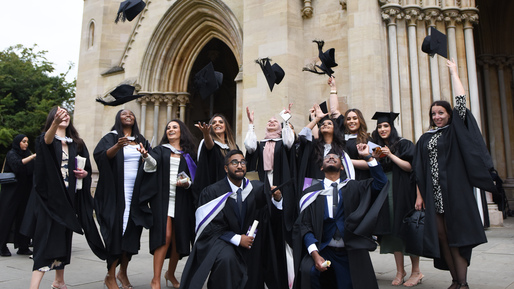
Kennedy Ameh
Head of Operations Strategy at Collins Aerospace
Since graduating, Kennedy has gone on to work for Collins Aerospace, a subsidiary of United Technologies Corp. He currently holds the role Head of Operations Strategy within the organisations Mechanical Systems Business Unit. 'I joined through the graduate development programme, and I have held roles of increasing responsibility throughout my career here. In my role, I am responsible for creating, developing and executing manufacturing strategy across six global sites in Asia and Europe.' Kennedy credits being ‘results driven’ and always rising to the challenge as the driving factors that have gotten him to where he is today.
University experience and opportunities
Kennedy recognises the impact the University made on his career, having been exposed to many fantastic opportunities during his time as a student. He says, 'During my time at the University, I was exposed to a faculty of experts that drew from industry experience and transferred this knowledge to the classroom. I also acquired a plethora of information through the Learning Resources Centre during my placement year in the industry. During my studies, I was challenged to think differently, identifying solutions before problems. I was taught to use my initiative and leverage on teamwork.'
Diverse community
A key factor that made Kennedy choose the University was the diverse community. He says, 'As an international student, the vibrant international community at the University was important to me. However, the real attraction was the rich aviation heritage of the University of Hertfordshire.' Kennedy took advantage of the University’s industry connections to propel himself forward in the sector.
Aspirations for the future
Looking forward, Kennedy intends to stay at Collins Aerospace yet still remains ambitious. He says, 'I want to run an aviation business in the future and I am very conscious of the opportunities emerging in markets like Africa. I hope to be an employer on the continent to enhance, enable and empower young minds like mine to operate globally.'
What you'll study
In your first year, you’ll learn the fundamental skills and knowledge required by a modern engineer, including principles of flight and aircraft operations. You’ll be introduced to computer packages commonly used in the aerospace industry.
In your second year, the first-year core themes are developed for use in aerospace engineering. You’ll learn about the design process through group design and detail design work and expand your knowledge of aerodynamics, with wind tunnel experiments. If you want to take to the sky, you can fly at a local flying school.
Work placement/study abroad option happen between your second and final year, you’ll have the option to study abroad or do a work placement for up to a year. Not only will this give you an amazing experience to talk about but will also give your CV a boost. If you’d rather go straight to your final year, that’s absolutely fine too.
In your final year, you’ll work on two projects. The Aerospace Design group project - is where you’ll showcase your engineering skills. You will be allocated to a team to design an aircraft and test fly it using our flight simulator. Every year the design task is different and in previous years our students designed wide body commercial airliners, heavy cargo aircraft, fire-fighting aircraft, and even strategic bombers. The Individual Major Project - is where you’ll immerse yourself in an area of aerospace engineering, you’re passionate about, using either the University or industrial facilities. This is a rewarding part of your degree that can lead to future employment.
What if I need support?
You’ll get a personal tutor to guide you through your course, all the way to graduation.
You might also want or need extra support during your time with us. Rest assured, no matter what you study, we’ve got you covered. For help with study skills, including referencing, essay writing and presentations, you’ll have access to our academic support services. You can attend workshops, 1-to-1 sessions, and online tutorials. Both our LRCs (Learning Resource Centres) run drop-in study skills sessions. And the best thing is, it’s all free.
Optional placement year
Graduate with invaluable work experience alongside your degree and stand out from the crowd. This course offers you the opportunity to enhance your study and CV with a year in industry, typically between your second and third years of study. It’s a chance to explore career possibilities, make valuable contacts and gain sought after professional skills.
Research shows that over 70% of employers prefer students with work experience, which is why we believe work placements are career gold. Our Careers and Employment service are here to support you explore your options and make valuable contacts for your future career.
You’ll pay no tuition fee for this year and won’t need to worry about the details of your placement until your second year of study.
Study Abroad offers the opportunity for an amazing experience, which will help make you stand out from the crowd. With more and more companies working internationally, experience of living in another country can make a great impression on future employers.
This course offers you the opportunity to enhance your study and CV with a sandwich year abroad. The University has partnerships with over 150 universities around the world, including the USA, Canada, Asia, Africa, Australia, South America and closer to home in Europe.
If you study abroad between your second and third year of study, you’ll pay no tuition fee to the partner university and no tuition fee to us either. We’ll ask you to make your decision in your second year, so there is plenty of time to think about it.
Graduate with invaluable work experience alongside your degree and stand out from the crowd. This course offers you the opportunity to enhance your study and CV with a year in industry, typically between your second and third years of study. It’s a chance to explore career possibilities, make valuable contacts and gain sought after professional skills.
Research shows that over 70% of employers prefer students with work experience, which is why we believe work placements are career gold. Our Careers and Employment service are here to support you explore your options and make valuable contacts for your future career.
You’ll pay no tuition fee for this year and won’t need to worry about the details of your placement until your second year of study.
Find out more about work placementsStudy Abroad offers the opportunity for an amazing experience, which will help make you stand out from the crowd. With more and more companies working internationally, experience of living in another country can make a great impression on future employers.
This course offers you the opportunity to enhance your study and CV with a sandwich year abroad. The University has partnerships with over 150 universities around the world, including the USA, Canada, Asia, Africa, Australia, South America and closer to home in Europe.
If you study abroad between your second and third year of study, you’ll pay no tuition fee to the partner university and no tuition fee to us either. We’ll ask you to make your decision in your second year, so there is plenty of time to think about it.
Find out more about study abroad optionsWhere you'll study
You’ll share College Lane campus with future nurses, scientists, artists and more. You can use the common rooms to relax with friends, work out in the 24-hour gym or have a drink in our on-campus bar or cafes. We also have restaurants for you to eat in or grab something on the go. Our Learning Resources Centres are open 24/7, which means you can study whenever suits you best. Want to pop over to the other campus? You can take the free shuttle bus or walk there in just 15 minutes.
New School of Physics, Engineering and Computer Science building now open
Learn in our new state-of-the-art building called Spectra, where you’ll experience a range of experiential learning zones. You will have access to modelling, simulation and research labs, our Merlin Flight Simulator and automotive workshop (complete with electric vehicle facility), wind tunnel, welding bay and controls testing suite.
You will also benefit from our Academic Support Hub, which is aimed at helping you build your employability and academic skills. Plus, have access to industry mentors who will provide you with pastoral support, vocational guidance, and career progression opportunities.
Spectra also provides space to collaborate, with plenty of workshops, social and meeting spaces available. Even better, the building has been designed with the University’s net zero carbon target in mind, and forms part of our plan to replace or upgrade older sites that are energy inefficient.
Check out our student blogs
How we support our students
At the University of Hertfordshire, we want to make sure your time studying with us is as stress-free and rewarding as possible.
We offer a range of support services, from childcare to counselling, ensuring that you make the most of your time at Herts and can focus on studying, having fun, and have the support you need.
Student Blogs
Pratham - A day in the life on my aerospace engineering course
Hello!
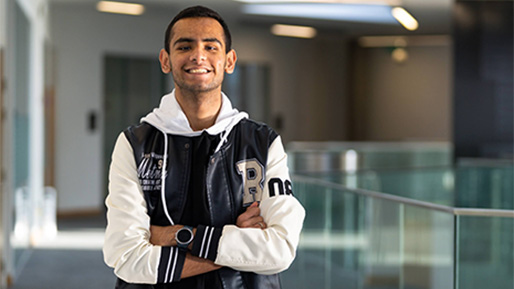
My name is Pratham Dharu and I am currently a Level 5 BEng Aerospace Engineering with Space Technology student at Herts.
I will be taking you through my average daily schedule on the most productive day of the week which would be Monday this semester 😀
A typical Monday
I usually start my day around 6am and wake up and start preparing all meals for the day. Once I am done cooking, I brew myself a cup of coffee and start walking towards The Oval for my morning gym session. After a sweaty session I go back to my room for a shower. After finishing my breakfast, I leave my flat at around 8.45am and go for my 9am Aerodynamics lecture. Aerodynamics is the study of objects under fluid flow - this module mainly covers fluid dynamics and mechanics. At Herts, we use multiple wind tunnels for aerodynamic testing such as CRM, Subsonic and Supersonic, also using industry-grade software such as CATIA and XFLR5 for computational simulations.
I always carry my charger and iPad with me so I can take notes and charge my phone anywhere on campus. After finishing the three-hour lecture, we get a one-hour break, after which I have my weekly appointment with my research mentor to discuss my progress in the research I am doing this year under the University’s undergraduate pathway research programme. After a great discussion with my mentor, I head back to my flat as it is already 1pm and I am hungry by this point in time 😋
After lunch, I clean my room and do my laundry then head to my 3pm practical session for Materials Science module - it's easy for me to get to the classes as it is just a five-minute walk from my flat. Materials is one of the most important topics for aerospace, as it deals with strength and testing different types of material for aircrafts and spacecrafts.
The University has various active student sessions suitable for both freshers and pro league players. The reason I go for active student sessions is not just the fitness, but the free merch you get for just participating in sports such as shirts and hoodies! After practice on my way back to College Lane on my bike, I stop at Aldi which is a two-minute walk from de Havilland Campus, pick up my weekly groceries and head back to my flat. I head to the LRC, which again is just a five-minute walk from my flat.
I finish my homework and work emails on the silent floor as I am the ‘do not disturb’ kind of person when it comes to work or academics. I complete all my work by 10pm and head back home.
This was a productive day in my weekly schedule but usually it is not this busy!
After hours
I enjoy going out with my friends to The Forum for Friday lights or karaoke nights on campus. I participate in a lot of active student and society events and am currently a committee member for four societies at Herts SU. I do occasionally spend my time on the Cessna 172 full scale flight simulators, especially a few days before when I must go for my flying classes so I can complete my 20 hours of flying before I graduate.
This was a typical day in the life of an average aerospace engineer 👨🎓

Student Blogs
Pratham - About the aerospace learning facilities and how I use them on my course
Hello everyone! My name is Pratham and I’m currently studying BEng Aerospace Engineering with Space Technology at Herts.
I have already talked about the theory-based learning in a separate blog, but the real joy of engineering comes from making things happen and bringing things to the real world. I'm going to talk here about the engineering facilities I have benefited from at the University of Hertfordshire so far during my 18 months of studies.
Simulators
The most important facility for any aerospace engineer would be simulators, both for pilot studies and engineering students. Herts has a variety of simulators such as the four-axis merlin simulator that is used for engineering model simulation in the final year projects, but students are trained on all the simulators in the first year. The University has two types of pilot studies simulators running on industry grade X plane software for training pilot studies students on navigations, communications and control systems. These labs are open access which means after appropriate training is done, students can book them to get their hours on the simulator.
Labs
Let’s talk about the facilities I used in my second year during the Materials module: the structural and materials lab that has various tensile testing machines. A particular highlight would be the SEM (Scanning Electron Microscope) which is one of the most amazing machines available to engineering students, for final year projects only.
The next lab I use a lot is the electronics and circuit fabrication labs which have thousands of different types of resistors, wires, circuits and so on. There is a soldering and fabrication room in the lab that students can use for both academic and personal projects (after approval).So now it's time to talk about my favourite: the 3D printing and fabrication workshop! This lab has five different types of 3D printers, laser cutters and all the power and hand tools you could think of. My personal choice is 3D printing - it’s like giving candy to an engineer 😊
Machinery
There are many students who like making the parts by themselves by using powered machines such as the lathe, grinder and CNC.
Wind tunnels
The primary tool of an aerodynamicist! The University has a total of four different wind tunnels - sub-sonic, transonic, closed return and supersonic which are helpful in your second and third years.
So, these are just a few facilities that engineering students at Herts are able to use on a day-to-day basis.
I hope to see all of you at Herts soon 👋

Student Blogs
Pratham - What I love about studying aerospace engineering at Herts
Hello everyone, my name is Pratham Dharu and I'm a second year BEng Aerospace Engineering with Space Technology student at Herts 👋
I am someone who always dreamt about space and how rockets used to work and how humans went to space. I am personally an admirer of the Apollo missions, especially the Apollo 11 mission. So, I decided to pursue a career in space technology and decided to fly 7000 km to live my dream of studying rocket science 🚀
I chose Herts as a medium to live my dream because of the amazing aerospace research and sports that the University offers. So, let’s talk about my experience so far and why I love studying at Herts...
My first semester was partially re-capping my 12th grade physics and maths content and partially learning new topics such as project management, CAD design and aerospace industry. This got me off to a great start!
As I went into semester B of the first year, we studied electronics and programming which was helpful for the CDIO (Conceive, Develop, Implement, Operate) module of Robotics and is also helping me this year in the Thermodynamics and Aerodynamics modules. The faculty at Herts knows the software that is currently being used in the industry and includes it in our curriculum: Solid is a popular CAD (Computer Aided Design) software used for 3D modelling and is a great option for students to use but is not popular in the aerospace industry. CATIA V5 is the major software used for CAE (Computer Aided Engineering) in the aerospace industry. The best part is that I haven’t needed to buy any of the software as everything is available in the University library/computer lab for students to download 😀
Let’s now talk about my current semester!
From the second year, things do start to get a little tough and you must put in the self-study and work. The faculty members, technical officers and the SPECS Academic Support Hub (SASH) staff are always there to help you with any kind of academic help you might require such as citations and academic writing. There is also a team of senior faculty members at the Academic Math Support Hub who are always welcoming and encouraging students who wish to learn higher level concepts that might help them with personal research or in final year projects.
The first semester modules include specific aerospace modules such as Thermodynamics, Materials and Aerodynamics. If you still have extra time, you can volunteer to be a SPECS student representative or join multiple academic clubs at SPECS; you can choose from 40 different clubs and activities so there is something for everyone! I am currently a member of the Drone club, and UP research. A club that aerospace students like to join is the UH Racing club, helping with aerodynamic analysis of the Formula student cars developed by UH Racing club.
But if I had to choose between all the facilities and resource available at SPECS, I would choose the teaching and faculty members who understand students as well as the industry and help with one-on-one drop-in sessions to understand the problems we students face on a personal basis and try to resolve them.
So that was a summary of my journey of studying aerospace engineering at Herts. Hope to see you guys at SPECS soon 😊
Entry requirements
Clearing entry requirements
The University of Hertfordshire is committed to welcoming students with a wide range of qualifications and levels of experience. The entry requirements listed on the course pages provide a guide to the minimum level of qualifications needed to study each course. However, we have a flexible approach to admissions and each application will be considered on an individual basis. This also applies to Clearing applications, so if you don’t have the advertised grades, you can submit a Clearing application and we’ll review and consider your application on an individual basis.
| Typical offer (UCAS points) | 120 |
|---|---|
| Typical A Level offer | BBB Mandatory subjects: Mathematics Excluded subjects: General Studies, Critical Thinking |
| Typical IB offer | 120 UCAS points from a minimum of two HL subjects at grade 4 or above to include HL Mathematics and HL Physics or HL Technology or engineering-based subjects |
| Typical BTEC offer | DDM Mandatory subjects: Extended Diploma in Engineering (DDM) to include merit in a Mathematics unit and Principles at Level 3 |
| Accepted T Levels | Design and Development for Engineering and Manufacturing (with specialism 'Mechanical Engineering' OR 'Control and Instrumentation Engineering') grade M, plus A Level Maths grade B Engineering, Manufacturing, Processing and Control OR Maintenance, Installation and Repair for Engineering and Manufacturing will be considered at Admissions Tutor discretion dependent on specialism, plus A Level Maths grade B |
| Access courses | Engineering diploma with 30 Level 3 credits at distinction, to include Mathematics or Science or Principles units, with the remaining 15 Level 3 credits at merit |
| GCSE | Grade 4/C in English Language and 4/C Mathematics |
| Additional information | Find out more about our Undergraduate Entry Requirements Academic Technology Approval Scheme (ATAS: All students applying for specific courses who are on time-limited visas are required to obtain ATAS approval prior to registering on the course. Find out more about the Academic Technology Approval Scheme (ATAS) |
| English language | All students from non-majority English speaking countries require proof of English language proficiency, equivalent to an overall IELTS score of 6.0 with a minimum of 5.5 in each band. If you do not have the required IELTS or equivalent for direct entry on to your degree programme, our Pre-sessional English and International Foundation courses can help you to achieve this level. |
|---|---|
| Additional information | Find out more about International Entry Requirements. |
Ready to apply?
UK and EU applicants with pre-settled/settled status in the UK
| Start date | Study type | Apply |
|---|---|---|
| September 2026 | Full time | Apply via UCAS |
| Full time with placement year | Apply via UCAS | |
| Full time with study abroad year | Apply via UCAS | |
| September 2027 | Full time | Apply via UCAS |
| Full time with placement year | Apply via UCAS | |
| Full time with study abroad year | Apply via UCAS |
International and EU applicants without pre-settled status in the UK
Apply through Clearing


Our Clearing hotline is open for support, Monday - Thursday 9.00-16.45 and Friday 9.00-15.45. You can apply online at any time.
Fees and funding
At Herts, we’re dedicated to providing world-class teaching supported by industry-level facilities and incredible social spaces. We believe cost shouldn’t be a barrier to higher education, and we strive to keep both our standard and additional costs as low as possible.
Falko Aerospace Scholarship
The scholarship is valued at £2,000 and is awarded to a BEng Aerospace Engineering student progressing into their second year. To apply, you will be invited to submit an application during your first year of study. The shortlist of applicants will be interviewed by a judging panel and a winner identified.
Sir Gerard Newman Scholarship
The Sir Gerard Newman scholarship is valued £2,000 (£500 paid in the first and second year, £1,000 in the final year) and is awarded every year to a UK or EU student studying on any aerospace, automotive, civil or mechanical engineering degree. To apply you will be invited to submit an application in your first year at University.
| Study type | Fees | |
|---|---|---|
| UK students | Full time | £9,790 for the 2026/2027 academic year |
| EU students | Full time | £17,450 for the 2026/2027 academic year |
| International students | Full time | £17,450 for the 2026/2027 academic year |
Tuition fees are charged annually. The fees quoted above are for the specified year(s) only. Fees may be higher in future years, for both new and continuing students. Please see the University’s Fees and Finance Policy (and in particular the section headed “When tuition fees change”), for further information about when and by how much the University may increase its fees for future years.
| Scholarships, grants and bursaries | Depending on your circumstances, you may be eligible for a non-repayable scholarship, grant or bursary to support your studies. |
|---|---|
| Disabled Students' Allowance | The Disabled Students’ Allowance can cover any study-related costs you have because of a mental health problem, long term illness or any other disability. |
| Student loans | Find out about securing a student loan, from how much you could be eligible for to when you need to start making repayments. |
| Accommodation costs | We offer a great choice of student accommodation, on campus or nearby in the local area, to suit every student budget. |
| Additional course fees | Read more about additional fees in the Programme Specification. |
| Study type | Fees | |
|---|---|---|
| UK students | Full time | £10,050 for the 2027/2028 academic year |
| Part time | £1,225 per 15 credits for the 2027/2028 academic year | |
| EU students | Full time | £17,970 for the 2027/2028 academic year |
| Part time | £2,246 per 15 credits for the 2027/2028 academic year | |
| International students | Full time | £19,025 for the 2027/2028 academic year |
| Part time | £2,246 per 15 credits for the 2027/2028 academic year |
Tuition fees are charged annually. The fees quoted above are for the specified year(s) only. Fees may be higher in future years, for both new and continuing students. Please see the University’s Fees and Finance Policy (and in particular the section headed “When tuition fees change”), for further information about when and by how much the University may increase its fees for future years.
| Scholarships, grants and bursaries | Depending on your circumstances, you may be eligible for a non-repayable scholarship, grant or bursary to support your studies. |
|---|---|
| Disabled Students' Allowance | The Disabled Students’ Allowance can cover any study-related costs you have because of a mental health problem, long term illness or any other disability. |
| Student loans | Find out about securing a student loan, from how much you could be eligible for to when you need to start making repayments. |
| Accommodation costs | We offer a great choice of student accommodation, on campus or nearby in the local area, to suit every student budget. |
| Additional course fees | Read more about additional fees in the Programme Specification. |
More about the course
| Programme specifications | |
|---|---|
| BEng (Hons) Aerospace Engineering with Study Abroad - Full time, Sem A | Download PDF |
| BEng (Hons) Aerospace Engineering - Full time, Sem A | Download PDF |
| BEng (Hons) Aerospace Engineering (Part Time, Semester A Intake) | Download PDF |
| BEng (Hons) Aerospace Engineering with Placement Year - Full time, Sem A | Download PDF |
| BEng (Hons) Aerospace Engineering with a Year Abroad - Full time, Sem A | Download PDF |
| Additional information | |
|---|---|
|
Applications open to international and EU students |
Yes |
Course length |
Full Time, 3 YearsSandwich, 4 Years |