
Strategy and governance
Sustainability is a strategic priority for the University of Hertfordshire and is embedded throughout the way we plan, govern and operate as an institution.
Our governance framework provides strategic leadership, accountability and oversight for sustainability activities across the University. It ensures sustainability objectives are aligned with institutional priorities, embedded within decision-making processes and supported through transparent reporting and continual improvement.
Through collaboration between academic schools, professional services, students, staff and external stakeholders, we work to ensure sustainability remains an integral part of the University’s long-term development.
Our sustainability framework
The Environment and Sustainability Framework provides the strategic direction for sustainability across the University and establishes the priorities that guide our activities.
The Framework identifies four key impact areas:
- climate change;
- biodiversity;
- waste and resource management;
- sustainable communities.
These priorities are delivered through the University’s sustainability pillars:
- our estate and operations;
- sustainable communities;
- education and student experience;
- research, enterprise and knowledge exchange;
- responsible procurement and partnerships.
Together, these pillars provide a coordinated approach to sustainability across teaching, research, operations and engagement activities.
Governance structure
The University has established a governance framework that provides strategic oversight, operational coordination and stakeholder engagement across sustainability activities.
This framework supports:
- strategic leadership;
- accountability;
- performance monitoring;
- stakeholder engagement;
- risk management;
- continual improvement.
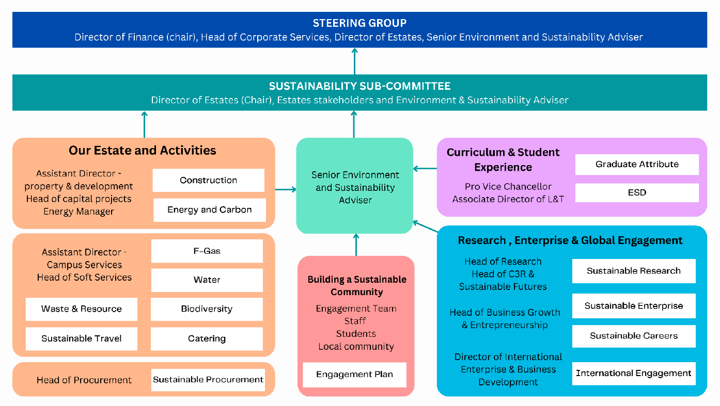
The governance structure ensures sustainability is embedded throughout the institution and supported through clear responsibilities and reporting arrangements.
Sustainability steering group
The Sustainability Steering Group provides strategic oversight of sustainability activity across the University.
The Group is responsible for:
- Monitoring delivery of the Environment and Sustainability Framework
- Reviewing sustainability performance
- Supporting delivery of institutional sustainability objectives
- Identifying risks and opportunities
- Reviewing progress against targets and commitments
- Providing strategic direction
The Steering Group ensures sustainability remains aligned with the University’s wider strategic priorities.
Related Document
Sustainability sub committee
The Sustainability Sub Committee supports the implementation of sustainability objectives through collaboration across the University community.
Membership includes representatives from academic schools, professional services, Estates, Hertfordshire Students’ Union and recognised trade unions.
The Committee provides a forum for discussion, collaboration and the development of sustainability initiatives whilst ensuring a broad range of perspectives inform decision-making.
Related Document
Working groups
A number of specialist working groups support the delivery of sustainability objectives across key themes.
These groups provide subject matter expertise, stakeholder engagement and operational support.
Current working groups include:
- Biodiversity Working Group
- Sustainable Food Working Group;
- Travel Working Group;
- Waste Working Group
Each group operates under approved Terms of Reference and reports through the University’s governance structure.
Related Documents
- Biodiversity Working Group Terms of Reference
- Sustainable Food Working Group Terms of Reference
- Travel Working Group Terms of Reference
- Waste Working Group Terms of Reference
Environmental management system
The University operates an Environmental Management System (EMS) certified to ISO14001:2015 and accredited through EcoCampus Platinum.
The EMS provides a structured framework for:
- legal compliance;
- environmental risk management;
- objective setting;
- performance monitoring;
- internal auditing;
- management review;
- continual improvement.
Independent certification provides assurance that environmental management processes remain effective and robust.
Measuring Performance
Performance monitoring is essential to understanding progress and identifying opportunities for improvement.
The University monitors a range of sustainability indicators and reports progress through established governance arrangements.
Key performance information is reviewed regularly to support evidence-based decision making and ensure accountability across the institution.
Areas monitored include:
- carbon emissions;
- energy consumption;
- water consumption;
- waste and recycling;
- resource efficiency;
- biodiversity initiatives.
Further performance information is available through the Sustainability Dashboard and Annual Sustainability Performance Report.
Transparency & Accountability
The University is committed to transparency in the management and reporting of sustainability performance.
Policies, plans, reports and governance documents are published to provide staff, students and stakeholders with visibility of sustainability commitments, activities and progress.
Regular reporting supports accountability and helps ensure sustainability objectives remain embedded within institutional decision-making.
Continual Improvement
The University is committed to continually improving its sustainability performance.
Through effective governance, stakeholder engagement, environmental management and transparent reporting, we seek to identify opportunities to strengthen sustainability outcomes and respond to emerging challenges and opportunities.
Regular review of objectives, performance data, legislation and stakeholder feedback helps ensure our sustainability programme remains effective, relevant and aligned with the University’s strategic ambitions.