
Cosmology
Lyman-alpha forest as a tool for precision cosmology (Irsic)
The Lyman-α forest — a tracer of neutral hydrogen gas in the intergalactic medium — has become one of the most powerful cosmological probes at high redshift. Researchers at the University of Hertfordshire are at the forefront of this international effort, through leading roles in both the Dark Energy Spectroscopic Instrument (DESI) and in state-of-the-art analyses of the three-dimensional (3D) Lyman-α forest power spectrum. Hertfordshire scientists have been instrumental in advancing statistical and modelling techniques to extract cosmological information from the forest, including pioneering work by de Belsunce et al. (2024) on the full-shape 3D power spectrum using the eBOSS DR16 quasar sample. That study introduced a novel configuration-space estimator capable of handling the sparse sampling of quasar sightlines, validated on extensive mock data, and demonstrated the feasibility of precision cosmology with the 3D Lyman-α field. Building on this foundation, the DESI Lyman-α Working Group, co-led by Dr Vid Irsic (2020–2023), has now delivered the most precise high-redshift distance measurements ever achieved. When combined with galaxy and quasar clustering results presented in the DESI DR2 Main Cosmology paper (DESI Collaboration 2025), these measurements offer strong evidence for an evolving dark-energy component, marking the first indication of a possible deviation from the cosmological constant. These breakthroughs represent a major milestone in mapping the cosmic expansion history deep into the early Universe.
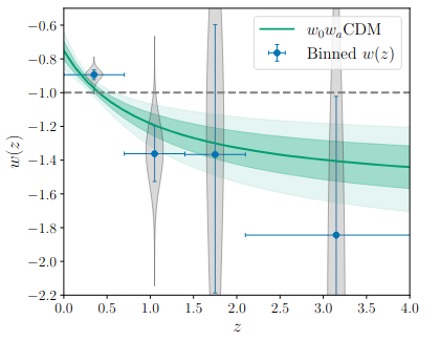
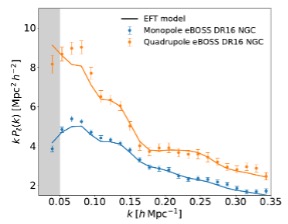
Figure 1: (Left) The Dark Energy Spectroscopic Instrument (DESI) has provided first hints of evolving dark energy, which implies physics beyond the standard model of cosmology and dark energy as a cosmological constant. The figure shows the reconstructed equation of state (ratio between dark energy pressure and density) as a function of redshift, compared to the best-fit w0waCDM model from DESI DR2 (DESI collaboration). (Right) The first measurements of the full 3D Lyman-alpha transmitted flux power spectrum in the spectra of eBOSS DR16 quasars. The theoretical prediction from a perturbative effective field theory of large-scale structure agrees incredibly well with the measurements, suggesting that the same theory can spawn billions of years over cosmic history of non-linear structure evolution. Such measurements will provide further constraints on the standard model of cosmology, including dark energy.
The Nature of Dark Matter (Irsic)
High‑resolution measurements of the Lyman‑α forest — the absorption features seen in quasar spectra caused by intervening neutral hydrogen in the intergalactic medium — have been used to probe the small‑scale clustering of matter. The one‑dimensional flux power spectrum (P1D) of the Lyman‑α forest, obtained from instruments such as the Very Large Telescope (VLT/UVES) and the Keck Observatory (HIRES), has been compared with hydrodynamical and cosmological simulations to place stringent constraints on dark‑matter models that suppress structure at small scales (via free‑streaming or wave‑like behaviour). The constraints are derived through Bayesian Likelihood inference and supported by cosmological simulations (link to Sherwood-RELICS Herts page).
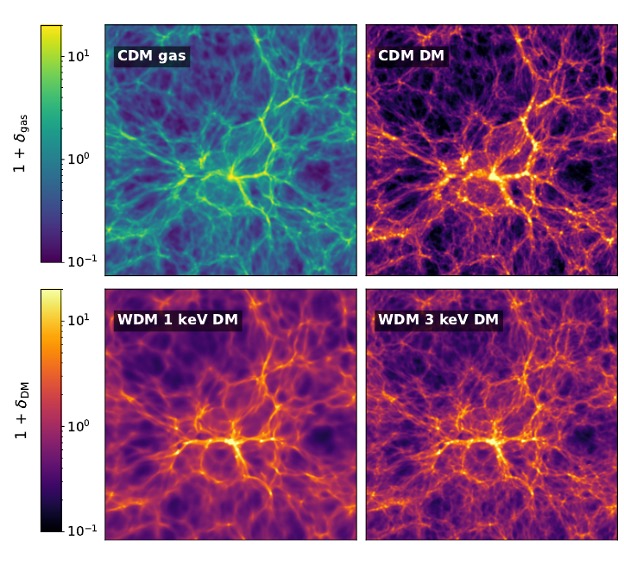
Figure 2: A slice through a cosmological hydrodynamical simulation, with volume of (20 Mpc/h)^3 and 2x1024^3 number of gas and dark matter particles. Different panels show the gas density (top left) and dark matter density (top right) in a standard cold dark matter (CDM) model. The bottom panels show only the dark matter density for two alternative models with smaller dark matter particle masses of 1 and 3 keV. These simulations are taken from Sherwood-RELICS suite of simulations that was used to compare observations of the Lyman-alpha forest in simulations and in observations to constraint warm dark matter models (Irsic et al. 2024; Garcia-Gallego et al. 2025).
Ultra‑light axions
The nature of ultra‑light bosonic dark matter, often referred to as “fuzzy” dark matter, has been constrained using Lyman‑α forest data and hydrodynamical simulations (Iršič et al. 2017). Masses in the range ~1–10 ×10⁻²² eV are strongly ruled out, with a combined lower limit of ~20 ×10⁻²² eV (2σ) based on high‑resolution quasar spectra. Further restrictions on post‑inflation ultra‑light axion models were obtained through analyses of early structure formation, indicating that the dominant dark matter component cannot consist of ultra‑light axions within the canonical “string axiverse” window without conflicting with observed small‑scale structure (Iršič et al. 2020).
Warm dark matter (including mixed cold + warm models)
Constraints have also been placed on warm dark matter (WDM) and mixed cold + warm dark‑matter (CWDM) scenarios. Most recently, a lower bound of ~5.7 keV (95 % CL) was derived for a thermal‑relic WDM particle using high‑resolution, high‑redshift quasar spectra from HIRES and UVES (Iršič et al. 2024). In addition, the fraction of WDM in CWDM models has been constrained: for mWDM = 1 keV, the warm component fraction is limited to fWDM < 0.16 (2σ), increasing to ~0.35, 0.50, and 0.67 for masses of 2, 3, and 4 keV, respectively (Garcia‑Gallego & Iršič et al. 2025). These results indicate that the dominant dark-matter component must be sufficiently cold to allow the observed small‑scale structure in the high‑redshift intergalactic medium.
Overall, the evidence suggests that the dominant dark matter component is unlikely to be extremely light or substantially warm, supporting the standard cold‑dark‑matter paradigm while leaving room for sub‑dominant deviations. Continued involvement in observational programmes, such as the EQUALS survey on VLT/ESPRESSO (led by T. Berg) and the GHOSTLy survey on Gemini/GHOSt (led by S. Bosman), is expected to provide higher-precision Lyman‑α forest data to further refine constraints on the nature of dark matter.
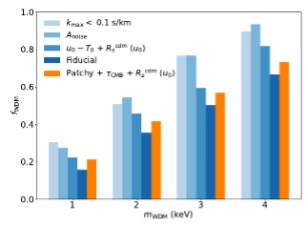
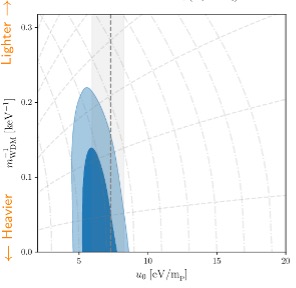
Figure 3: (Left) Amount of fractional energy that a warm component of the dark matter is allowed to have as constrained by the high redshift Lyman-alpha forest data. For heavier masses, a large fraction of the energy density of the Universe could be composed of such particles; but for lighter particles the fractional density is severely limited (Garcia-Gallego et al. 2025). (Right) The constraints on the warm dark matter particle mass and cumulative injected heat that was deposited into the intergalactic medium during the process of reionization (Irsic et al. 2024).
Simulations, Machine Learning, and Bridging Astrophysics with Cosmology (Irsic)
High-resolution cosmological and hydrodynamical simulations have been developed to explore variations in both astrophysical and cosmological parameters simultaneously. The CAMELS project, for example, provides thousands of simulations designed for use in machine learning and statistical inference frameworks, enabling the study of degeneracies between astrophysical feedback processes and cosmological parameters such as the growth of structure or dark matter properties (Villaescusa‑Navarro et al., 2022). By integrating large-scale simulations with advanced data-driven techniques, detailed modelling of the IGM, galaxy formation, and feedback processes has been linked to the analysis of observable structures. This approach effectively bridges the gap between astrophysics and cosmology, providing tools and frameworks that are essential for interpreting data from upcoming surveys and observational campaigns.
Inflation, Primordial Physics, and Initial Conditions (Irsic)
The imprint of primordial physics and the initial conditions of structure formation has been studied through the analysis of small-scale cosmological observables. Observations of the IGM and the Lyman‑α forest have been used to constrain properties of early-universe phenomena such as primordial magnetic fields, providing novel probes of inflationary physics and other processes in the primordial epoch (Pavičević et al., 2025; UH press release). High-resolution simulations combined with absorption-line data have been employed to place limits on the characteristics of the early Universe, including the spectrum of primordial fluctuations and the nature of dark matter. This research demonstrates the potential of small-scale structure observations to inform fundamental questions in cosmology, linking modern astrophysical measurements with the conditions present in the early Universe.
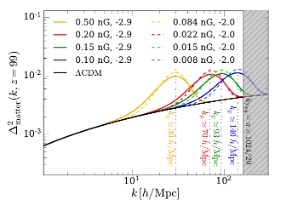
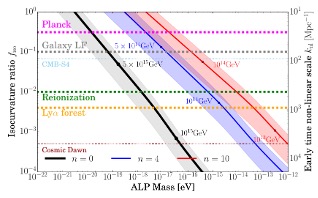
Figure 4: (Left) Recent analysis of the intergalactic cosmic web put stringent constraints on the strength of the primordial magnetic fields in the Universe, with the allowed strengths to be below 0.2 nG. These tiny magnetic fields nevertheless leave a detectable imprint on the matter distribution, shown as the a little peak in the figure, that arises due to competing effects of Lorentz force clumping gas tighter together and Alfven-wave dissipation of the magnetic energy (Pavicevic et al. 2025). (Right) Exotic models of inflation and primordial physics, such as axion-like particles (ALP), can be constrained using cosmological data. The figure shows current existing constraints (dashed horizontal lines) and forecasts of future observations (dotted horizontal lines) on the ability to constrain the presence of isocurvature perturbations sourced by light axion models of different ALP masses and coupling constants (Irsic et al. 2020).