
Magnetic fields in the infant Universe may have been billions of times weaker than a fridge magnet
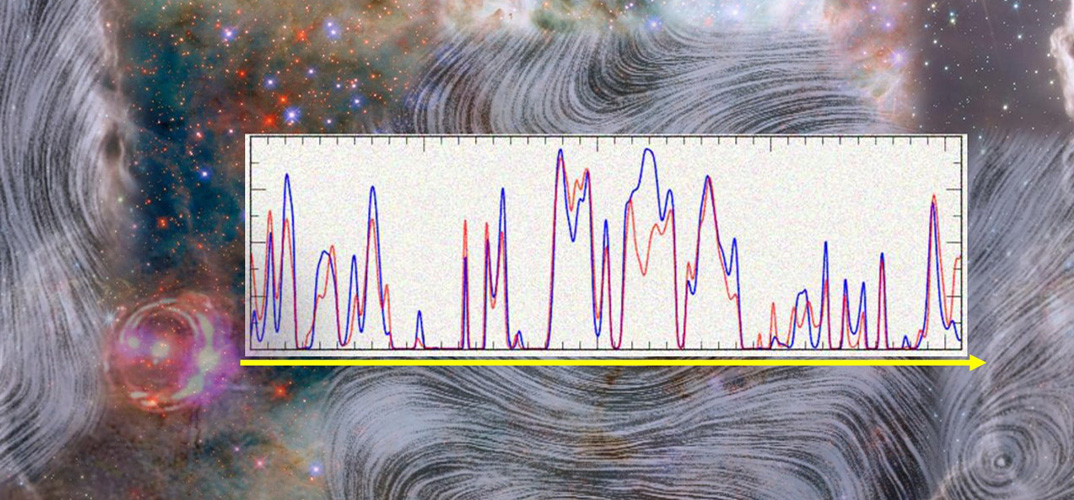
The magnetic fields contain strengths comparable to magnetism generated by neurons in the human brain. Yet, despite such weakness, quantifiable traces of their existence still remain in the cosmic web, the visible cosmic structures connected throughout the Universe.
These conclusions emerge from a study using around a quarter of a million computer simulations, conducted by a team from SISSA (Scuola Internazionale Superiore di Studi Avanzati, based in Trieste) in collaboration with the Universities of Hertfordshire, Cambridge, Nottingham, Stanford, and Potsdam. Observational data were subsequently used to validate these findings.
The research specifies both possible and maximum values for the strengths of primordial magnetic fields. It also offers the possibility of refining our knowledge of the early Universe and the formation of the first stars and galaxies.
At the origin of the Universe with a quarter of a million simulations
The international team used over 250,000 computer simulations to study the cosmic web and better understand the influence of primordial magnetic fields.
Dr Vid Iršič, a senior lecturer in the School of Physics, Engineering & Computer Science (Spectra) from the University of Hertfordshire, and a co-author of the study, says that “these are the most realistic and largest suite state-of-the-art simulations of the influence of primordial magnetic field on the intergalactic cosmic web.”
Mak Pavičević, a SISSA PhD student is lead author of the research, and Matteo Viel, his supervisor and also co-author of the study, explain further:
"By comparing these simulations with observational data, we saw that our hypotheses were correct. When the influence of primordial fields is included in the picture, the cosmic web looks different and more in agreement with observed data. In particular, we can say that a standard model of the Universe with a very weak magnetic field of around 0.2 nano-gauss actually fits experimental data much better."
A magnetic cosmic web
Mak Pavičević adds that:
“The cosmic web, of which much remains to be discovered, is a filamentary structure connecting the galaxies that permeates the Universe. One of its many unsolved mysteries is why it is magnetised, not only near galaxies, where this might be expected, but also in distant regions that are sparsely populated and constitute the bulk of the cosmic web. This is harder to explain.
"Our hypothesis was that this could be a legacy of events occurring in cosmic epochs during the birth of the Universe, and that magnetism was linked essentially to physical processes in the primordial Universe. For example, the filaments would have become magnetised during the inflation process before the so-called "Big Bang" or through events in later epochs, called phase transitions. This is what we sought to ascertain with our work.”
The magnitude of primordial magnetic fields: a new upper limit
The scientists have derived a particularly low value for the magnitude of the primordial magnetic fields, establishing a new upper limit several times lower than previously estimated.
Pavičević and Viel add: "This evidence will help us to improve our understanding of events in the early Universe. The magnetic field would have increased the density of the cosmic web, in turn accelerating the process of star and galaxy formation. It will be possible to further validate our results through observations made by the James Webb Space Telescope."
Dr Vid Iršič concludes: “Not only will these new limits help us understand the impact of the primordial magnetic fields on the evolution of the Cosmos, but they also hold important implications for other theoretical models that enhance structure formation”.