
Medical students should meet real patients from year one – that’s how they learn to be compassionate doctors.
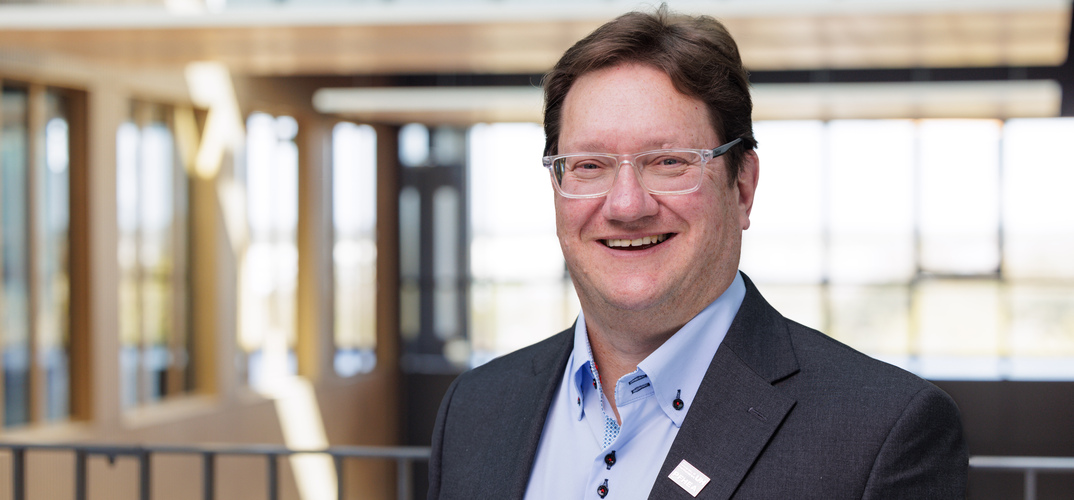
What makes a great doctor? According to Professor Earle Abrahamson, it starts with meeting patients early, learning from other healthcare professionals and developing compassion from day one. As Hertfordshire Medical School welcomes its first cohort, he shares the thinking behind its innovative approach to medical education.
“For as long as I can remember, I’ve had the idea that I would end up in medicine. I remember my parents collecting me from nursery school in Johannesburg, where I grew up, saying ‘we’re here for Dr Earle’”.
Nowadays, Dr Earle is Professor Abrahamson, Head of Anatomy at the University of Hertfordshire.
He wears another hat too: he also leads interprofessional learning within the Hertfordshire Medical School, which started welcoming its first cohort of student doctors this week to study the University's new Bachelor of Medicine and Bachelor of Surgery (MBBS) medical degree. Working with colleagues across the University, their aim is to create meaningful opportunities for future doctors to learn alongside students from other healthcare professions.
It’s very apt. Professor Abrahamson – whose own training spans anatomy, sports medicine, clinical psychology, and pedagogy (the study of teaching itself) - has published books and papers on the power of breaking down silos in education.
What does interprofessional learning mean for medical students at Hertfordshire Medical School? And why does it matter? Professor Abrahamson explains:
“Healthcare is a team sport. From the moment a patient enters the system, they’ll see professionals from different disciplines working together. Doctors, nurses, pharmacists, paramedics, radiographers, physiotherapists and others all bring distinct expertise and perspectives.”
To prepare students for this reality, the teaching team creates opportunities for them to see how different professions approach patient care. For example, pharmacy students might explain to medical students the effect of different drugs, and medical students might explain reciprocally what they know about an individual patient and their condition. The idea is that learning together like this helps students to develop the communication, teamwork and collaborative decision-making skills that are essential in modern medicine.
As students’ knowledge and clinical experience grow, they start to explore realistic patient cases with students from other disciplines. Staff steer discussions where necessary, to encourage students to consider patient needs from different perspectives. This builds teamwork as well as confidence in voicing their own ideas and insights.
“Our aim is not simply for students to understand their own professional identity,” says Professor Abrahamson. “It is to help them appreciate the expertise of others and recognise that the best patient outcomes are achieved when healthcare professionals work together.”
Professor Abrahamson believes that active learning is the hallmark of a modern medical school. It will help future medics to become forward-looking, open-minded, critical thinkers. Another marker of a contemporary approach is the embedding of compassion in the curriculum. And that’s created through exposure to patients from the start. He explains:
“At Herts, we build clinical experience into the first year. So students are already engaging with GP practices, observing consultations and taking patient histories. I think by exposing students to patients early on in their experience, they can begin to build the compassion they will need in the years ahead.”
Of course, Professor Abrahamson indicates that there’s another signifier of a thoroughly modern medical school: embracing up-to-the-minute technology.
At Hertfordshire Medical School, students will have all ‘mod cons’. The team are facing into the future. Professor Abrahamson says:
“We’re embracing technology, and AI, in a responsible, ethical way. In five years’ time, when our first cohort qualify, they will need to be ready for the world as it is then.
“So, we have state-of-the-art anatomy tables called Anatomage. Imagine a giant iPad with real bodies that they can virtually dissect. Students can remove tissue layer by layer, work out a cause of death or examine a diseased lung. They see births, heart attacks, surgeries.
“And we use 3D printers. If students scan one of their own organs, they can 3D print it, and then study it in detail. That’s the kind of opportunity that students connect with, and that they remember.”
Herts has a Human Tissue Authority licence which means students can study from plastinated specimens. They’re the exact same specimens used in the famous Body Worlds museum expo, which the team has attained. The medical school has 107 specimens which students can inspect.
And there are two immersive rooms, where the team can simulate life in an operating theatre, emergency department, or elsewhere.
“Nothing replaces the human experience” continues Professor Abrahamson, “so we have actors who will come in and pose as patients, as well as real patients who will talk to the students about living with their own diagnoses.”
What is Professor Abrahamson – or, indeed, Dr Earle - most looking forward to?
“I'm incredibly excited to see students embarking on the creative and innovative course that we’ve spent years preparing.”
Find out more about studying at Hertfordshire Medical School.