
“I was the first person in my family to go to university: representation matters to students.”
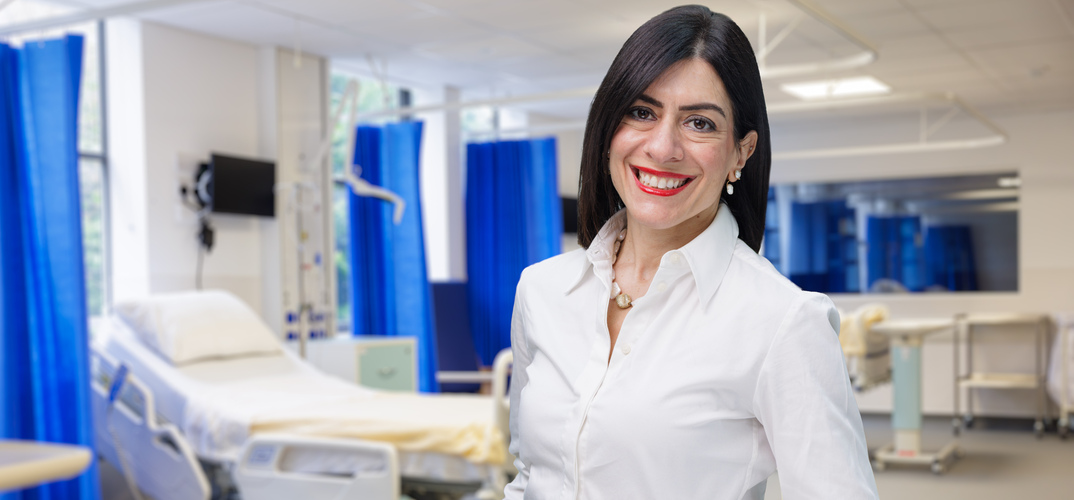
From widening access to medicine to tackling workforce shortages, Professor Irene Ctori, Dean of the School of Health, Medicine and Life Sciences at the University of Hertfordshire, explains why the county's first medical school is about more than educating future doctors - it's about building healthier communities and strengthening the NHS for generations to come.
For Professor Irene Ctori, the arrival of Hertfordshire Medical School’s first students will be more than a landmark moment for the University. It will be a powerful reminder of what becomes possible when people can see a place for themselves in medicine.
As the first person in her family to attend university and pursue a career in healthcare, she understands personally how much representation matters.
“I'm Greek Cypriot,” she explains. “I was born in the UK after my parents emigrated in the early 1970s. No-one in my family had a background in healthcare - I’m the first to go and do anything like this. They were massively proud. And I know that the families of our first cohort of medical students will be feeling the same way: bursting with pride for the undergraduates.”
Now the Dean of the School of Health, Medicine and Life Sciences, within which the new Hertfordshire Medical School sits, Professor Ctori is helping to shape a medical school with a wider purpose: to open doors, transform healthcare education and build the workforce Hertfordshire’s communities need.
An optometrist by background, her career has spanned three decades of clinical practice, research, education and leadership. That experience has convinced her that tomorrow’s doctors must learn not only the science of medicine, but how to collaborate across professions, communicate with people from every background and understand the communities they serve.
“I started my career as a clinician. I worked in community practices, and in a large eye department in an NHS Hospital and then moved into higher education taking on progressively more senior leadership roles within that.
“My clinical background has been invaluable in teaching: it’s so important to practise what we preach, but also to share real examples of lived experience. It's one thing to learn from a textbook, or through simulation or in a classroom. It’s another to hear from teachers about real patients. Experience brings teaching to life. And it’s the unique patient stories that students will remember in years to come.”
Professor Ctori, who joined the University of Hertfordshire in March 2025, says over the years she found herself wanting to get more involved in designing curriculums. Elsewhere, she began to see opportunities to strengthen health professions education, particularly in ensuring that the way students learn keeps pace with the changing needs of patients and communities.
One of the most forward-thinking aspects of the new medical school is the interprofessional nature of the education. And Hertfordshire, with its over 90 different healthcare courses, is among the best placed to deliver this.
“No longer do healthcare professions work in silos. Doctors work with nurses, with physiotherapists, with optometrists, with pharmacists and so on. Students need to learn like that. They will be working in a multidisciplinary team. And so they need to learn in those environments. When they go out into practice, they will be in a community of nurses, occupational therapists, radiotherapists, radiographers, and more. In the new medical school, the curriculum is designed for them to have opportunity to learn from each other.”
Professor Ctori has innovated in other ways too. And one such way relates to teaching students how to communicate with patients.
“I’d seen students practicing the standard scripts they’d been taught and thinking ‘actually, that's not what will work in the real world.’ Some patients want details, and technical language, many don’t - you have to tailor it. Different patients receive information in different ways. So, our students learn how to make things accessible, thinking how to break it down, repeating it, being really clear. Clinicians need to adapt to the individual person in front of them.”
Understanding health issues is as much about equality as anything else. Professor Ctori explains that patchy equality and accessibility in healthcare means that we end up with underserved populations who are not receiving the right healthcare. What stops people coming forward for health checks is varied: sometimes it’s the cost of travel or of missing work, sometimes it’s a fear of being told something they don’t want to know.
Professor Ctori believes that equality of opportunity matters for students as well as for patients:
“This is a university for the community and for the locality, and that’s really important. And this is Hertfordshire’s first medical school. We are home-growing medics. Whether they are international students, as the first cohort are, or domestic, as future students will be, we’re training clinicians to service our own region.”
The national shortage of GPs hits particularly hard in Hertfordshire. Here, there are only 0.5 GPs per 1000 people, whereas the national average is 2.8. The medical school is therefore answering not just a national need but also a local one. Professor Ctori expands:
“Our graduates will spend seven formative years living, learning and working in this region. They won’t just be studying medicine here, they’ll be contributing to healthcare in the communities around them from day one.”
For Professor Ctori, that is one of the most significant long-term benefits of Hertfordshire Medical School.
“People often choose to stay where they have trained. By educating doctors here, we have an opportunity not only to address workforce challenges today, but to build a stronger, more sustainable healthcare workforce for Hertfordshire in the years ahead.”
Find out more about studying at Hertfordshire Medical School.