
The real magic of magic
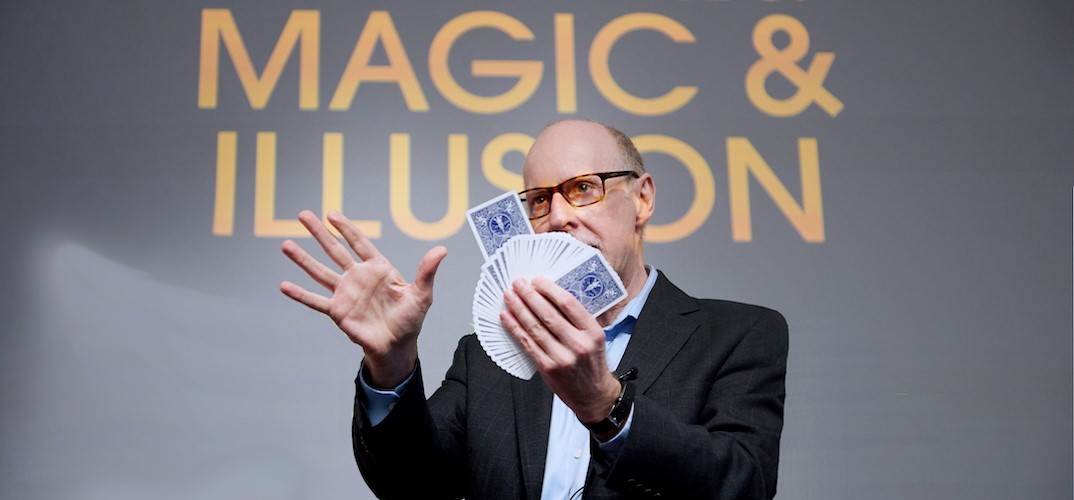
When I was a child, my grandfather showed me a great magic trick. He placed a Victorian penny into his hand and made it disappear. Next, he picked up a small metal tin and revealed that it contained the coin. Enthralled, I went to my local library, read lots of magic books, and became hooked.
I eventually joined The Magic Circle, performed hundreds of shows, and even appeared at The Magic Castle in Hollywood. In my late teens I became interested in the psychology of magic, examining how conjurers control attention, play with perception and manipulate memory. I studied for an undergraduate psychology degree at University College London (selected, in part, because of its proximity to The Magic Circle), completed a doctorate on deception at Edinburgh University, and then joined the University of Hertfordshire.
The relationship between magic and psychology has a long history and has attracted the attention of several well-known researchers over the years, including Alfred Binet and Joseph Jastrow. Building on this work, my initial studies identified the key principles behind conjuring (Lamont & Wiseman, 1999) and examined the psychology used by fake psychics (Wiseman, Greening & Smith, 2003; Wiseman & Morris, 1995).
I then started to focus on the psychological and physical benefits associated with watching and learning magic. The area has attracted a large amount of research, including studies examining how magic aids patients’ recovery in hospitals, promotes motor skills and coordination in occupational therapy, helps to develop life skills during counselling sessions, and promotes attention and curiosity in the classroom. Unfortunately, magic tends to be neglected by mainstream practitioners, in part because this work is often published in relatively obscure books and articles. To help address this issue, I recently co-authored several papers reviewing the area (Wiseman & Watt, 2018; 2020) and published a book on the topic (Wiseman, 2023).
I have also carried out several experimental studies into magic. In one educational project (undertaken with sleight of hand artist Dr Will Houstoun), we showed how magic enhances engagement and absorption for educational science videos (Wiseman, Houstoun, & Watt, 2020). Videos using this technique have now attracted over 900,000 views on YouTube. In other work, we showed how teaching schoolchildren magic tricks promoted creativity in the classroom (Wiseman, Wiles & Watt, 2021).
Eager to utilise the power of magic in the real world, I also teamed up with one of America’s best-known children’s entertainers to create performances that encourage children to persevere with challenging tasks and to cope with negative emotions (Wiseman & Kaye, 2020). Much of this work has been carried out with magic-based organisations around the world. In South Africa, The College of Magic uses conjuring to teach children key life skills, often focusing on those from rural and marginalised backgrounds. I am an International Ambassador for the College and have co-authored a book to celebrate their wonderful work. Similarly, I also work with Magic Care – a well-established organisation in the Netherlands that uses magic to help children in hospital.
Psychology is wonderful because it can be combined with almost any passion that you have. For me, it is magic. More importantly, it also has the potential to move from the laboratory into the real world, and to help improve the wellbeing of others. And that is the real magic of magic.
References
Wiseman, R. (2023). Arts For Health: Magic. London: Emerald Publishing.
Author
Professor of the Public Understanding of Psychology, Richard Wiseman