
Researchers uncover hidden ‘golden rule’ in abstract art
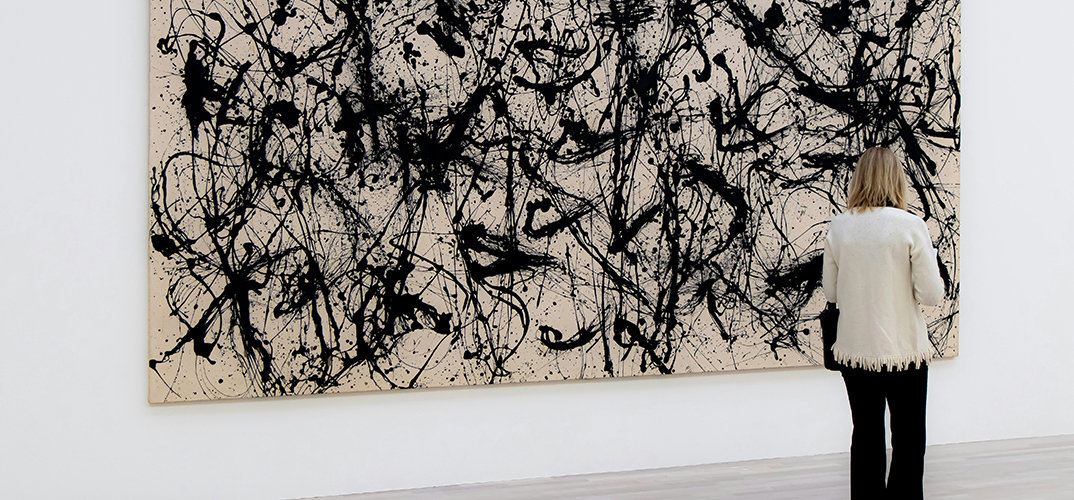
Human artists appear to follow a hidden mathematical rule when creating abstract works - one that artificial intelligence does not reproduce, according to a new study co-led by the University of Hertfordshire.
The international team of scientists explored how people respond to abstract artworks made by humans compared to visually similar images generated by AI.
The findings, published in PLOS Computational Biology, suggest abstract artists such as Jackson Pollock, Wassily Kandinsky and Mark Rothko instinctively followed a shared hidden “golden rule” in their paintings.
Dr Shabnam Kadir, Senior Lecturer in Computer Science at the University of Hertfordshire and joint senior author on the study, said:
“This is not a rule artists are taught or consciously apply. It becomes visible only through topological data analysis, revealing what may be a previously unrecognised ‘golden rule’ of abstract composition.”
Comparing human and AI-generated art
The researchers wanted to find out whether abstract artworks created without a human artist could engage viewers in the same way as human creations, particularly as abstract art does not have recognisable objects.
They compared abstract paintings made by a human artist with images generated by an artificial neural network trained on millions of real-world images
From thousands of AI‑generated works, the team selected 12 that most closely resembled the human‑made abstract art.
The AI‑generated images were given titles and exhibition descriptions generated by chatbot, and viewers were not told the artworks were produced by AI.
The study took place at the Wozownia Art Gallery in Toruń, Poland, where one group of visitors viewed an exhibition of human-created abstract art, while another saw a visually similar display of AI-generated images. Participants also completed laboratory sessions after each gallery visit. A week later, they revisited the same exhibition followed by a second lab session.
Researchers tracked eye movements, recorded brain activity and gathered emotional and aesthetic responses through questionnaires.
How people engage with art
When people look at an image, they naturally tend to group visual elements into larger structures rather than seeing individual points or pixels. This process is important when viewing abstract and geometric images, where meaning arises from relationships between visual elements rather than from identifiable objects.
The team used topology - a branch of mathematics - to analyse the artworks exhibited at the gallery as well as creations by famous artists including Wassily Kandinsky, Mark Rothko, Kazimir Malevich, Maria Jarema and Jackson Pollock.
Topology focuses on how things are connected rather than on precise measurements. Unlike geometry, which describes shapes using exact distances, angles, and sizes, topology focuses on relationships that remain unchanged when shapes are stretched or distorted.
Dr Kadir said:
“If the aim is to understand how people’s visual systems organise images according to regions and boundaries rather than exact measurements, topological descriptions are particularly well suited.”
Dr Emil Dmitruk, first author and postdoctoral researcher at the university of Hertfordshire, said:
“Imagine viewing a black-and-white image through a filter that allows only pixels above a certain brightness - or greyness - level to be seen. At first, only a few bright regions are visible, appearing as small, disconnected areas. As the threshold is gradually lowered, more pixels appear. Regions expand, merge, or form enclosed shapes. By sweeping through a range of thresholds we can observe how visual structures emerge, change, and disappear.”
In topology, tracking how image features change across different brightness thresholds is known as filtration. The ‘persistence’ of each visual structure - that is, the range of brightness levels over which it remained visible - was recorded.
Analysing images via filtrations reveals a link between structures inside an image and the space around them, a concept related to Alexander duality. Researchers say this duality applies only to structures within the image that do not touch the frame of the artwork. When this relationship breaks down, it is known as a duality violation (measured here on a scale of 0 to 2).
The researchers found art created by humans consistently showed a specific level of duality violation (approximately 0.4), whereas most of the AI‑generated images tended to remain close to perfect duality (near zero).
Why it matters
Laboratory results revealed human-made artworks tend to show different eye movement and aesthetic responses when compared with AI‑generated images, with human art drawing deeper engagement.
The gallery results were more complex, with AI-generated images attracting longer total viewing times, despite no significant differences reported between laboratory and gallery exhibitions. Researchers believe this is likely due to environmental factors. In controlled lab conditions, stable lighting makes topological features in artworks more consistent while changing light and viewer movement at the gallery can alter how these features appear over time, shaping aesthetic perception.
Dr Jacek Rogala, of the University of Warsaw and joint senior author of the study, added:
“What struck me most is that we could actually see the gallery environment doing something measurable. It wasn't just a backdrop - it changed which images held attention and for how long. That's a result you can put numbers on, and it still feels surprising.”
The researchers said their study offers a potential new tool for distinguishing human creativity from AI-generated images and improving the understanding of visual scenes and how people engage with them.
Read the full article here.
Learn more about PhD in Computer Science at the University of Hertfordshire.