
Herts sports scientists share marathon training secrets with BBC presenter Tim Harford
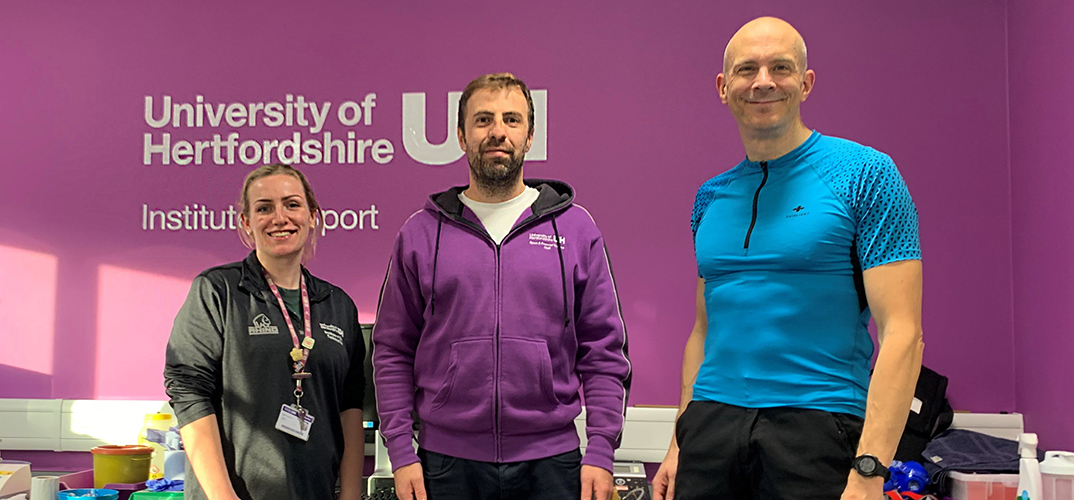
BBC presenter Tim Harford has been working with experts at the University of Hertfordshire’s Institute of Sport (IoS) to find out.
Tim, who is the host of BBC Radio 4’s More or Less show, is preparing to take on the TCS London Marathon in April in support of the Teenage Cancer Trust, which provides vital care and support for young people facing cancer.
As part of his training, Tim visited the state‑of‑the‑art physiology laboratory at IoS, where he completed a series of assessments on a medical‑grade treadmill - a highly specialised system used in clinical evaluation, rehabilitation, and supervised exercise.
The treadmill’s precision data, along with blood tests, allowed researchers to closely monitor his performance while collecting detailed physiological data.
During the session, Dr Daniel Muniz, Senior Lecturer in Exercise Physiology, and Madison Klymyszyn, Senior Technical Officer at IoS, measured Tim’s blood lactate levels, oxygen uptake, and running pace. Using these indicators, the team produced an evidence‑based prediction of Tim’s marathon finishing time and offered personalised training advice.
Dr Muniz explained that faster marathon performances are strongly associated with a “pyramidal” training structure of completing around 70% of training at an easy, conversational pace, and with only 5% at high intensity - the point at which breathing becomes laboured and speaking in full sentences is difficult.
His findings come from the largest study ever conducted on marathon runners, analysing data from 119,452 recreational athletes who logged their training on Strava in the 16 weeks leading up to 151,813 marathons. The study suggests that consistent, moderate training is more effective than frequent all‑out efforts.
Dr Muniz said:
“Data clearly indicates the more miles you run in training, the faster your marathon time is likely to be. Our research shows spending more time in the easy, comfortable pace is strongly associated with quicker finishing times.”
For those preparing for spring marathons, he recommends gradually increasing mileage to reduce injury risk and maintaining steady, consistent training habits.
Dr Muniz said:
“We are delighted to support Tim on such an inspiring challenge, raising crucial funds for the many incredible causes backed by Teenage Cancer Trust. It was a pleasure to welcome the BBC Radio 4 crew on campus, where they embraced our tests and insights with enthusiasm and resilience.”
The Institute of Sport is also home to one of the UK’s few Gait Real‑time Analysis Interactive Lab (GRAIL) systems. Its facilities also include human physiology and blood research laboratories, a sports injury clinic, and specialist teaching spaces for anatomy, massage, manual therapy, and electrotherapeutic techniques.
Additional resources include an environmental chamber capable of simulating temperatures from 10-40°C and altitudes up to 5,750 metres, a consultancy suite, a performance testing centre featuring a gold‑standard Bod Pod for body composition analysis, and a fully equipped strength and conditioning gym with advanced testing technology.
BBC Radio presenter Tim Harford said:
“I’m running the London Marathon in April - my first ever marathon - and I want to run it as fast as I can. The challenge is, I don’t know what ‘fast’ looks like for me. I don’t want to over‑train, get injured, or end up unable to start or finish.
“Everyone tells you to take it easy and not push too hard, yet at the same time you’re trying to find your limit and make the most of your potential.
“That’s what I’m hoping Danny (Dr Muniz) and the team here can help me figure out: a realistic sense of what I’m capable of, so I’m not going out too hard, but also not holding back more than I should.
“It’s been genuinely fascinating to learn about all the different physiological measurements they can take - and how those numbers might actually translate into performance.”
Find out more about the University of Hertfordshire's Institute of Sport.
Listen to Dr Daniel Muniz reveal the secrets of marathon training on BBC Radio 4’s More or Less podcast.