
From quiet student to BAFTA-winning director: Olaide Sadiq's journey to Netflix success
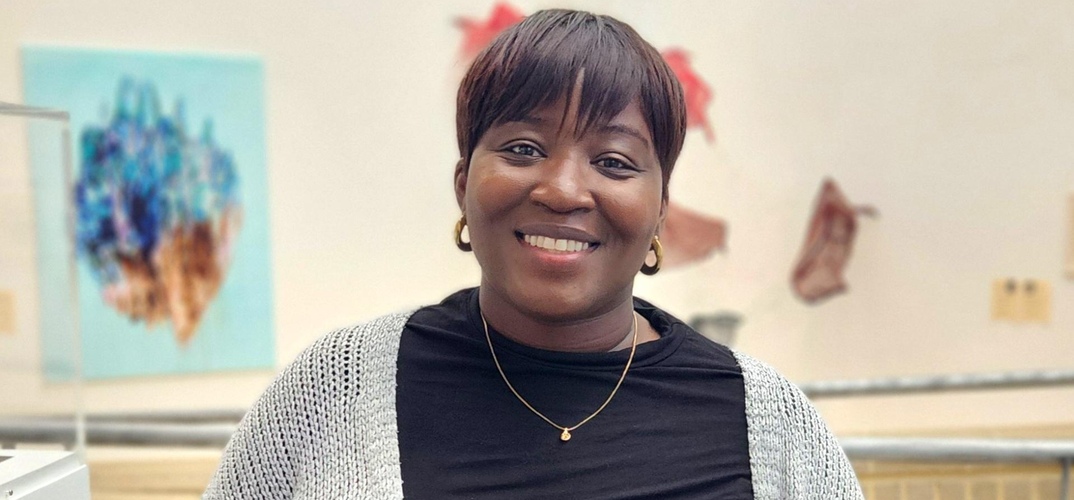
Rejections, career detours and moments of uncertainty never stopped Olaide Sadiq pursuing her ambitions. The University of Hertfordshire graduate shares how staying curious, embracing opportunity and trusting herself helped turn a passion for storytelling into an award-winning career.
It was a true pinch me moment when Olaide Sadiq received the phone call telling her she had landed her first directing role.
“I was walking in the park,” she recalls. “I just stood there thinking, ‘Are you serious?’”
The call changed everything. Within months, the University of Hertfordshire graduate would be directing Grenfell Uncovered, Netflix’s powerful documentary examining the events leading up to the Grenfell Tower fire and its devastating aftermath. The film would go on to win both a BAFTA Television Award and a BAFTA TV Craft Award.
But for Olaide, the journey to that moment was anything but straightforward.
It was built on uncertainty, career detours, self-doubt, relentless hard work and, above all, a determination to stay true to herself.
Finding the right path
It had all started over a decade before - when Olaide was faced with choosing the right university. She quickly realised that practicality – alongside high quality – would be the priorities, leading her to the University of Hertfordshire. It was close to home, several of her friends were already planning to study there, and crucially, it offered a degree combining the subjects she loved.
“I wanted to study something traditional like English, but also have a mixture of media or journalism,” she says. “There weren't many universities offering that combination at the time, so Hertfordshire made a lot of sense.”
She graduated in 2015 with a degree in English Literature with Journalism and French, but while she enjoyed her time at university, she admits she was often quieter than those around her.
“I was quite introverted,” she says. “I didn’t always come out of my shell, particularly on my course. But I had a really good experience and I was lucky to be studying something I genuinely enjoyed.”
That passion mattered.
“I’ve always felt that if I don’t enjoy what I’m studying or doing, I can’t give it my best.”
She also credits the University’s support during difficult periods.
“There were times when health issues and things outside university made life challenging. The University was brilliant when I needed support, extensions or a bit of understanding.”
Learning by saying yes
Olaide’s television career began soon after graduating - with an internship in TV development – the department responsible for generating ideas for new programmes.
But, it quickly became clear it wasn’t quite the right fit.
“I knew after a few months that my heart wasn’t really in development,” she says. “I wanted to be involved in production.”
Rather than walk away, she threw herself into every opportunity she could find.
When colleagues needed an extra runner for a shoot, she volunteered. When a pilot programme needed support, she said yes. Studio shows, reality television, documentaries – she absorbed as much experience as possible.
“I always had documentary in the back of my mind, but I wanted to try everything.”
That willingness to learn would become a defining characteristic throughout her career.
One of her most significant breakthroughs came on Channel 4’s acclaimed Educating series.
Despite already being more senior, she accepted a junior logging role simply because she loved the programme.
“It was technically a step backwards, but I just wanted to work on it,” she says. “I thought, ‘I’ll be the best logger ever.’”
The decision paid off.
Her enthusiasm and work ethic caught the attention of senior colleagues, who increasingly trusted her with more responsibility. Soon she was gaining experience across filming and editing, learning how stories were constructed and shaped.
“It was like a boot camp,” she says. “I learned so much about how television is actually made.”
That experience opened doors to bigger documentary projects, including Ambulance, 999: What’s Your Emergency?, 24 Hours in A&E, The Blacklist with will.i.am, Amazon Prime documentaries and Netflix’s The Final: Attack on Wembley.
Each project added another layer to her experience.
“All roads eventually led to Grenfell.”
The opportunity that almost slipped away
The directing role for Grenfell Uncovered arrived unexpectedly.
A former colleague invited Olaide for a coffee and casually mentioned that Netflix was looking for directors for a new documentary about Grenfell.
The conversation quickly became serious.
“He basically asked me, ‘How would you feel about directing something on Grenfell?’”
The opportunity excited her, but also terrified her.
To be considered, she needed to submit a director’s vision – a proposal explaining exactly how she would tell the story.
“I had no idea what a director’s vision was,” she laughs.
What she lacked in directing experience, however, she made up for in passion.
“I couldn’t talk about lenses or technical camera language. What I could talk about was why the story mattered, how I wanted audiences to feel, and what I wanted the film to achieve.”
Then the doubts crept in.
Convinced she hadn’t done enough, Olaide nearly withdrew from the process entirely.
“I basically sent an email pulling out,” she admits. “I got into my own head.”
Fortunately, the production team saw something she couldn’t yet see in herself.
Soon afterwards, the call arrived offering her the job.
“I was probably the least experienced director on the shortlist,” she says. “Everyone else had directed before. I had no expectations of getting it, yet there I was, being offered the job.”
Telling a story that demands to be heard
From the beginning, Olaide knew exactly what reaction she wanted from audiences.
“Anger,” she says.
“The Grenfell story makes me angry. I can’t believe it happened and I can’t believe there still hasn’t been resolution for so many people affected.”
She wanted viewers to understand not only the facts but the human impact behind them.
“I wanted people to really know what happened, really know the people behind the story, and to care.”
The responsibility weighed heavily.
“Some of it is incredibly difficult to watch. But we couldn’t sanitise it. We had to show the reality of what people experienced.”
Directing also revealed just how much collaboration lies behind a major documentary. Editors, composers, archive researchers, graphic artists, legal teams and dozens of specialists all contributed to building the final film.
“There’s a constant state of refinement,” she says. “You’re making hundreds of creative decisions all at once.”
And knowing when to stop?
“That’s easy,” she laughs. “You stop when someone tells you it’s finished.”
Trust the process
Today, as a BAFTA-winning director working on a new Netflix feature documentary, Olaide is often asked for career advice.
Her answer is surprisingly simple.
“Trust the process.”
The creative industries, she says, are built on rejection.
“You hear ‘no’ constantly. It’s part of the industry. But one of the biggest lessons I learned is not to let those ‘nos’ define you.”
Just as importantly, she encourages young creatives to stop trying to be the person they think employers want.
“When I was starting out, I thought I had to sound a certain way or present myself differently,” she says. “The moment I stopped doing that and was myself, things changed.”
That authenticity led to her first television job, and ultimately to a BAFTA-winning career.
For Olaide, sharing her story is about showing others what’s possible.
“When I was younger, I didn’t always see people like me in this industry,” she says. “If people can see someone who looks like them or has a similar background achieving something, then maybe they start believing it’s possible for them too.
“Even if it only helps one person, that’s enough.”
Find out more about studying at the University of Hertfordshire.