
Planet-wrecking stellar storm observed in nearby star redefines search for habitable worlds
An international team of astronomers, including scientists from the University of Hertfordshire, analysed data from Europe’s LOFAR radio telescope, located mainly in the Netherlands and spread across seven other European countries - including the UK.
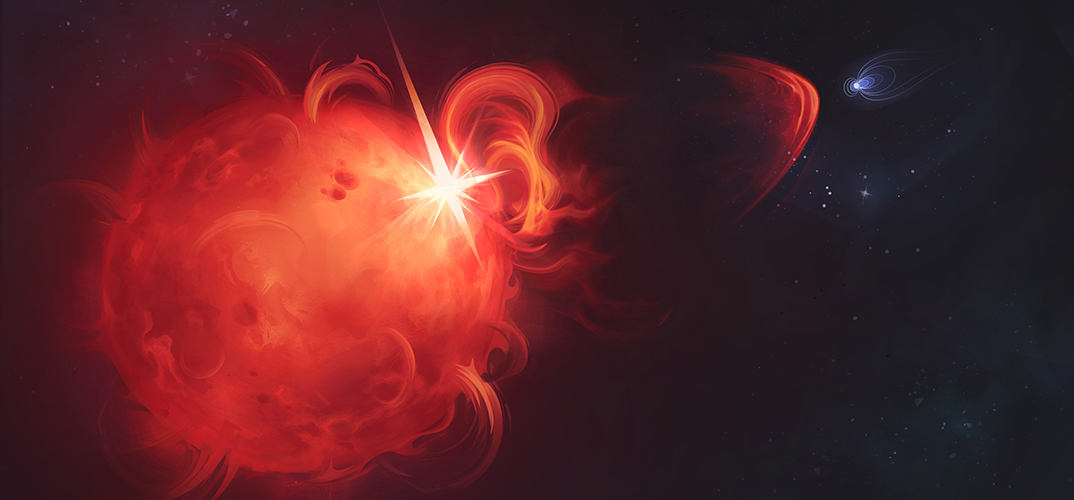
The team detected what they say is the first clear radio signal of a violent burst of material from the star.
This eruption is similar to coronal mass ejection (CME) seen on the Sun - dramatic expulsions of magnetised plasma flung out from our star that play a major role in shaping space weather in our Solar System, such as the dazzling auroras or the Northern Lights we see on Earth.
Professor Martin Hardcastle, of the University of Hertfordshire’s Centre for Astrophysics Research (CAR), said: “This is the first time direct evidence for a coronal mass ejection has been observed in another star. We see these from our Sun very regularly and we have assumed these would happen on other stars as well, based on indirect evidence. However, until now, we had no idea about how frequent or violent they were.
“The outburst that we see is very strong and would have a devastating effect on the atmosphere of a planet round that star. Life as we know it is probably not possible near a star capable of such violent activity.”
The eruption came from a nearby red dwarf star, known as StKM 1-1262. These stars are smaller than the Sun and are thought to host rocky, Earth-sized planets in their habitable zones - regions where worlds with liquid water could exist. However, because these zones are so close to the star, orbiting planets are likely to be exposed to intense stellar storms.
The University of Hertfordshire played a central role in processing the vast amounts of telescope data analysed in the study, which is published in the journal Nature.
Study author Professor Hardcastle said: “These observations are the result of a programme to survey the whole northern sky with the LOFAR radio telescope. At the University of Hertfordshire, we have been involved in this programme for the last 10 years and I have been co-ordinating the processing of all the telescope data for the survey, most of which was done using the University of Hertfordshire supercomputer in Hatfield.”
The discovery opens new avenues for studying space weather in other solar systems and offers a fresh approach to identifying potentially habitable planets, the researchers said.
Professor Hardcastle said: “Our findings tell us that some nearby stars are simply too violently active for their planets to support life. It is possible that this behaviour is common among red dwarf stars, but we don’t yet know for sure. What we have shown is that such extreme activity is possible, and that opens up a new way to identify which stars are most likely to host habitable planets.
“We are now exploring how next-generation radio telescopes, like the Square Kilometre Array - which we are also heavily involved in at the University of Hertfordshire - can carry out more sensitive searches.”
Lead author Dr Joseph Callingham, of by ASTRON (Netherlands Institute for Radio Astronomy) - which led the study, added: “For the first time, we have evidence that hot plasma has been ejected from another star into interplanetary space. This gives us a chance to move beyond theory based solely on the Sun.
“We show that this eruption would be devastating for a planet around such a star. The CME has the power to compress an Earth-like magnetosphere all the way down to the planet's surface, temporarily removing the planet’s atmospheric protection. This means such eruptions could determine whether a planet is potentially habitable.”
Co-lead author Dr Cyril Tasse, of the Observatoire de Paris-PSL, said: “This discovery shows us that violent space weather is not unique to our Sun. We now know planets around small stars are facing frequent, powerful blasts. Thanks to the advanced data-processing methods developed at the Observatoire de Paris-PSL, we now have a way to measure just how extreme those conditions are”.
The LOFAR radio telescope is used in the LOFAR Two-metre Sky Survey, which has so far observed around 86,000 stars within roughly 326 light-years of Earth, helping scientists build a clearer picture of the cosmic neighbourhood.
The research was supported by the European Research Council, the Dutch Research Council (NWO), and other international partners. LOFAR is operated by ASTRON as a European Research Infrastructure Consortium (ERIC).
Study astrophysics at the University of Hertfordshire.