
Herts astrophysicist awarded prestigious Royal Society Fellowship to advance her pioneering work on supermassive black holes
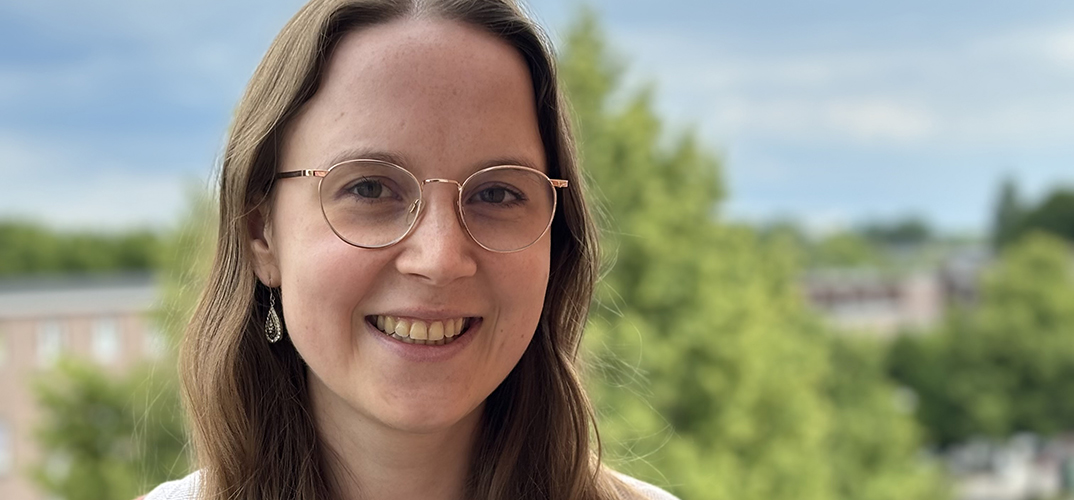
Dr Sophie Koudmani, of the Centre for Astrophysics Research at Herts, joins an elite group of exceptional researchers awarded funding through the Royal Society’s early-career schemes, which aim to tackle major scientific challenges, attract top talent, and help establish the next generation of leading researchers across the UK and Ireland.
Supermassive black holes are, as their name suggests, truly colossal - millions of times more massive than our Sun - and play a pivotal role in shaping the growth and evolution of the Universe.
Yet, despite their importance, the origin and the reason behind their immense size remains one of the most confounding cosmological mysteries.
The University Research Fellowships are awarded to scientists in the early stages of their research career who have the potential of becoming leaders in their fields.
The eight-year fellowship, backed by £1.87m in funding, will allow Dr Koudmani to build a research team to unlock the secrets of supermassive black holes by developing next-generation, multi-scale models.
Since its launch in 2021, the James Webb Space Telescope (JWST) has revealed an unexpectedly large population of black holes in the early Universe, creating new opportunities for researchers to investigate how and when they formed.
Meanwhile, LISA (Laser Interferometer Space Antenna), the first space-based observatory dedicated to studying gravitational waves - ripples in spacetime produced by the Universe’s most powerful events, such as merging black holes - is scheduled for launch in 2035.
Together, these observatories have the potential to transform the understanding of different types of black holes.
Dr Koudmani said: “I am delighted to have been awarded this prestigious fellowship from the Royal Society, which will enable me to drive forward my research on supermassive black holes.
“Every galaxy, including our Milky Way, hosts a supermassive black hole at its centre, yet we still do not understand how these objects formed.
“Data from the James Webb Space Telescope is beginning to reveal their infancy in the early Universe, but to interpret these observations we need robust theoretical models.
“The central aim of my research is to run advanced, massively parallel simulations to study how the first black holes formed and compare them with observations.
“We will then extend this work to the entire population of supermassive black holes across cosmic time, combining high-performance computing with machine learning to connect detailed galaxy-scale processes to the broader Universe.
“The final strand of our work will focus on supermassive black hole mergers, which produce gravitational waves, ensuring we are ready for the LISA launch in the next decade, a mission that will revolutionise our ability to detect these events.”
Dr Koudmani also held a Royal Commission for the Exhibition of 1851 Research Fellowship at the Centre for Astrophysics Research, one of only eight awarded across the UK.
Previously, she was a Flatiron Research Fellow at the Center for Computational Astrophysics at the Flatiron Institute in New York City and a Bowring Research Fellow at St Catharine’s College, Cambridge.
Dr Koudmani earned her PhD in Astronomy from the University of Cambridge, where she pioneered theoretical models of black hole feedback from active galactic nuclei (AGN) in dwarf galaxies.
Funding for the University Research Fellowship scheme is provided by the Department for Science, Innovation and Technology and the KC Wong Education Foundation.
Learn more about the Centre for Astrophysics Research.