Landscapes and Producers in Medieval England | University of Hertfordshire Press Skip to content
search
menu
  • UH Press
  • About UH Press
  • Browse our catalogue
  • How to order
  • Our new eshop
  • Join our mailing list
  • News
  • Events
  • Author biographies
  • Book proposals
  • Open Access
  • Follow us on social media
  • Contact us
  • Ebook options
  • Summer Sale
University of Hertfordshire
University of Hertfordshire Press
  • UH Press
  • About UH Press
  • Browse our catalogue
  • How to order
  • Our new eshop
  • Join our mailing list
  • News
  • Events
  • Author biographies
  • Book proposals
  • Open Access
  • Follow us on social media
  • Contact us
  • Ebook options
  • Summer Sale
Home > Agricultural History Economic History Landscape history New releases Social History Studies in Regional and Local History > Landscapes and Producers in Medieval England
Section menu

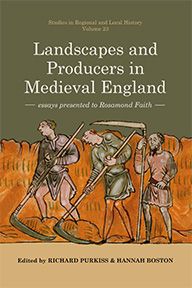
Landscapes and Producers in Medieval England

Essays presented to Rosamond Faith

Editor: Richard Purkiss, Hannah Boston

Price: £18.99 £15.19 (free p&p)

"

“This book is not just a celebration of one of the most interesting medieval historians of our time; it is a working through of the radical implications of her work.”

-Professor Mark Gardiner,
University of Lincoln

About the book

Dr Rosamond Faith is a leading historian of the English peasantry in the early and central Middle Ages. In a series of influential studies, she has uncovered the basic structures of rural society, revealing how economic organisation, physical environment, and ideology shaped the lives of ordinary people in the earliest documented centuries.

In this Festschrift, friends and colleagues take up her theme, offering new perspectives on people who worked for a living between the seventh and fourteenth centuries. King Alfred famously divided society into three orders, but whereas the lives of ‘those who fight’ and ‘those who pray’ are recorded in their own words, the experience of ‘those who work’ can only be recovered indirectly. The essays collected here approach rural society under three different headings, each examining a different dimension of peasant life.

  • More about the book

    The first section addresses the organisation of rural society. Every locality was subject to instruments and processes regulating the exploitation of the landscape, whether administrative or co‐operative in nature, and whether operating on a regional or manorial scale. A second group of essays considers how the rural population was classified, and how this reflected or obscured realities on the ground. Administrative documents employed social categories which did not necessarily align with everyday usage, while people whose livelihood was not wholly agricultural, or not entirely encompassed by the manor, had a light documentary footprint. Further papers address the practicalities of agricultural production. While much was dictated by universal constraints, scientific and topographical studies shed light on adaptations in technology and cultivation systems.

    The expert contributions assembled in this lively volume include local studies ranging from Devon to Lincolnshire and will be of interest to anyone thinking about the social history of medieval England.

  • View the table of contents

    Contents


     List of illustrationsvii
     List of abbreviationsix
     List of contributorsx
     General Editor's prefacexiii
     Preface and acknowledgementsxv
       
    1Introduction: approaches to the medieval English peasantry 
     Hannah Boston and Richard Purkiss1
       
     Part I: Organising the landscape 
    2Rendlesham in context: Anglo-Saxon territories in East Anglia 
     Tom Williamson21
    3Old hides for new thegns: the Witney charter bounds and estate development, 969 and 1044 
     John Blair43
    4Commons and property in the south Lincolnshire fens 
     Hannah Boston61
    5Westminster Abbey's mandates to the bailiff of the manor of Birdbrook (Essex) in the early fourteenth century 
     Phillipp R. Schofield81
       
     Part II: Peopling the landscape 
    6The significance of the geneat in Rectitudines Singularum Personarum 
     Tom Lambert99
    7Wicing Batswegen: an eleventh-century witness in south-west England 
     Lesley Abrams116
    8Independent peasants on the eve of the Conquest 
     Richard Purkiss128
    9Classifying the English manorial population in the Domesday survey 
     C.P. Lewis152
    10Finding freedom in the thirteenth-century English countryside 
     Stephen Mileson178
       
     Part III: Farming the landscape 
    11Ymbhwyrft: the farming year in early England 
     Debby Banham193
    12Experimental archaeology and the study of early medieval farming 
     Helena Hamerow, Claus Kropp and Amy Bogaard212
    13Little England? Mapping Pembrokeshire settlement 
     David Austin218
       
     Bibliography of Rosamond Faith's writings251
     Index257

  • About the Editor/s:

    Richard Purkiss

    Richard Purkiss is a Postdoctoral Research Associate at the University of Manchester. He wrote his doctoral thesis on East Anglia in the tenth and eleventh centuries, and works mainly on English society and government in the late Anglo‐Saxon period.


    Hannah Boston

    Hannah Boston is a Leverhulme Early Career Fellow at the University of Lincoln. Her research covers regional societies, lordship, and loyalty in England between the eleventh and thirteenth centuries.

ISBN: 978-1-912260-74-4 Format: Paperback, 296pp Published: Nov 2025

Other titles you may enjoy
Shaping the Past
Shaping the Past
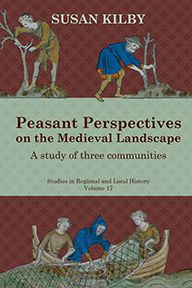
Peasant Perspectives on the Medieval Landscape
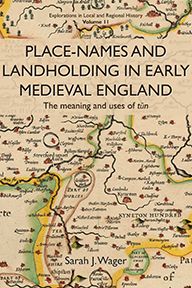
Place-Names and Landholding in Early Medieval England
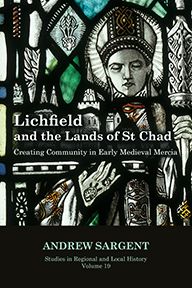
Lichfield and the Lands of St Chad

Any questions

Contact us at UH Press if you have any queries or would like to find out more about this book.

Top of page
  • Assembling Enclosure
  • Custom and Commercialisation in English Rural Society
  • Farmers, Consumers, Innovators
  • Lady Anne Bacon
  • Lost Gardens of Hertfordshire
  • Place-Names and Landholding in Early Medieval England
  • Wearmouth and Jarrow

Contact us

Switchboard

tel +44 (0) 1707 284000

Admissions Office

tel +44 (0) 1707 284800 fax +44 (0) 1707 284870

Email

ask@herts.ac.uk

Postal Address

University of Hertfordshire Hatfield Hertfordshire, UK AL10 9AB

Location by postcode

College Lane Campus: AL10 9AB de Havilland Campus: AL10 9EU Park and Ride: AL10 8HS

© 2026 University of Hertfordshire

  • HR Excellence in Research logo
  • QAA Quality Mark thumbnail
  • Stonewall logo
Top of page