
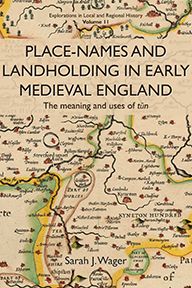
Place-Names and Landholding in Early Medieval England
The meaning and uses of tūn
Author: Sarah Wager
Price: £16.99 (free postage)
“This is an admirably forensic examination of an important, and controversial, category of English place‐names. It makes a most welcome contribution to our understanding of Anglo‐Saxon society, at both local and national levels.”
About the book
This book discusses how various recurrent early medieval place-names ending in tūn might have originated in response to social, economic, political or religious factors. It considers specifically whether these names might, as some scholars have suggested, reflect a possible function related to one or more aspects of early medieval society but which is not apparent from their etymology.
It examines studies of names such as Stretton, Eaton, Burton and Kingston and questions recent theories around suggested functions for these places. The author proposes that most of these recurrent compounds named a land unit distinguished by a simple topographical feature or by the name or status of the landholder rather than by a presumed function. She also considers the hypothesis that the perceived concentration of certain recurrent names in clusters, largely in the central and southern regions of England, was the result of a deliberate designation of these places to provide a function in the strategic defence and administration of Mercia during the eighth and early ninth centuries, with some other kingdoms, especially Wessex, following the Mercian example. She has sought to explain why there is not enough evidence to substantiate, or disprove, the hypothesis about clusters of ‘functional’ place-names and at the same time to show that there is enough evidence to cast doubt on that hypothesis and the nature of the data used to support it.
ISBN: 978-1-912260-76-8 Format: Paperback, 160pp Published: Mar 2026
Other titles you may enjoy
Any questions
Contact us at UH Press if you have any queries or would like to find out more about this book.