A Landscape of Reform | University of Hertfordshire Press Skip to content
search
menu
  • UH Press
  • About UH Press
  • Browse our catalogue
  • How to order
  • Our new eshop
  • Join our mailing list
  • News
  • Events
  • Author biographies
  • Book proposals
  • Open Access
  • Follow us on social media
  • Contact us
  • Ebook options
University of Hertfordshire
University of Hertfordshire Press
  • UH Press
  • About UH Press
  • Browse our catalogue
  • How to order
  • Our new eshop
  • Join our mailing list
  • News
  • Events
  • Author biographies
  • Book proposals
  • Open Access
  • Follow us on social media
  • Contact us
  • Ebook options
Home > Coming soon Economic History Explorations in Regional and Local History Landscape history Social History > A Landscape of Reform
Section menu

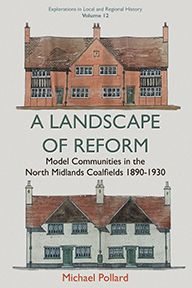
A Landscape of Reform

Model Communities in the North Midlands Coalfields 1890–1930

Author: Michael Pollard

Price: £16.99 (free postage)


Coming soon

About the book

This regional study centred on the coalfields of the North Midlands investigates the development of a series of model colliery villages, chief among them New Bolsover and Creswell (both in Derbyshire) and Woodlands/Brodsworth (South Yorkshire). Based on original archival research, the book considers the phenomenon of such ‘model villages’ to be inextricably linked to a wider set of political, religious and social concerns; the established interpretations of them – either as acts of philanthropy on the part of enlightened industrialists, or merely as a means of guaranteeing a supply of labour – are thereby considerably developed.

Building on the work of earlier industrialists such as Titus Salt and experiments in ‘model housing’ in Victorian cities (by the likes of Octavia Hill), a number of highly motivated individuals attempted to impose a particular social vision on the North Midlands coalfield during a period of rapid industrialisation. Rooted in late-nineteenth-century paternalism, this vision also formed part of a broader ‘progressive’ Liberalism and the key figures in this account all had strong links with the pre-1914 Liberal Party. In an era often characterised by optimism and a belief in progress, they demonstrated the ‘Nonconformist Conscience’ in action. All of them saw improved housing as a vital first step in creating communities that would offer moral uplift as well as social and environmental improvement, albeit while preserving the existing social hierarchy. They played a key part in elevating the political importance of housing and planning issues in this period and paved the way for widespread social improvements after 1918. Their legacy was considerable, architecturally, politically and socially, and was still relevant after 1945.

  • More about the book

    The establishment of these new communities is also linked to the development of garden cities and garden suburbs. In particular, Percy B. Houfton, the leading architect in the region, was closely associated with Raymond Unwin and had significant connections to the embryonic Town Planning Institute and the housing reform movement.

    Illustrated with architectural drawings, ground plans and photographs, this highly readable volume will be of interest to anyone with an interest in late Victorian liberalism, mining history and regional architecture and to social and economic historians more broadly.

  • About the Author/s:

    Michael Pollard

    Michael Pollard has a doctorate in History from the University of Sheffield and has published articles in Derbyshire Archaeological Journal (2023) and Midland History (2024).

ISBN: 978-1-912260-82-9 Format: Paperback, Published: Mar 2027

Other titles you may enjoy
The Peaceful Path
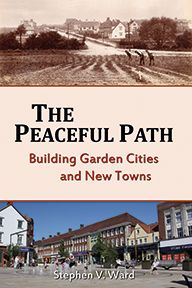
The Peaceful Path
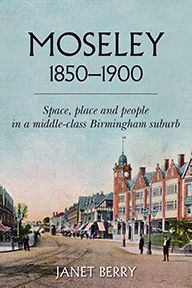
Moseley 1850–1900
Moseley 1850–1900
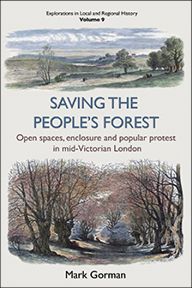
Saving the People's Forest
Farmers, Consumers, Innovators

Any questions

Contact us at UH Press if you have any queries or would like to find out more about this book.

Top of page
  • Assembling Enclosure
  • Custom and Commercialisation in English Rural Society
  • Farmers, Consumers, Innovators
  • Lady Anne Bacon
  • Lost Gardens of Hertfordshire
  • Place-Names and Landholding in Early Medieval England
  • Wearmouth and Jarrow

Contact us

Switchboard

tel +44 (0) 1707 284000

Admissions Office

tel +44 (0) 1707 284800 fax +44 (0) 1707 284870

Email

ask@herts.ac.uk

Postal Address

University of Hertfordshire Hatfield Hertfordshire, UK AL10 9AB

Location by postcode

College Lane Campus: AL10 9AB de Havilland Campus: AL10 9EU Park and Ride: AL10 8HS

© 2026 University of Hertfordshire

  • HR Excellence in Research logo
  • QAA Quality Mark thumbnail
  • Stonewall logo
Top of page